When does wisteria bloom? Beginners need to master these cultivation tips
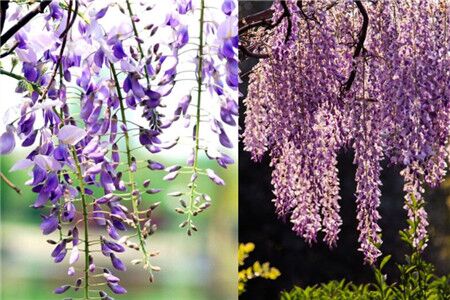
When it comes to the wisteria plant, everyone must have some understanding of it. It is a relatively large climbing plant, mostly growing in parks or courtyards, and potted wisteria is rarely seen. Moreover, it has strong reproductive capacity; simply plant it beside a wall and it will grow many tender green leaves. Combined with its excellent ornamental value, it is deeply welcomed by people.
I. When does wisteria bloom
Generally, from mid-April to late May each year is the blooming time for wisteria, but its flowering period is very short, lasting about one week. However, the blooming time of wisteria varies with different geographical environments. In the Yangtze River basin region, flower buds generally begin to appear in March each year, and flowering begins in April.
Wisteria planted in South China generally blooms in March, while in northern regions it does not begin to bloom until May. At the same time, wisteria will bloom again in late summer and early autumn.
II. When to plant wisteria
Generally, wisteria is more suitable for planting in spring. Wisteria planted every spring will produce purple flowers, and the entire plant looks like a sea of pink-purple, making people linger.
III. How to plant wisteria
1. Soil selection
If you want the plant to grow healthily, you must choose potting soil suitable for the plant's growth. Wisteria prefers alkaline soil with strong air permeability and loose texture. When planting, you should also avoid windy environments. Plant it on a fully enclosed balcony as much as possible. After preparing the soil, plant wisteria through layering or cuttings.
2. Temperature regulation
Even though this plant has very strong vitality, with good cold tolerance and heat tolerance, and it grows relatively fast in an environment of around 20 degrees. But when it is below 5 degrees, it will stop growing. If summer is too hot, it will also slow down the plant's growth rate, so at this time you should appropriately cool it down. Never place the plant in strong light, otherwise it will easily affect its normal growth.
3. Fertilizer management
Although wisteria is a plant with strong drought tolerance, it also likes moist soil. So water once a week, and each time water thoroughly. One thing to note is not to let water accumulate in the flower pot, otherwise the plant will easily develop root rot. Moreover, wisteria likes to grow in fertile soil, so apply fertilizer once a month. Choose fertilizers with relatively balanced nutrients as much as possible, and remember to water after fertilizing.
After the detailed introduction above, everyone must have mastered the techniques for planting wisteria! If you want to successfully plant this plant, you need to be careful and pay more attention during the cultivation process, so that you can see the scene of clusters of blooming flowers.
When is the wisteria flowering period? Beginners need to learn these tips
I believe many people usually like to grow some flowers and plants. Besides killing spare time in daily life, it can also cultivate the mind. There are many types of flowers and plants, and one plant called wisteria is very popular because it has great ornamental value, so many people like to grow it. But there are still many people who do not know when this plant's flowering period is, nor do they know what to do to cultivate it more successfully.
So next, the editor will give everyone a detailed introduction about the wisteria flowering period and planting methods. Come and learn about it!
I. Introduction to the wisteria flowering period
Generally, wisteria blooms from April to May each year. After flowering, the plant will bear fruit in August. But after it finishes flowering, be sure to cut off its spent flowers, otherwise they will compete with each other for nutrients, seriously affecting the growth of the wisteria.
II. Introduction to the growing environment of wisteria
If you want to understand how to cultivate the plant, you need to know what kind of environment it likes to grow in. Wisteria has very strong adaptability and is very cold-tolerant, and can overwinter in the ground in most areas of China. Moreover, this plant likes to grow in sunny environments, and its requirements for soil are relatively simple; it can grow normally in fertile, loose and deep soil. In addition, wisteria's main root is relatively long and its lateral roots are relatively few, so it can easily adapt to the urban environment.
III. Wisteria cultivation
This plant also has a variety of cultivation methods, including cuttings, sowing, layering and division. Because its main root is very deep and its lateral roots are relatively few, it is not suitable for transplanting. After each seed collection, dry and store them. Before sowing, soak the seeds for 12 hours, and then sow and raise seedlings in an open seedbed. After the Beginning of Autumn, thin the seedlings moderately. After three years, they can leave the nursery. If transplanting seedlings, it is recommended to bring a soil ball.
If you want to cultivate this plant, you can also choose early spring, select vigorous 1-year-old branches and cut them into 15-20 cm sections as cuttings. Dozens of them can be tied into a bundle, with the upper ends facing down, and first buried in a moist area sheltered from the wind and facing the sun. After covering the branches with 10 cm of soil, improve the plastic film to achieve the purpose of keeping warm and moist.
In early May, they can be dug out for cutting. This cultivation method has a very high survival rate, and the speed of forming seedlings is also relatively fast. In addition, division propagation can also be carried out, and cultivation can begin in spring and winter.
IV. How to care for wisteria
1. Watering
Because the plant's main root is very deep, it has very strong drought resistance. However, wisteria still likes moist soil, but do not water excessively at ordinary times, causing the roots to soak in water, which can easily cause root rot.
2. Fertilizing
Generally, applying compound fertilizer only 2-3 times a year to wisteria can meet its growth needs. Before it sprouts, you can apply a little nitrogen fertilizer, superphosphate, etc., and during its growth period you also need to apply additional fertilizer 2-3 times; decomposed human feces and urine can be used.
3. Pruning
If you want to prune wisteria, you should choose the plant's dormant period. When pruning, you can make the branches distribute evenly by removing dense growth and keeping sparse growth, as well as by manually guiding the branches. In order to promote abundant flowers and lush leaves, it is recommended that everyone prune reasonably according to the plant's activity.
How to grow a wisteria bonsai? Teach you six steps to get it done easily
Wisteria is named for its color and shape, has high ornamental value, and is deeply loved by many friends. I had heard many people praise it before, and after seeing a wisteria bonsai, I also became someone who loves it. So, how exactly should a wisteria bonsai be grown? Below, let me share with everyone the cultivation methods for wisteria bonsai.
Selecting seedlings for planting wisteria bonsai is very important. Actually, any method can be used for selecting seedlings, but in most households the seedlings for bonsai are purchased directly from flower shops as mature seedlings, so the survival rate is also relatively high. But a small number of "experts" like to start cultivating from seeds.
I. Seedling source.
Propagation can be done by sowing or cuttings. Sowing can be done in early spring, requiring a temperature between 10°C and 13°C. If propagating by cuttings, it can be done in autumn.
II. Making a wisteria bonsai.
1. Potting.
In spring, that is, in February to March, planting is better. For the potting soil, we should use a mixture of relatively fertile, well-drained leaf mold and soil. Good flowers should be paired with a good pot. We can choose some relatively deep pots that look more imposing. The shape is yours to choose; it can be angular or round.
2. Styling.
We mainly focus on pruning and arranging, with tying and binding as secondary. The purpose of doing this is to fully express the plant's simple and beautiful natural form. When pruning, the branches should be arranged in a staggered and orderly way to avoid monotony, but there should not be too many layers. The forms of wisteria bonsai we commonly see are varied. In this respect, you can use your imagination to create a good-looking shape.
3. Watering.
We will find that it actually consumes a lot of water, but even so, we cannot water it frequently. If it is only wet and never dry, it is not conducive to flowering. As for watering, if it is not dry, do not water; when you water, water thoroughly. Especially in August, you should appropriately water less. By September, normal watering can be resumed.
4. Fertilizing.
Applying thin fertilizer frequently is a key point for making wisteria bloom abundantly and grow lush leaves, so remember this. During the plant's growth period, you can water according to the situation, and for fertilizing we can apply a relatively low-concentration cake fertilizer once every half month, stopping fertilization only in July to August, and continuing fertilization again in September. However, both the frequency and concentration should be appropriately reduced. Before flowering, the frequency of applying phosphorus and potassium fertilizer can be appropriately increased depending on the situation.
5. Pruning.
When wisteria sprouts tender buds in spring, appropriately remove dense buds. When new branches grow to more than 20 cm, we can cut off the overlong part of the new branches. September is the period when wisteria's old leaves easily age and droop. Because this affects the appearance, we can remove the old leaves to speed up the sprouting of new leaves. The newly sprouted leaves are relatively tender and can effectively delay the leaf-falling period, extending the bonsai's ornamental period.
6. Repotting.
For repotting, it is better to choose the time before budding in early spring. After that, repot once every two to three years.
III. Pest and disease control.
Compared with the cultivation of other flowers, wisteria has fewer pests. But pests are everywhere, and aphids and leaf moths are pests of wisteria. Our main control method for this is to spray and kill them with insecticidal solutions such as trichlorfon and emulsified dimethoate.
The above is all my sharing on growing wisteria bonsai. After reading it, can it help you?