How do bulbous flowers reproduce? Both division and sowing work
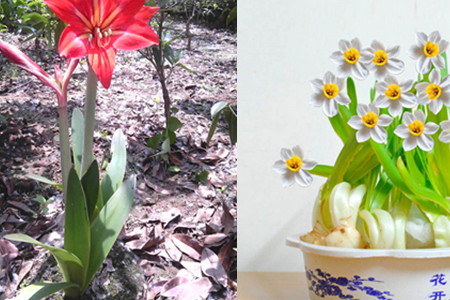
Among the flowers we commonly see, many have bulbs. As the name suggests, a bulb means its root grows looks just like a ball. This is because its root undergoes abnormal swelling, changing from a thin root into an approximately round bulb. Plants with bulbs are divided into many varieties, among which the more common ones we see include narcissus and lilies, and so on. But do you know how this kind of plant reproduces?
1. Division
For this kind of plant, the more commonly used method of propagation is to separate new individual plants from the roots. After this kind of plant grows for a certain period of time, its root is no longer a single bulb, but instead grows many small bulbs. At this point, gardeners carefully break off these small bulbs, and then more plants can be grown.
2. Cuttage
For this kind of plant, propagation can also be done using only cuttage. First cut the flowering stems into segments, taking care that they are not too long, then insert them into a loose growing medium, or peel off the scales on the stem and bury them in fine sand, and before long new bulbs will grow.
3. Sowing
This method is applicable to almost all plants, and of course this kind of plant is no exception. Before formally sowing, first select plump seeds for later use, then prepare a pot of nutrient soil, sow the selected seeds into it, and sprinkle a very thin layer of soil on top. As for the water supply, you can first soak the soil in the pot and then sow, or sow first and then sprinkle water.
These methods can all propagate new bulbs, but controlling the temperature is still relatively difficult, so gardeners can try them first.
Propagation methods for yellow flag iris: division, sowing, and bulbs
Yellow flag iris is a perennial herbaceous plant with yellow flowers. It is very beautiful when in bloom. The flowers contain 2 blooms, and the flowering period is May to June. We can usually see yellow flag iris on hillside grasslands and forest-edge meadows. It has relatively high horticultural value. Below is an understanding of the propagation methods for yellow flag iris.
Propagation method 1 for yellow flag iris: divisionDivision propagation is generally carried out once every 2 to 4 years, in spring and autumn or after flowering. Iris is divided after flowering (avoiding the plum rain season), and before winter arrives the flower buds can differentiate sufficiently, so it can bloom the following year. When dividing the rhizome, 3 to 4 buds are preferable. If the divisions are too thin, it will affect flowering the next year. When carrying out division propagation, the upper leaves of the plant should be cut off, leaving about 20 cm for planting. Most iris varieties are suitable for shallow planting. Planting spacing varies by type; strong-growing types are 50×50 cm, while general varieties are around 20×20 cm.
a. Apply sufficient base fertilizer, and keep the soil relatively moist during the growing period, especially during the flowering period, when the roots need to grow in water, with a water depth of 5-7 cm being suitable.
b. The soil pH is best below 6.5, otherwise the plant will grow slowly and may also show yellowing.
c. Fertilize 3-4 times during the growing period, and pay attention to removing weeds and withered yellow leaves. In summer's high temperatures, water the leaves frequently to increase air humidity, so the seedlings are strong and the leaves are green.
2. Sowing yellow flag irisIf seed propagation is used, it should be carried out immediately after the seeds mature, so the seeds germinate easily and can bloom in 2 to 3 years. Sow in pots from March to April, with an optimum germination temperature of 18-21°C; germination occurs 15-20 days after sowing, and transplant when the seedlings are 5-6 cm tall.
3. Yellow flag iris bulbsAfter a bulb is planted and blooms for one year, its nutrients will be exhausted and new roots will form. Around the new bulb there will also be many daughter bulbs. After 1 to 2 years of planting, the daughter bulbs can develop into flowering bulbs. Flower cultivation experts around the world have carried out tissue culture on different organs of bulbous iris, such as axillary buds, bulbs, stem discs, and flower stems, to make them grow new bulbs. This provides a new method for accelerating propagation and cultivating healthy, disease-free mother bulbs.
Flowers suitable for sowing and propagation in May; growing flowers in May is not too late
May is about to arrive, and many flower growers think they have already missed the best time for sowing flowers, so they give up on sowing and growing flowers. Actually, this is unnecessary. Now a succulent nursery has summarized flower planting in May for everyone.
The climate characteristic of May is that temperatures continue to rise, and rainfall gradually increases from south to north across our country. After each rainfall, the temperature rises noticeably, with many continuous spring rain days. By the time the Lesser Fullness spring rain ends, the weather turns muggy, marking the imminent arrival of summer.
Therefore, May, at the turn of spring and summer, is a key period for planting and growing flowers, and it plays an important role in laying the foundation for the summer and autumn growth of potted flowers.
Types of flowers and trees suitable for courtyard display
Entering May, at the turn of spring and summer, temperatures rise greatly across the country, and sunlight becomes increasingly strong. The types of potted ornamental plants that can be displayed in courtyards increase, such as Chinese rose, Norfolk Island pine, Malus halliana, Canary Island date palm, rubber tree, five-needle pine, Buddhist pine, nandina, amaryllis, jasmine, bamboo palm, sago cycad, king coconut, areca palm, variegated schefflera, palm, bottle palm, cinnamon, beautiful phoenix palm, European primrose, lily, dwarfed potted plants, pomegranate, Chinese peony, banana shrub, red maple, Aglaia odorata, four-season osmanthus, and bitter orange, etc.
Propagation of courtyard flowers:
1. Sowing
Herbaceous flower types suitable for sowing in May include: four-season primrose, garden balsam, globe amaranth, etc.
Woody flowers include loquat, Japanese aralia, leatherleaf mahonia, areca palm, bottle palm, and osmanthus. Among them, the seeds of the first 5 kinds of flowers can be washed clean and sown immediately after collection, but only osmanthus, whose ripe fruit turns black, softens, and is covered with white powder, should have the peel and flesh washed off, then be stored in clean wet sand until February of the following year, and sown only when the seed cracks and shows white.
For seeds sown immediately after collection, the following points should be noted when sowing: first, keep the seedbed moist, but not waterlogged; second, cover with grass to prevent the seeds from "sprouting back"; third, after the seeds emerge, remove the covering grass in 2 to 3 rounds, and promptly build a shade to prevent the sun from burning the young seedlings.
In addition, although loquat has large seeds, its young sprouts have weak soil-penetrating ability and are prone to bending. Sowing too deep will affect the emergence rate and seedling survival rate, so shallow sowing is suitable. Generally, a furrow 2-3 cm deep covered with soil up to the brim is sufficient.
At this time, planting gladiolus bulbs in the ground can bloom in August. Planting tuberose in the ground can bloom from August to September.
2. Cuttage
Herbaceous ornamental plants suitable for cuttage in May include: scarlet sage, pansy, chrysanthemum, spiderwort, snapdragon, wax begonia, cane begonia, Swiss cheese plant, clearweed, arrowhead plant, anthurium, white nerve plant, globe amaranth, marigold, coleus, pepperomia, geranium, and coral flower, etc.;
Succulent ornamental plants include: night-blooming cereus, orchid cactus, cactus used as rootstock, triangular cactus used as rootstock, echeveria, and graptopetalum, etc.;
Woody ornamental plants include: azalea, chloranthus, jasmine, crown of thorns, Chinese rose, fuchsia, hibiscus, clerodendrum, nandina, red-backed excaecaria, mahonia, rubber tree, dragon tree, red mulberry, hydrangea, pomegranate, rose of Sharon, lantana, cordyline, bougainvillea, schefflera, firethorn, purple magnolia, and butterfly bush, etc.
3. Grafting
In May, wild rose can be used as rootstock for bud grafting Chinese rose;
Use 1- to 2-year-old purple magnolia seedlings or cuttings as rootstock for approach grafting Michelia alba;
Use 2- to 3-year-old single-trunk rubber trees as rootstock for branch grafting variegated weeping fig;
Use green maple seedlings as rootstock for soft-tip grafting red maple;
Use finger-thick wintersweet seedlings as rootstock for approach grafting superior varieties of wintersweet;
Use osmanthus seedlings or small-leaf privet as rootstock for approach grafting improved osmanthus;
Use red camellia or single-petal camellia seedlings as rootstock for softwood grafting camellia;
Use vigorously growing rhododendron as rootstock for cleft grafting Western azalea;
Use yellow wormwood as rootstock for grafting variety chrysanthemums;
In early May, use cactus and triangular cactus as rootstock for grafting crab claw orchid;
Use triangular cactus as rootstock for grafting Gymnocalycium mihanovichii, etc.
4. Division
Flower types that can be propagated by division in May include: hosta, purple hosta, iris, aspidistra, autumn zephyr lily, silver-variegated lilyturf, haworthia, Guangdong evergreen, orchid grass, jasmine, chloranthus, black-eyed Susan, purple loosestrife, wax begonia, and sword fern, etc.
5. Layering
Flower types that can be propagated by layering in May include: banana shrub, chloranthus, plum blossom, winter jasmine, Chinese rose, Malus halliana, cherry blossom, Michelia alba, rubber tree, Belgian azalea, osmanthus, purple magnolia, croton, Buddhist pine, Chinese weeping cypress, true cypress, gardenia, wisteria, Chinese trumpet creeper, and Aglaia odorata, etc.