Is the small-leaf red sandalwood bonsai real? Teaching you to tell genuine rare potted plants from fakes
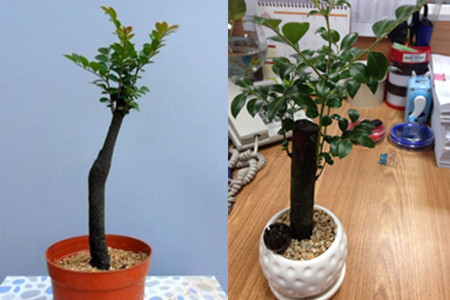
Small-leaf red sandalwood is the finest among red sandalwoods. Because its wood is hard and its fragrance unique, it is deeply loved by many people. In ancient times it was used as royal furniture timber, and ordinary people could hardly use it. Small-leaf red sandalwood grows slowly, taking eight hundred years of growth before it can be harvested and put to use, which has further caused an extreme shortage of resources and soaring prices. After the founding of the People's Republic of China, the state banned the felling of precious timber, and small-leaf red sandalwood became popular as an ornamental bonsai; profits have kept fakes coming on the market, so how can you tell genuine rare bonsai from fake?
The plant currently used on the market to pass off as this rare bonsai is a species called black-bone tea (Dracaena cambodiana). Because its leaves, root nodules and small-leaf red sandalwood are similar, illegal traders use it to pass fake off as real and seek profit. To tell real small-leaf red sandalwood from fake, we first need to know the characteristics of this tree, and identify the genuine article by comparing it with black-bone tea.
1. Tell real from fake by the leaves of small-leaf red sandalwood.
Although the name small-leaf red sandalwood contains the words "small leaf", its leaves are actually not small. Red sandalwood is a tree, and its leaves are fairly large and grow opposite each other, generally elliptical or ovate. The leaves of the red sandalwood tree grow in odd numbers, usually in groups of three arranged symmetrically on both sides of the leaf axis, and the leaf arrangement looks fairly regular.
Black-bone tea is a shrub, and its leaves are much smaller than those of small-leaf red sandalwood. The leaves of black-bone tea grow alternately, looking like strings of leaves.
Observe the main trunk of small-leaf red sandalwood: the bark is generally dark brown, and as the years pass the bark splits, like a grid. The trunk of black-bone tea, however, is black, and no colour change occurs even when it is cut open.
2. Tell real from fake by the wood.
Small-leaf red sandalwood is famous for its hard texture and fine wood grain; it takes five years of growth to form a single annual ring, so the timber is extremely heavy and sinks immediately when placed in water. Because the wood density of small-leaf red sandalwood is fairly high, its growth rings are not easy to observe, and its grain interlaces and curls into a twisted-silk pattern.
Black-bone tea is a shrub, and its wood hardness and density are far below those of small-leaf red sandalwood; it will not sink immediately when placed in water.
3. Tell real from fake by the scent.
Small-leaf red sandalwood has a faint woody fragrance, and the scent is not obvious. If you saw off a small piece of wood, and carefully distinguish the sawdust aroma, it resembles the smell of incense burned in temples; this is also one of the reasons small-leaf red sandalwood is so precious.
Black-bone tea plants have no scent, and this is a fairly striking difference between the two.
4. Tell real from fake by the colour of the wood.
As its name suggests, small-leaf red sandalwood has a very distinctive wood colour. Cut open the wood of small-leaf red sandalwood with a knife, and the fresh cut surface is orange-red or bright red; after a period of oxidation it turns purple or blackish purple.
There is another fairly simple way to identify small-leaf red sandalwood: draw a small piece of the wood across white paper and look at the colour of the mark. Genuine small-leaf red sandalwood leaves a purplish-red mark. If you soak wood shavings in alcohol, the exudate is purplish-red; it is a good material for dyeing cloth, with vivid colour that does not fade easily.
Currently, ninety-nine out of a hundred small-leaf red sandalwood potted plants on the bonsai market are black-bone tea passed off as the real thing. In fact, as long as you know a little about the characteristics of small-leaf red sandalwood, you can easily tell whether a bonsai is real or fake by the differences in leaves and wood. A special reminder: when buying rare bonsai, be sure to go to a fixed brick-and-mortar shop; products sold online cannot be examined closely in person, which increases the chance of being cheated.
How to grow a small-leaf red sandalwood bonsai: a few key points for growing this rare potted plant well
Red sandalwood ranks first among rosewoods, and small-leaf red sandalwood is the finest among red sandalwoods, so it is very valuable. In Buddhist scriptures, small-leaf red sandalwood is called a tree bestowed by heaven, with the effects of detoxifying, warding off evil and improving feng shui, so this bonsai is not only for ornament. As the saying goes, an inch of red sandalwood is an inch of gold; what techniques are there for growing such a precious plant? Let's go through them in detail below.
1. Temperature requirements.
Small-leaf red sandalwood is a tropical plant from India, adapted to the temperature and climate conditions of Southeast Asia, so it likes sunlight and cannot adapt to low-temperature environments. The growing temperature for small-leaf red sandalwood is between 20 and 30 degrees, and below 3 degrees Celsius it is prone to cold damage. In spring, summer and autumn it can all be grown outdoors, but in summer it needs moderate shading, and in winter it should be kept indoors to avoid low temperatures.
Generally, when people grow potted plants they like to place them in the study or the living room, but these spots have no direct sunlight and are not suitable for sun-loving plants. If small-leaf red sandalwood stays in such an environment for a long time, it will grow leggy, with branches getting longer and longer and the shape becoming unattractive, so it should be placed in a spot with plenty of sunlight.
2. How to water.
Small-leaf red sandalwood has fairly high water requirements and is a tropical plant that does not tolerate drought, so it needs watering about every two or three days. There is a technique to watering small-leaf red sandalwood: water thoroughly each time, but be careful that no water accumulates in the pot. Do not water at noon when the sun is direct and the temperature is high; evaporation caused by high temperature will make the plant wither and die. Small-leaf red sandalwood likes a fairly humid environment, so you can use a spray bottle to spray misted water to create a humid environment.
Many people who grow small-leaf red sandalwood bonsai fail to judge the timing and amount of watering well, causing the plant to lack water. Here is how to deal with it.
1) How to handle the early stage of water shortage.
When you notice the bonsai's branches drooping, it shows that it lacks water. This state shows the plant is in the early stage of water shortage, which is fairly easy to handle: just water it once in the morning and once in the evening, watering thoroughly each time.
2) How to handle new tender shoots drying out due to severe water shortage.
When the water shortage is severe, you will find the leaves of small-leaf red sandalwood half withered and the newly grown tender branches dried out. At this point you should prune off the dried branches, seal the wounds with lacquer or wax, place the bonsai in a shady spot and wait for it to slowly sprout new buds, taking care to water during this period.
3) How to handle water shortage that has damaged the main trunk.
When the bonsai has lost water very severely and the main trunk has already dried out, what should you do? You should cut off the dried main trunk, seal the wound, then place the whole bonsai in water to replenish moisture. Once the bonsai has absorbed enough water, place it in a shady spot and let it recover.
3. How to fertilise.
Small-leaf red sandalwood has a fairly developed root system, and its own parasitic root nodules fix nitrogen, so it does not demand much from the soil and does not need frequent fertilising. You can dilute plant nutrient solution once a month and water it onto the soil with the water.
Because of the special nature of its developed root system, small-leaf red sandalwood bonsai cannot have its potting soil directly replaced with nutrient soil, nor should nutrient fertiliser be buried directly in the soil, as this will damage the roots. Too much nutrient soil and fertiliser will also burn the roots, which is instead harmful.
4. Do not move the bonsai's location at will.
Once your small-leaf red sandalwood is growing well and has adapted to its existing environment, do not move the pot at will, otherwise it will increase the burden on its growth.
The above are the care techniques for small-leaf red sandalwood. A special reminder: because red sandalwood timber is precious, there are many imitation goods on the market, so please verify authenticity before buying.