What are the rootstocks for grafting roses? You need to understand these precautions
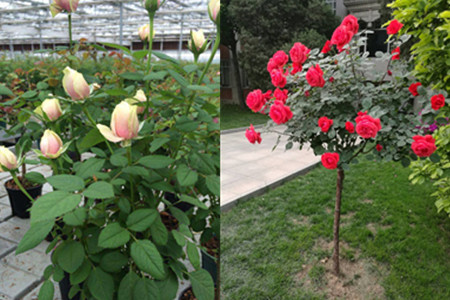
Roses are common garden ornamental flowers, and most varieties are cultivated through grafting. Through grafting, the branches and leaves of roses can be artificially raised, allowing the plant to receive sufficient sunlight. When ventilation is improved, pests and diseases are greatly reduced. The grafted rose trunk has no thorns, making it easy to view, and the height and layout of the grafted plant can also be controlled according to the form of one's own courtyard. The benefits of grafting roses are obvious. Let me explain in detail below what precautions should be taken when grafting roses.
1. What trees can roses be grafted onto?
The principle of grafting flowers and trees is that the two plants must belong to the same family. Varieties with too great a difference cannot survive. The factor affecting the survival rate of rose grafting is the compatibility between the rose scion and the selected rootstock. This compatibility is the similarity and commonality in the tissue structure and genetics of the two plants.
We all know that roses belong to the Rosaceae family, so the rootstocks more commonly chosen for grafting are varieties such as wild rose, Rosa banksiae, Rosa multiflora var. carnea, and Rosa spinosissima. Their common characteristics are a relatively developed root system and strong disease resistance, which can provide sufficient nutrients to the scion.
2. Choose the right time for grafting.
As is well known, temperature and environment have a great impact on plant growth. During grafting, the plant is relatively fragile, so even more attention should be paid to the effects of climate and temperature. The grafting time is generally chosen in spring, when the rootstock has not yet sprouted, or when the sprouts have not yet produced a large number of leaves. If the time is chosen too early, the wound heals slowly due to climate effects. If too late, the rootstock weakens and may die. Generally, grafting is carried out in May in northern China, while in southern China grafting and cultivation can begin in April.
The selection of scions is also very important. Generally, one-year-old roses are chosen, and their sun-facing, well-growing branches are picked as scions.
3. Grafting methods.
Face the cross-section of the rootstock upward, and use a cutting tool to make two vertical cuts at the top. The spacing between the two cuts should match the diameter of the scion to make it easier for the two to fit together. The depth should cut through the bark to reach the xylem. Peel off the excess bark to expose the xylem.
Cut the scion at an angle, and press the exposed part tightly against the xylem of the rootstock. Be careful to leave about 3 mm as a gap, so that after the scion grows it can merge better with the rootstock.
Wrap the two joined plant sections with special grafting film. Pay attention to the tightness of the wrapping. Too loose is not conducive to the plant joining, and too tight will squeeze the scion to death.
4. How to care for the plant after grafting.
After grafting, the plant is fragile and easily infected by pests and diseases, so pesticides should be sprayed at the joint in time after grafting. Generally, it can survive ten days after grafting. If after ten days the scion shows no sign of survival, it is necessary to graft again.
After the scion survives, it needs more nutrients to support growth. At this time, pay attention to fertilizing.
5. Other precautions.
1. To make viewing and management easier and to increase the plant's sunlight exposure, the grafting height is generally between 60 and 80 cm. You can also adjust the height appropriately according to the layout of your own courtyard.
2. Three to five rose varieties can be grafted onto one rootstock. You can choose your favorite flower colors and flower shapes and concentrate them on one rootstock to fully decorate the courtyard.
3. The scion length only needs to be about 10 cm. When cutting, make sure the cuts on the rootstock and scion are smooth.
4. Check the survival situation about ten days after grafting. Gently touch the scion leaves. If the petiole falls off at a touch, the grafting was successful. If it does not fall off easily, and the scion turns black and hard, the grafting failed and needs to be redone.
Overall, rose grafting is relatively easy among plant graftings. March of spring is exactly the good time for grafting and cultivation. Come and try it yourself.
Cultivation methods for rootstocks used in rose grafting
Roses are known as the "queen of flowers" and are also one of China's top ten famous flowers. They are also one of the main varieties in cut flower production. The flowers are large and brightly colored, and more than 8,000 varieties have been bred around the world. They are the mass flower most loved by the Chinese people. The rootstock selected for grafting roses is the rose. Strong rose plants are cultivated and propagated by cuttings.
After years of research and summary, Nanyang Jinpeng Rose Co., Ltd. believes that the following five points should be noted in rootstock cultivation:
First, choose the nursery site. Soil is the main environment for the growth and development of seedling roots and is the main source of water and nutrients needed for seedling growth and development. Therefore, the quality of the seedling site directly affects seedling quality, yield, and seedling cost, and is the key to success or failure in seedling cultivation. Roses like new-crop sandy loam that is fertile, moist, loose, well-drained, and free of pests and diseases. Therefore, places with coarse sand, heavy clay, low-lying areas, and continuous cropping are not suitable.
Second, carefully prepare the soil. After the seedling site is selected, deep plowing is carried out in late autumn and early winter. Deep plowing is required to be timely, level, uniform in depth, with suitable depth, loose on top and firm below, with fine soil clods, and free of miscellaneous roots and gravel.
Third, apply sufficient base fertilizer. Applying sufficient base fertilizer is the prerequisite for cultivating strong rose seedlings. It can not only directly meet the soil nutrient needs of seedling growth, but also improve the physical and chemical properties of the soil, promote the formation of soil aggregate structure, increase soil microbial activity, and facilitate the decomposition of organic matter, thereby creating good environmental conditions for seedling growth and development. Fertilization should mainly use organic fertilizer. Per mu, 5-6 m3 of manure can be applied. After application, shallow plowing and fine raking should be done to achieve uniform mixing of soil and fertilizer.
Fourth, build beds. Flat beds are 10-15 m long and 1 m wide; raised beds are 10-15 m long, with a bed surface width of 60 cm, height of 20-30 cm, and ditch width of 30 cm. Whether flat beds or raised beds, the bed surface should be level and uniform, with fine, even soil and convenient drainage and irrigation.
Fifth, cuttings and tending. Insert the winter-stored and treated cuttings into the seedbed, or transplant small seedlings rooted from softwood cuttings into the seedbed. Two rows per bed, with a plant spacing of 25 cm. After cutting or transplanting, water immediately. After the seedlings survive, strengthen tending and management, and ideal rose grafting rootstock seedlings can be cultivated.
What are the grafting techniques, methods, and precautions for roses? How can tree roses be cultivated using grafting techniques?
When it comes to roses, I believe everyone is familiar with them. Roses are a common flower that blooms in summer. They have beautiful flower colors and charming floral fragrance, and are deeply loved by many flower enthusiasts. Today, the editor will introduce to you the grafting techniques, methods, and precautions for roses. How can tree roses be cultivated using grafting techniques?
Cultivating tree roses by the double grafting method
Select vigorous, upright Rosa banksiae with a trunk height of about 2 m to 4 m and transplant them. Before transplanting, disinfect the soil in the field and use Bisumie and Furadan to kill soil pests. When planting, soak the lower cut section of the Rosa banksiae in a mixed solution of appropriate concentrations of chlorothalonil, rooting hormone, and carbendazim for sterilization and rooting. Seal the upper cut section with paraffin. Apply a mixed medication of petroleum jelly and hormones to the upper branches to promote lateral bud development. After planting, use a mixed liquid of rooting hormone, plant growth hormone, and streptomycin to give the tree an IV drip, which is beneficial for trunk rooting, sprouting, and increasing lateral branches. After 1 to 2 years of domesticated cultivation, when 3 to 5 branches grow from the top and the degree of lignification is relatively high, it can be used as a rootstock.
When grafting, choose thick, pest-free rose branches as scions. For the first grafting, use the bud grafting method to graft rose buds onto Rosa banksiae branches. Graft 2 to 3 buds on each branch at intervals of 15 cm in different directions. After the first grafting, strong buds will emerge from the grafting points and grow into multiple strong branches. Before they become lignified, use them as rootstocks and carry out the second grafting in time. During the second grafting, first cut off 1/4 to 1/3 of the upper part of the strong branch, make a vertical cut on the outer side of the cut section down to the xylem, and pry open the bark. Then choose rose branches with the required flower color, thick growth, and no pests or diseases as scions. The scion should be 15 cm long, with 1 to 2 buds kept at the upper end, and both sides of the lower end cut into large horseshoe-shaped slopes. Then insert the lower end of the scion with the large slope facing inward and the small slope facing outward into the pried-open bark of the rootstock, so that the torn bark at the upper end of the rootstock is slightly exposed. Then bind and tie the grafted area tightly with plastic strips. Graft 2 to 3 scions on the same branch in different directions and promptly bag the scions to keep them warm. After 7 days, the scions begin to sprout, and after one year they can bloom, initially forming a colorful tree rose.
Cultivating tree roses by the single grafting method
Choose Rosa banksiae with a relatively high degree of lignification, vigorous growth, no pests or diseases, a diameter of 3 cm to 5 cm, and a trunk height of 1 m to 1.5 m. Cut it off from below the top of the main trunk at 2 nodes, leaving more lateral buds to promote their sprouting into lateral branches. Through field transplanting, use it as a rootstock after survival. When grafting, choose according to need the current-year healthy branches of young plants or middle-aged plants of excellent varieties such as tea-scented roses and floribunda roses with good flower color, strong trunk character, vigorous growth, many branches, and good crown shape as scions. Branches cut during winter pruning can be stored in sand for later use. When grafting, they can also be used immediately after collection. When the scions need to be preserved, they can be quickly dipped in liquid paraffin to form a very thin wax film on the surface, then put into plastic bags and placed in a low-temperature, moist place for later use. Grafting time differs among different regions, and in the same region, grafting time also differs among different years due to climate influence. The best time is from early March to mid-April, when the rootstock sap begins to flow.
For single grafting, the cleft grafting method can be used. First use a cleft grafting knife to make a vertical cut down the center of the rootstock cross-section, about 3 cm to 4 cm deep. Cut both sides of the scion base into a wedge shape 3 cm to 4 cm long, leaving 2 to 3 buds on top. Use the knife to pry open the rootstock and insert the scion, and align the cambium of the rootstock and scion. If the bark thickness of the scion and rootstock is inconsistent, it is better to place the outer epidermis of the scion slightly closer to the center of the rootstock. The grafting site should be tied tightly with plastic strips. Graft 2 to 3 scions on the same branch in different directions and positions. After grafting, bag the scions in time to keep them warm and promote survival.
Single grafting can also use the bud grafting method. Select plump rose buds as scions, use Rosa banksiae as the rootstock, and use a blade to cut off the bud piece. Leave a distance of more than 5 mm above and below, keep the cut smooth, and cut the lower end into a 45-degree bevel. On the rootstock, select a thicker branch section and cut it to the xylem. The size of the cut surface should be roughly the same as the scion, and the lower bevel angle should match the scion. One side of the cambium must fit tightly. Cut plastic wrap into long strips and wrap tightly from bottom to top. The second loop is best to cover the first loop to prevent air leakage. Wrap only one layer at the bud, and wrap several more layers above and below, tie tightly, cut off excess rootstock branches, wrap the cut well, and water. Graft 2 to 3 buds on the same branch in different directions and positions. Promptly remove sprouts on the rootstock. After the scion buds out, use a toothpick to open the film and let the bud be exposed.
Management after grafting
After grafting, strengthen fertilizer and water management. Check the survival of the grafted seedlings after about 25 days. If the scion has sprouted or the scion is fresh green, it indicates survival. Otherwise, it should be regrafted as early as possible. For bagged scions, when the scion buds grow to more than 3 cm, cut a small ventilation hole in the bag to harden the buds. After another 5 to 7 days, the bag can be removed. When the scion buds grow to more than 10 cm, use a sharp knife to cut the binding strip on one side, being careful not to injure the grafted buds. After the scion buds develop into branches, carry out proper shaping and pruning as needed to promote the formation of an ideal tree shape. After flowering, prune timely and reasonably. It is best to cut below the third compound leaf of the flower. If there is a new bud below it, cut above the strong bud to promote strong new branches and early flower buds. Prune strong branches less and later; prune weak branches more and earlier. When pruning, be careful to retain strong buds. After budding, keep only the large terminal bud to concentrate nutrients and promote large, brightly colored flowers.
In early summer and midsummer, appropriate shading and more water spraying should be provided to lower temperature and supplement humidity, while also paying attention to maintaining air circulation. Pay attention to scientific fertilization. Fertilization should mainly be base fertilizer, and decomposed fertilizer mixed with bone meal or hoof pieces can be used. During the growth period, apply fertilizer once every about 10 days. For topdressing, use liquid fertilizer diluted with water, such as cake fertilizer water plus bone meal, superphosphate, or potassium dihydrogen phosphate.
The above is all the content I have learned about roses today. I hope flower enthusiasts will find it helpful after reading this article. To learn more about roses, please continue to follow Duorou Huapu. We will provide you with more related knowledge!