How can you tell real red sandalwood (Pterocarpus santalinus) bonsai from fakes? Three aspects to help you tell them apart easily
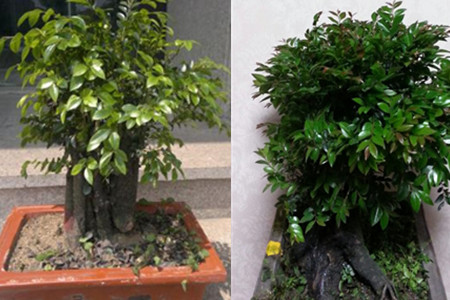
Red sandalwood bonsai is a new favorite in today's flower and bird markets; with its elegant, rustic form it has captured many people who love flowers and trees. However, because red sandalwood grows very slowly, cultivating a bonsai takes a long time, so the price of red sandalwood bonsai has always stayed high. For bonsai enthusiasts, the high price also reflects the bonsai's preciousness, and they are still happy with it. But the most heartbreaking thing is: spending a lot of money yet buying a fake red sandalwood!
A veteran once exposed: of the red sandalwood bonsai sold on the market today, ninety-nine percent are a plant in the Ebenaceae family called Black Bone Tea (Diospyros vaccinioides)! This plant and red sandalwood are actually two things as different as chalk and cheese! Isn't it a bit shocking to sigh at how deep the water is here?
How can you tell real red sandalwood bonsai from fake? In fact, once you understand the characteristics of these two plants, distinguishing them is not hard. Let's break it down from three aspects so you can easily tell the "real Li Kui from the fake".
1. Plant nature.
1. Black Bone Tea, also called small-fruited persimmon or Maple Harbor persimmon, is very common in Taiwan, China and southern China, and is generally made into foliage bonsai. It is a shrub with very small leaves. A so-called shrub is something that does not grow tall or large, and certainly cannot become timber for making furniture.
2. Red sandalwood is a tall tree. Its wood is heavy and solid, with strong stability, and it is an excellent wood for making furniture. But because it takes eight hundred years to grow into usable timber, furniture made from this wood is very expensive.
2. Appearance
1. Leaves
Black Bone Tea's leaves are very small, like a chicken-heart shape, opposite, and arranged in rows along both sides of the branches. As far as bonsai form goes, this kind of leaf makes Black Bone Tea look more elegant and beautiful.
Because red sandalwood is a tree, its leaves are very large, roughly round, also opposite, but a branch usually has only about three to five leaves, so it is not very refined when actually made into bonsai. If you have seen a real red sandalwood once, you will easily distinguish these two plants. It is just that red sandalwood is not commonly seen in daily life, so it gives merchants room to exploit and "bully" people who do not know it.
2. Branches and trunk
Black Bone Tea's branches and trunk are very rough, the bark is black, and most have some straight vertical lines. Thinner branches are white-green, and only when a branch grows to 1CM does it turn black.
Red sandalwood's trunk is upright, with dark brown bark that is relatively smooth. After it grows up, the bark splits, forming patterns like a grid. New broken or cut surfaces of the branches are bright red or orange-red, while old cuts turn purplish-black or purple. The wood grain contains purplish-black lines.
3. Weight and sap
Dense, heavy wood is a characteristic of red sandalwood, so if you put branches of red sandalwood and Black Bone Tea of the same size into water, the red sandalwood one will sink much faster.
Red sandalwood's sap is red; break off a bit and use it to draw on a white wall, and it will leave purplish-red marks, while Black Bone Tea will not.
Old red sandalwood's color is very firm and will not release color when placed in water. But younger, tender red sandalwood soaked in water will leach out red, and in ancient times there was even a saying that water soaked from red sandalwood could be used as a red dye. You can also shave off a little red sandalwood sawdust and soak it in baijiu, and it will immediately break down into a sticky, glue-like pink substance. Generally, red sandalwood used for bonsai is not very old, so this is also a very effective way to identify it.
It is not that there are no bonsai truly made from red sandalwood, but the number is extremely small. Because its growth rate is really too slow, its trunk too straight, and its root system too deep, cultivating it into a beautiful bonsai is not easy, and it is impossible for so many red sandalwood bonsai to be sold on the market.
Moreover, from the perspective of bonsai appreciation, the ornamental value of Black Bone Tea bonsai is even higher than that of red sandalwood. Because:
1. Black Bone Tea also grows relatively slowly, tolerates shade, and has strong resistance to pests and diseases, making it suitable for indoor placement.
2. Black Bone Tea is evergreen all year round and very easy to shape; its branches rise in a forest-like form, and it can be made into root-connected forms, giving it high ornamental value.
It is just that merchants, in order to seek greater profits, sell it under the name of red sandalwood at a high price; in fact, Black Bone Tea is quite wronged.
The value of red sandalwood bonsai
Red sandalwood is the raw material for rosewood furniture and belongs to scarce resources. Many people invest in planting red sandalwood. Mature red sandalwood has a prominent reputation and a very high market valuation. As a flower lover, if you are only viewing red sandalwood for ornament, it is also a well-deserved first choice; red sandalwood is one of many tree species, with dense, dark green leaves and a very obvious feeling of spring. It gives people a suddenly open and bright state of mind.
Now have you learned how to deal with a red sandalwood bonsai that is dropping leaves? If your red sandalwood shows leaf drop, please handle it promptly; when we cherish our plants, the plants will also repay you with their beauty.
Handling leaf drop in red sandalwood bonsai
Red sandalwood is a tropical plant and has high requirements for water. If you do not water it, it will cause withered leaves and thus leaf drop. So if your red sandalwood is dropping leaves due to drying out, then you should pay attention to watering it once every few days. But it is not suitable to water too much; most plants will get root rot from too much watering, and this will also cause leaf drop.
Another possibility for withered leaf drop is soil compaction. Because the soil is compacted and does not let water through, the water poured in cannot reach the root system, causing the leaves to lose water, dry out, and drop. You can choose some loose soil to grow red sandalwood.
Another reason red sandalwood drops leaves is insufficient light. Because red sandalwood is a green plant, its need for photosynthesis is relatively strong, so it needs sufficient light to provide enough nutrients for its own growth. So it is best to place your red sandalwood in a sunny spot to grow.
In addition, you should also pay attention to the effects of pests and diseases on red sandalwood, as well as the appropriate amount of fertilizer during care.