What tree is used to graft roses? Both Rosa multiflora and Rosa rugosa can be chosen
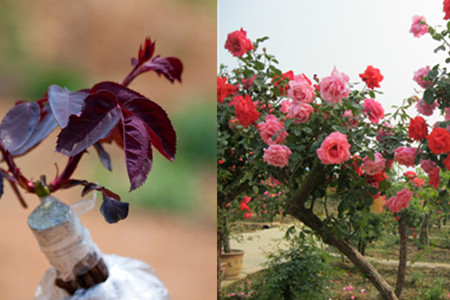
In the past, the roses we saw were all very short. Even if one or two occasionally grew taller, their branches were extremely slender. Nowadays, many roses growing along both sides of roads have very thick, sturdy stems and grow fairly tall. Is this because their varieties have mutated? Of course not. Roses like these appear because people have grafted them onto other plants.
Moreover, friends have probably noticed that these grafted roses can also produce larger and more numerous flowers. So, which plants can be used to graft with roses?
1. Rosa multiflora
Among the grafted roses we see, a large portion use Rosa multiflora, because these two plants are not very different in their habits, and they can even be considered "close relatives." However, not all Rosa multiflora can be used; only those vines that have already grown for many years and are relatively thick and sturdy can be used for grafting.
2. Rosa rugosa
Many people say that the roses sold on the market today are actually fake, that they are all actually Chinese roses. We do not know whether this is true, but it is true that Rosa rugosa can be used for grafting. Many flower growers like to use this plant as rootstock, because it can make the roses more vivid in color.
3. Wild roses
In fact, not all roses are grafted using plants of other varieties. Some people also use wild roses, because such plants are easier to keep alive; even in very poor environments, they can grow and bloom.
These three plants are all very useful rootstocks. If friends have the energy, they can also try grafting them themselves.
Rose tree grafting, rose tree planting
Tree roses, also called rose trees or rose standards, are a new type of rose produced from an upright trunk through horticultural methods (cuttings, root cultivation, trunk training, grafting, pruning, shaping and other measures). Below, let us learn about the planting methods for rose trees.
Rose tree planting
To rapidly propagate rose trees, two nurseries are needed. One is the rootstock nursery, and the other is the scion nursery. What the two nurseries have in common is: choose flat, sunny, well-drained, moist and fertile, neutral to slightly acidic soil with a pH of 6 to 6.5, and both use raised beds. During intertillage, apply base fertilizer per mu according to the following formula: 5000 kg of farmyard manure, 20 kg of nitrophosphate, 10 kg of urea, 5 kg of carbofuran granules.
The rootstock nursery bed is 1.2 m wide. Plant Rosa banksiae var. normalis or Rosa multiflora var. cathayensis as rootstock by cuttings, with a plant and row spacing of 40 cm, cutting from May to July each year. After cutting, pay attention to seedling-stage management. At the Start of Winter, heavily prune all branches, leaving only the buds on one or two vigorous branches; the remaining weak branches can be cut off close to the roots, and appropriate measures should be taken for overwintering and cold protection.
Rose tree grafting
1. Disinfection of tools before grafting: When grafting, while ensuring that the cambium layers of rootstock and scion align, also ensure that the cut surfaces of rootstock and scion must be flat. The binding action should be nimble and quick, to prevent the cut surface from oxidizing and changing color.
2. Selection and storage of scions: The selection of rose scions is directly related to the survival quality of the grafted seedlings and whether vigorous grafted plants can be formed. Stored scions can be taken out for grafting at any time, eliminating the trouble of collecting them just before grafting, saving a great deal of time, and allowing grafting at any time.
Management of rose trees
Roses are light-loving, strongly sun-loving flowers, and tree roses are no exception. If the plant is given insufficient light, poor ventilation or excessive shading, the branches of tree roses will become slender, the leaves will become thin, and nutrient accumulation will be poor, ultimately leading to poor plant growth, fewer and smaller flowers, dull flower color, and a shorter flowering period.
Because tree roses have the characteristic of blooming multiple times a year, their nutritional requirements are also relatively higher than those of other flowers. Throughout the entire growing season of tree roses, fertilizer should be applied several more times as appropriate, that is, apply fertilizer once after each blooming of the tree rose, so that the rose plant can recover its growth as quickly as possible. When topdressing, pay attention to the ratio of nitrogen, phosphorus and potassium; do not apply only a single nitrogen fertilizer or only phosphorus and potassium fertilizers. Otherwise, it will cause symptoms such as the plant growing only branches and leaves or failing to form flower buds normally.
The above is the relevant information on rose tree planting methods introduced to you by the editor. We hope it is helpful for your rose tree planting!
What trees can be used to graft roses? What are the benefits of grafting roses?
Rose flowers are elegant and beautiful, varied in appearance, and bloom in all four seasons, and are deeply loved by people. We all know that roses can be grafted, so what trees can be used to graft roses, and what are the benefits of grafting roses? Let us take a look together below!
What trees can be used to graft roses
When grafting roses, the main factor affecting survival is the compatibility between the scion and the rootstock. So-called compatibility means that the scion and rootstock are the same or similar to each other in internal tissue structure, physiology and genetics, and thus have the ability to combine with each other. Rosa and Rosa rugosa belong to the Rosaceae family. The best rootstocks for grafting roses and Rosa rugosa are various wild roses, such as Rosa multiflora 'Grevillei', Rosa davurica, Rosa banksiae, Rosa macrophylla, etc. These varieties have well-developed root systems, strong disease resistance and vigorous growth, and can provide sufficient nutrients to the roses to be grafted.
Grafting propagation techniques for roses
Rose grafting commonly uses wild roses as rootstock, and is divided into bud grafting and branch grafting. Bud grafting has a relatively high survival rate and is generally carried out from August to September. The grafting site should be as close to the ground as possible. The specific method is to make a "T"-shaped cut in the bark on one side of the rootstock stem or branch with a budding knife, then select a bud from the middle of a well-grown current-year branch of the rose. After inserting the bud into the "T"-shaped cut, bind it with a plastic bag and provide appropriate shade; in this way, it will heal after about two weeks.
What are the benefits of grafting roses
1. Vigorous growth: The rootstock used for grafting roses is vigorously growing Rosa multiflora, so the stems, leaves and flowers are all clearly superior to those of ground-planted roses.
2. Less disease: The branches and leaves of grafted roses are relatively high above the ground and have good ventilation and light transmission, so there is almost no disease.
3. Less space occupied: A traditional three-year-old ground-planted seedling occupies about 0.09 sq m, while a grafted rose occupies only about 0.001 sq m.
4. Convenient management: The main trunk of Rosa multiflora has no thorns and is easy to manage, and the grafting height can be controlled, allowing arbitrary layout according to the form of the courtyard.
5. Multiple flowers on one plant: 3 to 5 varieties can be grafted onto one Rosa multiflora plant, and ten plants can reach more than 30 varieties, which is completely sufficient for courtyard cultivation.