How to prune a winter jasmine bonsai? Simple, practical and easy-to-learn methods
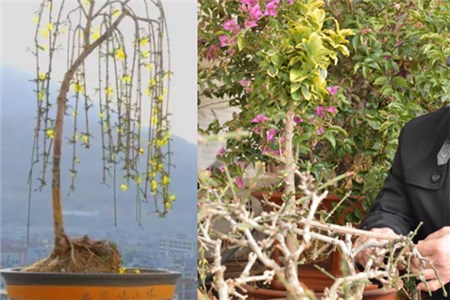
I. Advantages of pruning winter jasmine bonsai
Spring arrives, and the winter jasmine blooms. As one of the flowers that bloom relatively early in spring, people give it the meaning of announcing the arrival of spring, and the branches of this flower grow rapidly, so many bonsai enthusiasts like to make bonsai based on winter jasmine. Bonsai making is mainly based on pruning; proper and reasonable pruning can regulate the tree's growth, make the branches distributed reasonably and evenly, and make the whole tree look fresh and beautiful.
II. Timing and methods of pruning
As is well known, flower buds grow on the branches of the previous year, therefore, neither autumn nor winter is suitable for pruning, so the appropriate time should be within 10 days after the flowers have all withered. After the flowers wither each year, the long branches should be cut off to promote the sprouting of new branches. Moreover, the new branches must not be too long, so between May and July, pinching is carried out.
It is likewise important to note that after the winter jasmine flowers wither each New Year, a comprehensive pruning should be carried out, cutting off the scattered and withered ones, otherwise they will disperse nutrients.
III. Pruning precautions
Be sure to firmly remember the several time points for pruning; only with proper timing can the overall beauty and neatness of the bonsai be ensured. Secondly, you must be thoroughly familiar with the growing conditions of winter jasmine, otherwise it will be counterproductive. It is drought-tolerant and cold-tolerant, likes sunlight, and does not have very strict requirements for soil; generally it is neutral loam, and acidic soil is also acceptable. Choosing matured vegetable garden soil, which is rich in nutrients and has a soft texture, is relatively suitable for the growth of winter jasmine.
During the pruning process, for dense areas, appropriate pruning should be carried out, so that the overall light transmission is better. Moreover, when pruning, you should first treat it as a plant, and only then as a bonsai. Respect the natural laws of plant growth, and only in this way can the artistic beauty of the combination of nature and artifice be fully displayed.
Precautions for pruning winter jasmine bonsai, winter jasmine bonsai pictures
Winter jasmine has characteristics such as not being picky about wind and soil and having strong adaptability, so it has always been very popular among people. Today, the editor will explain to you the precautions for pruning winter jasmine bonsai and take you to enjoy beautiful pictures of winter jasmine bonsai.
Precautions for pruning winter jasmine:
I. It is best to prune winter jasmine twice. After it finishes blooming in spring, carry out one pruning, cutting off all the branches of the current year and leaving 1--2 buds. After it grows for a period of time, prune once more, and according to the degree of evenness of the branches of the trunk and crown, cut off the weak branches. If the branches grow too fast, another shortening can be carried out in late March or early April, and after lateral buds grow out, remove one lateral bud according to the growth direction of the branch.
II. After flowering, prune according to the shape until it is in place; after the roots are also heavily pruned, change to a larger pot. There must be base fertilizer at the bottom of the pot. Maintain with plenty of water and fertilizer until mid-July, then prune into place again. After budding, slightly withhold water, and water again when the leaves are seen curling. In September, apply phosphorus and potassium fertilizer 2 times. In October, carry out normal maintenance. By November, it can be put into a fine pot. Place it in a warm and sunny place for maintenance. In late January, prune after flower buds appear, and enjoy after flowering. At this time, the branches should be below 10 cm, with flowers all over the branches.
After two to three years of pruning and cultivation, once the shape of a pot of winter jasmine is fixed, a pot of both beautiful and good winter jasmine will appear before your eyes.
Pruning methods for winter jasmine bonsai
Generally, what flower lovers need to know about winter jasmine pruning is mostly winter jasmine bonsai pruning, because few flower lovers think of pruning winter jasmine planted in the ground, but pruning has many benefits. Below, the editor will introduce the methods of winter jasmine pruning to everyone.
Winter jasmine needs pruning to regulate tree vigor, save nutrients, make the branches evenly distributed, and make the plant crown neat and beautiful, and importantly, it is beneficial for producing more flowers. Whether the timing of pruning winter jasmine is appropriate or not is a key link in growing winter jasmine well.
The flower buds of winter jasmine are formed on the branches of the previous year, therefore pruning is not suitable in either autumn or winter. If pruned at this time, the branches with flower buds formed in summer will be cut off, leading to the consequence of no flowers to bloom.
The best time to prune winter jasmine is within 10 days after all the flowers have withered, leaving two to three buds on each branch. After pruning, apply nitrogen fertilizer twice, once every 10 days, to promote the sprouting of new shoots. When the new branches grow to about 15 cm, apply phosphorus fertilizer 3 times, once every 7 days, to meet the nutrients needed for flower bud formation and differentiation and for bud development and flowering.
The flowering characteristic of winter jasmine is that the flowers are large and concentrated on the new branches grown in autumn. Branches formed before summer bear few flowers, and old branches basically cannot bloom. Therefore, after flowering each year, the long branches should be cut off from the base to promote the sprouting of new branches, so that more flowers can be produced the following year. To avoid the new branches being too long, generally within May-July, pinching should be done 2 or 3 times; each pinching only needs to retain two pairs of buds at the base of the new branch and cut off the top shoot; for plants that grow robustly and have many branches, pinching may no longer be done after July, and for plants that grow thin and weak, pinching may be done less or not at all.
In addition, after the flowers fade in early spring each year, a thinning pruning is needed, cutting off dead branches, diseased branches and overly dense branches from the base, so that nutrients are relatively concentrated. Only in this way will winter jasmine have a neat plant shape and bloom abundantly.
How can winter jasmine produce more flowers?
First, necessary pruning should be carried out. The flowers of winter jasmine are mostly concentrated on the branches of one year; two-year-old branches bear fewer flowers, so the following points should be achieved:
1. After flowering each year, the flowering branches should be heavily cut back, leaving only 3-4 buds at the base, and weak branches should be left with fewer.
2. When the new shoots grow to a certain length, pinch them according to the size of the potted plant and the degree of proportionality of the plant shape, or repeatedly cut them short, to promote branching.
3. After mid-July, generally no more shortening is done. In this way, the vigorous growth of new shoots can be inhibited, which is beneficial for the fullness of new shoots and the formation of flower buds.
The above is the pruning method for winter jasmine bonsai introduced to everyone by Succulent Garden, and we hope it can help everyone. Everyone is welcome to continue following Succulent Garden to learn more about bonsai making and maintenance methods.