Scarifying ginkgo seeds before planting is an essential step
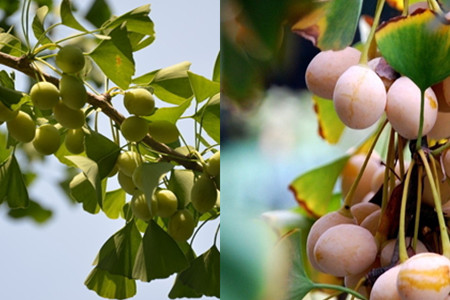
Every year around November, the roads in some schools turn golden. Do you think the workers painted them? No, it is because they are covered with a kind of leaf. At this point, many friends should already be able to guess what this article is about. That's right, it is ginkgo. This plant is fairly common in our country, but in fact it is also an ancient and rare tree species. Almost all the ones we see are relatively "young" trees.
There are roughly three ways to propagate this tree, and what we are discussing here is propagation using its seeds. So, how should it be done specifically?
1. About seed selection
If you want to get robust plants, you must first select good seeds. When choosing seeds, friends must first ask about the age of the mother tree, because if the tree has not grown long enough, its seeds will not be very healthy either. In addition, you should pick those that are relatively plump, because seeds in this condition are new stock.
2. Choosing the time
For our country, around Qingming is a good time to plant this plant. Or friends can also observe the ginkgo trees outside; if the trees have already begun to sprout, then it is time to plant.
3. Preparing to scarify
Before formally planting them, friends need to first place the seeds on sandy soil and let them sit for a few days. Of course, you should first spray a little water on the sand. This is scarification. If you do not carry out this step, these seeds will find it very difficult to sprout.
4. Dibbling
Insert the treated seeds one by one into the soil, taking care to leave the sprouts exposed, and about two weeks of waiting is enough.
Although the whole planting process is not simple, after they are planted they do not need much care.
Mint seed planting method: scarification techniques
Mint seed planting method: scarification techniques
[Common questions] How should mint seeds be planted so they sprout?
[Expert answer]
The requirement for scarifying mint seeds is to keep them moist without letting there be too much water. Therefore, under ordinary circumstances, if you add only a little water it dries out very quickly. Mint scarification generally needs to be done under relatively high temperature conditions, and around 30 degrees is best.
First prepare cool boiled water at about 40 degrees, then pour in the mint seeds and let the mint seeds soak in it for 5 hours. The water temperature does not need to be kept constant; just let the water cool naturally.
After the mint seeds have soaked, start cutting a mineral water bottle, cutting out a section in the shape of a cylinder about 5 cm tall, then stand the cylindrical section upright in a dish, then lay a facial tissue over the top of the cylinder so that the tissue can hang down to the bottom of the dish, pour the mint seeds onto the tissue in the middle of the cylinder, and then cover with another layer of facial tissue. Then add water to the dish. The water will be absorbed upward by the facial tissue and keep the tissue moist, while gravity will prevent the tissue from becoming too wet.
[Editor's comments] Today's article "Mint seed planting method: scarification techniques," compiled by Yuelan of First Agricultural Network, mainly introduces the scarification method for mint seeds. We hope it is helpful to everyone.
What are the methods for scarifying ginkgo seeds?
Ginkgo (Ginkgo biloba L.) is a deciduous tree of the Ginkgo family, genus Ginkgo. Ginkgo appeared hundreds of millions of years ago and is the oldest relict plant among the gymnosperms left after the Quaternary glaciation. The ginkgo trees alive today are rare and scattered, and old trees over a hundred years old are no longer common. All other plants in the same class as it have become extinct, so ginkgo also has the reputation of being a living fossil. Varieties and cultivars include: yellow-leaf ginkgo, tower-shaped ginkgo, split-leaf ginkgo, weeping ginkgo, variegated-leaf ginkgo, and 26 others.
The fruit of the ginkgo tree is commonly known as white fruit, so ginkgo is also called the white fruit tree. The ginkgo tree grows relatively slowly and has an extremely long lifespan. Under natural conditions, it takes more than twenty years from planting to bearing ginkgo fruit, and only after forty years can it bear fruit in large quantities. Therefore, some people also call it the "grandfather-grandson tree," with the meaning of "the grandfather plants and the grandson eats," and it is the longevity star among trees, possessing ornamental, economic, and medicinal value.
What are the methods for scarifying ginkgo seeds?
(2) Seedbed scarification method. Similar to fermentation hotbed scarification. Use a flat bed after land preparation, or dig it 20-30 cm deep, spread 3-5 cm of wet sand on the bottom, then mix 1 part water-saturated seeds with 3-4 parts wet sand evenly and spread flat, then cover with a layer of fine sand, cover with plastic film to keep warm, uncover the straw curtain around 8 a.m., and cover it again at 4 p.m. Generally after about 20 days germination begins. Taixing mostly uses this method, starting scarification from the end of February to early March and sowing in mid-to-late March.
(3) Water soaking scarification. Dry-stored ginkgo seeds can be directly soaked in water for scarification. The pile height should not exceed 20 cm, and the water surface should be about 5 cm above. First soak in hot water at 50-70 degrees C for 2 hours, then soak in warm water at 40 degrees C for 1-2 days, then soak at room temperature in river water or water at about 25 degrees C, changing the water once a day. After about 20 days a small number will show white. You can also mix water-saturated seeds with sand or place them in a clay pot or bamboo basket and then put them in a greenhouse or a heated room, keeping the temperature above 20 degrees C and the humidity above 80%. Because the water soaking method has a slightly lower temperature, the sprouting time is delayed. Therefore, this method should be carried out appropriately earlier.