How to grow globeflower? Please keep this cultivation guide
Soil
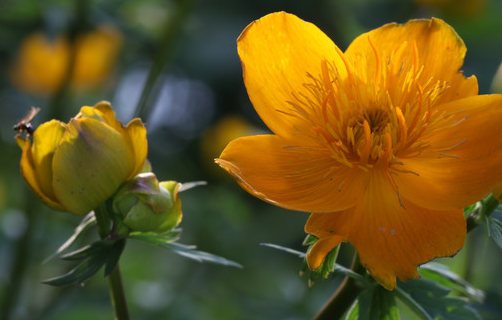
Globeflower has relatively high requirements for soil. When choosing soil, select sandy loam rich in organic matter. If possible, it is best to test the pH of the soil. If the pH is between 5-6, that is best. Also, add some organic fertilizer to the soil as a base fertilizer, so that the soil is more fertile and more conducive to the plant's growth.
Temperature
Globeflower does not much like a warm environment; it likes to grow in a relatively low-temperature environment. Its most suitable growing environment is between 10°C and 15°C. But in winter, the temperature is too low, so even though globeflower is relatively cold-tolerant, it still needs to be moved indoors for care.
Watering
Globeflower is relatively strict about watering, because it likes a moist environment, so the soil must always be kept moist as well as the environment around the plant. But do not overwater, otherwise the plant's root system will rot.
Fertilizing
For globeflower seedlings, fertilize once every ten days. After that, reduce fertilizing as much as possible; you can apply water-soluble fertilizer about once every 20 days. However, we should note that before globeflower blooms, apply fertilizer water once every 7-10 days so the flowers bloom more vividly. But too much fertilizer can burn the seedlings, so pay attention to this point.
How to grow Nymphoides indica? Cultivation methods for Nymphoides indica
Nymphoides indica is a perennial floating-leaf herbaceous plant. It has very strong adaptability to the environment and is also very suitable for ornamental use. Below, follow the editor of wed114 wedding website to see how to grow Nymphoides indica. We will introduce this plant and the cultivation methods for Nymphoides indica.
Introduction to Nymphoides indica
Nymphoides indica (scientific name: Nymphoides indica (L.) O. Kuntze): perennial aquatic herb. Stem cylindrical, unbranched, shaped like a petiole, with a single leaf at the top. Leaves floating, nearly leathery, broadly ovate or nearly circular, densely glandular beneath, base heart-shaped, margin entire, with rather inconspicuous palmate veins, petiole short, cylindrical. Flowers numerous, clustered at the nodes, flower pedicels slender, cylindrical, unequal in length, divided nearly to the base, lobes oblong-lanceolate, apex obtuse, veins inconspicuous; corolla white, yellow at the base, divided nearly to the base, corolla tube short, lobes ovate-elliptic, apex obtuse, densely covered on the ventral surface with fringed long soft hairs. Capsule elliptic, flowering and fruiting period August-October.
Nymphoides indica occurs at altitudes of 50-1530 m and is widely distributed in tropical to temperate regions of the world. It is distributed in Northeast China, East China, South China, Hebei, and Yunnan.
1. Morphological characteristics
Stem: Nymphoides indica is a perennial aquatic herb. The stem is cylindrical, unbranched, shaped like a petiole, with a single leaf at the top.
Leaves: The leaves of Nymphoides indica float, are nearly leathery, broadly ovate or nearly circular, 3-18 cm long, densely glandular beneath, base heart-shaped, margin entire, with rather inconspicuous palmate veins, petiole short, cylindrical, 1-2 cm long.
Flowers: The flowers of Nymphoides indica are numerous, clustered at the nodes, 5-merous; pedicels slender, cylindrical, unequal in length, 3-5 cm long; calyx 3-6 mm long, divided nearly to the base, lobes oblong-lanceolate, apex obtuse, veins inconspicuous; corolla white, yellow at the base, 7-12 mm long, 6-8 mm in diameter, divided nearly to the base, corolla tube short, with 5 bundles of long soft hairs, lobes ovate-elliptic, apex obtuse, densely covered on the ventral surface with fringed long soft hairs; stamens inserted on the corolla tube, regular, filaments short, flattened, linear, 1.5-1.7 mm long, anthers arrow-shaped, 2-2.2 mm long; ovary sessile, conical, 2 mm long, style stout, cylindrical, about 2.5 mm long, stigma swollen, 2-lobed, lobes triangular.
Fruit: The capsule of Nymphoides indica is elliptic, 3-5 mm long, indehiscent; seeds swollen, brown, nearly spherical, 1.2-1.5 mm long, smooth. Chromosome number 2n=18. The flowering and fruiting period of Nymphoides indica is August-October.
2. Ecological habits
Nymphoides indica likes a warm and humid climate environment. The optimum temperature for plant growth and development is 20-35°C. When above 40°C or below 15°C, it does not bloom or growth stagnates. It has a relatively wide range of adaptation to acidity and alkalinity. It often lives in lakes, ponds, rivers, and streams.
How to grow Nymphoides indica
1. Cultivation methods
Nymphoides indica is like ordinary aquatic plants and has no special requirements; generally, just keeping the water relatively clean is enough.
1. Pond
A water depth of about 40 cm is relatively suitable; for pot cultivation, a water depth of about 10 cm is enough. Use ordinary pond mud as the substrate; it should not be too fertile, otherwise the branches and leaves flourish but flowers become sparse instead. If the leaves turn yellow, bury a small amount of compound fertilizer or fertilizer tablets in the pot. Usually maintain sufficient sunlight, and the pot must not lack water, otherwise it is also very easy to dry out.
2. Pot cultivation
Depending on the size of the pot and how crowded the plants are, divide the pot once every 2-3 years. In winter, keep water in the pot and place it in a wind-sheltered, sunny spot to overwinter. In northern winters, the temperature is relatively low, so overwintering treatment is needed when cultivating Nymphoides indica.
3. Fertilizing
In order to promote the growth and development of Nymphoides indica plants and improve their ornamental effect, during the growing period of Nymphoides indica plants, promptly remove weeds and debris, keep the water clean, and combine weeding with 1-2 additional fertilizer applications.
2. Propagation methods
Propagation by division and cuttings
For division, in March each year, divide the denser clumps into small pieces and plant them separately; cutting propagation also easily survives. Its nodal stems can all take root. During the growing period, take branches with 2-4 nodes and insert them in shallow water; they root after two weeks. New plants form where the petiole attaches, so asexual propagation is possible, but seeds can also be soaked in water at 22-25°C to promote germination and propagation.
3. Disease and pest control
The main pest of Nymphoides indica is aphids. Spraying with 40% dimethoate emulsifiable concentrate at 1000 times dilution can achieve control results.
How to grow globeflower well
Globeflower is also known as dry lotus, dry lotus flower, etc. Although globeflower's appearance is not very eye-catching, globeflower has certain medicinal value and can clear heat and detoxify. If you are also interested in cultivating globeflower, do not miss the precautions for globeflower cultivation that the editor has compiled for you.
Globeflower
Tropaeolum majus is cultivated throughout the country. It likes a warm, humid, sunny environment, avoids cold (the lowest temperature must not be below 10°C), is slightly drought-tolerant, and has no strict requirements for soil. Propagation is mainly by sowing. In autumn, place newly collected seeds in a dry, ventilated place to dry, and then sow them. You can also select plump, dry seeds in early spring, soak them in warm water at 20 to 30°C for 1 to 2 hours, remove them, and sow.
The seedbed should be shaded and ventilated. Cover with soil just enough to cover the seeds. Young shoots can grow in about a week. It can also be propagated by cuttings. In early summer, select robust, well-filled stems, cut cuttings 10 cm-15 cm long, and insert them into a cutting bed of sandy soil or perlite with good water and air permeability. Pay attention to shading and maintaining air humidity. In about 15 days, they root and produce leaves and can be transplanted.
After transplanting, the seedlings need repeated pinching to prevent leggy growth. This makes the plant full and beautiful in shape. Because Tropaeolum majus is a vine plant, it is relatively easy to shape; it can be trained to a suitable position for shaping. Promptly cut off dry stems, leaves, and spent flowers to facilitate ventilation, reduce nutrient consumption, and also keep it in a graceful form.
During the seedling stage, pay attention to applying more phosphorus and potassium fertilizer. During the growing period, there should be sufficient sunlight, and frequent hoeing and weeding have already improved soil aeration. During the bud stage, apply thin fertilizer frequently. After each pinching, appropriately apply phosphorus and potassium fertilizer to promote abundant flowering on new shoots. Tropaeolum majus leaves resemble lotus leaves, and the calyx base is united into a tube, making the whole flower resemble a dragonfly skimming the water. The bright flowers stand upright among lotus-like leaves, lively and extraordinary, forming a beautiful picture. In landscaping, it is mostly used for greening walls, balconies, and fences, and can also be used to arrange flower beds. It is extremely easy to cultivate and maintain and can self-sow and multiply. Tropaeolum majus is also edible. In the United States, it is treated like chili in China, a food loved by the general public, and its tender stem tips can also be eaten cold with a little seasoning, and its taste is also fresh and delicious.