What are the care precautions for dichondra?
Weed removal
When dichondra is used for lawn greening, since it takes a period of growth to fully cover the ground, weeds will appear. When there are few weeds, they can be pulled out by hand; if there are many weeds, herbicides can be sprayed to kill them.
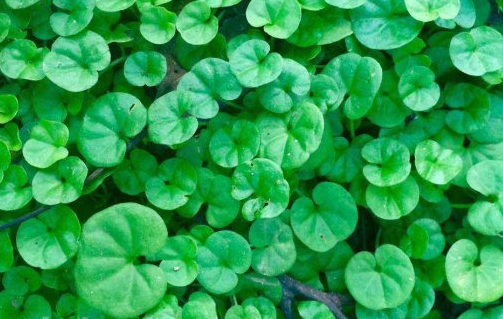
That is all for today. I hope that after learning how to grow dichondra, you can boldly give it a try, and then you will get a pot of lush dichondra.
Dichondra growing methods and precautions
Chinese scientific name: dichondraLatin scientific name: Dichondra repens Forst.Also known as small coin grass, lotus bud grass, meat wonton grass, golden key, copper coin grass, small dichondra, jaundice grassBinomial name: Dichondra repensKingdom: PlantaePhylum: AngiospermsClass: DicotyledoneaeSubclass: SympetalaeOrder: TubifloraeFamily: ConvolvulaceaeSubfamily: ConvolvuloideaeTribe: ConvolvuleaeGenus: DichondraSpecies: Dichondra repensDistribution area: tropical and subtropical regions of both hemispheresDichondra (Dichondra repens Forst.), also known as small coin grass, lotus bud grass, meat wonton grass, golden key, copper coin grass, small dichondra and jaundice grass, is a plant of the genus Dichondra in the family Convolvulaceae. It is distributed in areas south of the Yangtze River in China (including the Taiwan region), and is widely distributed in Guizhou, Guangxi, Fujian, Sichuan, Zhejiang, Hunan and other places. It grows in areas at altitudes of 1300 m to 1980 m, mostly by roadsides, on mountain slopes and grasslands or beside ditches, and has been introduced and cultivated artificially. It is a commonly used herbal medicine among the Miao people for treating hepatitis, with the Miao medicinal name "wobisheliu". It is a perennial creeping herbaceous plant, harvested from April to June. Bitter and pungent in taste, slightly cold in nature, mainly entering the lung meridian and stomach meridian, it has the effects of clearing heat and detoxifying, promoting diuresis and activating blood circulation. It is a Miao folk medicinal material with abundant resources and good development and utilization value.1. Morphological characteristics
Perennial creeping small herb, stems slender, covered with gray short soft hairs, rooting at the nodes. Leaves kidney-shaped to round, 4-25 mm in diameter, apex broadly rounded or slightly emarginate, base broadly heart-shaped, leaf surface slightly hairy, abaxial surface covered with appressed short soft hairs, entire margin; with long petioles, petioles (1.5) 3-5 (6) cm long.Flowers solitary in leaf axils, pedicels shorter than petioles, thread-like; sepals obovate-oblong to spatulate, obtuse, 2-3 mm long, abaxial surface and margins hairy; corolla campanulate, shorter than to slightly longer than the calyx, yellow, deeply 5-lobed, lobes oblong-lanceolate, hairless; stamens 5, inserted at the sinuses between the 2 corolla lobes, filaments short, equal in length; ovary sparsely pilose, 2-locular, with 4 ovules, styles 2, stigmas capitate.
Capsule nearly spherical, small, shorter than the calyx, about 1.5 mm in diameter, membranous. Seeds 1-2, yellow to brown, hairless.
Dichondra growing methods and precautions during the growing process
Dichondra is a plant of the genus Dichondra in the family Convolvulaceae, and is a Miao folk medicinal material with abundant resources. So, would you like to know what cultivation techniques there are for dichondra? Do you want to grow dichondra well? Today, next we will get to know this plant, dichondra.
Dichondra growing methods
Light and temperature
Dichondra needs sufficient light for its growth. It should be exposed to sunlight more every day so that dichondra can grow vigorously and green. Dichondra has a growth habit of both liking light and tolerating shade, and can grow in semi-shady and moist places. It has low requirements for temperature, but it will suffer cold damage when the temperature drops to -6°C to -7°C.
Water and fertilizer management
Dichondra needs regular irrigation and moderate fertilization during its growth process. After the dichondra seedlings emerge, water them 1-2 times a week, and irrigation frequency should be increased in dry seasons. After the plants mature, watering should be controlled in early spring and early winter, and during the peak growth period around the Spring Festival, the number of waterings should be determined according to the soil quality.
Dichondra likes nitrogen fertilizer. Usually, in combination with rain and watering, appropriate amounts of nitrogen fertilizer should be applied as a top dressing. After fertilizing, a large amount of water should be poured to reduce the degree of leaf burn. Alternatively, fertilize first, then sweep the fertilizer under the leaves, and then water. At the same time, fertilization is not allowed during high summer temperatures.
Soil
Dichondra is not very strict about soil requirements. As long as drainage conditions are moderate, it can be planted in both sandy loam and clay.
It mostly grows in fertile fields or mountain areas.
Dichondra care precautions
Weed removal
When dichondra is used for lawn greening, since it takes a period of growth to fully cover the ground, weeds will appear. When there are few weeds, they can be pulled out by hand; if there are many weeds, herbicides can be sprayed to kill them.
Dichondra propagation methods
Dichondra is commonly propagated by seed sowing and division.
Dichondra pest and disease control
Dichondra lawns have strong disease resistance, with only southern blight and a small amount of leaf spot mold disease occurring. Rust disease and
sclerotinia disease may also occur.
The larvae of scarab beetles, white grubs, and the larvae of noctuid moths, armyworms, and black cutworms are the main pests of dichondra lawns. There are also other harmful insects such as snails, the meadow moth, and Atractomorpha sinensis.
The above is the knowledge about herbaceous plants that I have learned today. I hope fellow flower lovers will find this article helpful after reading it. If you want to know more about herbaceous flowers, please continue to follow our Succulent Garden, and we will provide you with more related content as soon as possible!