Detailed Explanation of the Production Method and Steps for Making a Miracle Fruit Bonsai
1. Substrate selection
Miracle fruit requires a fertile, loose substrate with good air permeability and drainage. It is suitable to use mountain soil or garden soil, then add about 1/3 peat, compost, wood chips, and 5% decomposed cake fertilizer, and mix evenly.
2. Potting
The suitable time for potting miracle fruit is between April and August, and it should be potted after its newly emerged leaves have aged. The size of the flower pot is determined by the actual size of the seedling.
3. Placement
The spacing of placement should be appropriately wide, and as the plant grows, the placement distance needs to be continuously adjusted. In addition, it is best to place dry grass in the gaps between pots to help reduce water evaporation from the pots and prevent weed growth.
4. Management and care
For a period after potting, it is sufficient to apply thin fertilizer frequently, applying 0.3% compound fertilizer and the like once every 15-20 days or so.
Do you think the process of making a miracle fruit bonsai is very simple, and that you can make one just by getting started? Then do you know what value your own handmade bonsai has? Below is an introduction to the ornamental value of miracle fruit bonsai.
Miracle Fruit Synsepalum Dulcificum Denill Miracle Fruit Illustrated Guide: How to Grow Miracle Fruit / How to Propagate Miracle Fruit
Miracle Fruit ProfileMiracle Fruit Synsepalum Dulcificum Denill
Miracle Fruit Cultivation Methods and Precautions Introduction to Miracle Fruit
Miracle fruit (scientific name: Synsepalum dulcificum), also known as flavor-changing fruit, belongs to the Sapotaceae family as a perennial dwarf shrub. The flesh of the miracle fruit is sour and astringent, but it contains miraculin. Within half an hour after eating a miracle fruit, if you then eat other acidic fruits, you will feel that these sour fruits are no longer sour but have become sweet, hence the name miracle fruit. In addition, its seeds are large and bitter, its leaves can be brewed as tea, and its tree form is attractive, so it can also be used as a bonsai.
The miracle fruit is also known as dream fruit and miracle berry. Its flesh contains miraculin, which can change people's sense of taste. Within a few hours after eating a miracle fruit, acidic foods taste noticeably sweet. It can be eaten fresh and can also be made into a food aid for acidic foods, or into a sweet flavor-changing agent needed by diabetic patients. The miracle fruit is also an interesting ornamental plant, suitable for planting in the hot, humid subtropical and tropical regions of China. It is a fruit that combines ornamental value and economic value in one.
Morphological Characteristics of Miracle Fruit
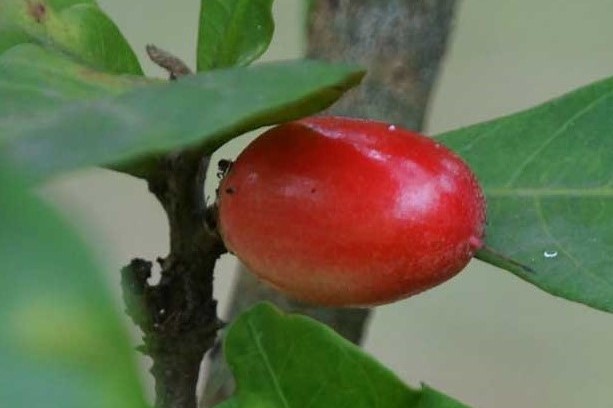
The miracle fruit tree is 2-4 m tall, the fruit is 2 cm long and 8 mm in diameter, the branches and stems are grayish brown, and the branches have irregular net-like grayish-white stripes. The upper leaf surface is fresh green, the lower leaf surface is grass green, and the leaves are pipa-shaped or obovate. The flowers are small, axillary, and white; the fruit is single, oval, and the mature peel is bright red, the flesh is thin, milky white, slightly sweet in taste, with little juice, and 1 brown seed. The fruit matures from July to August. The flesh of the miracle fruit contains miraculin, which can change people's sense of taste. Within a few hours after eating a miracle fruit, acidic foods taste noticeably sweet.
The miracle fruit is a small tree, about 3-4 m tall, and it bears fruit continuously throughout the year. Its fruit is not large, about 2 cm long and about 8 mm in diameter. Peel off the red skin to reveal the white pulp, with only one large seed in the middle. The miracle fruit tree grows in the tropical regions of West Africa. Local residents often use it to adjust the taste of food. It can make sour bread sweet and delicious, and make sour palm wine and beer sweet. After eating sour, spicy, bitter, or salty food, chewing a few miracle fruits immediately turns the taste sweet. The strange miracle fruit truly deserves to be called a fruit with universal flavor-changing ability.
The miracle fruit plant is 1.5-4.5 m tall, with many branches and dense leaves. The tree is shaped like a steamed bun and belongs to low-position sprouting, with strong side-branch sprouting ability. The stems and branches are brown, and the green branches with red tips are uniquely distinctive. The leaves are relatively small, alternate, with low branching and clustered growth, with 5-7 leaves per node, and the color is glossy. The flowers are small, white, and axillary. The flowering period is from February to May, and the fruit ripening period is inconsistent, with peak fruiting periods in March, June, and October. The fruit is small and oval, 2 cm long and 1.2 cm wide. When mature, the fruit is bright red, the flesh is white and juicy, and there is one olive-shaped dark brown seed. Pollination is carried out by insects such as ants.
Evergreen shrub or small tree, 2-3 m tall, with many branches, short and dense, forming a compact crown; obovate leathery leaves are alternate, solitary or clustered in the leaf axils of fruiting branches. The flowers of the miracle fruit are borne on the branches, with two obvious flowering and fruiting periods each year (the first with full bloom in February-March and fruit ripening in April-May, the second with full bloom in April-May and fruit ripening in June-July), and a small number of flowers and fruits appear throughout the year; the small berries have a smooth surface, are green with red when unripe, 0.6 to 1 cm in diameter, like peanut kernels, and are orange-red when mature. The tail end of the fruit has a relatively strong small steel-like hair, and there is only a thin layer of flesh.
Tree shape:
The miracle fruit is an evergreen shrub throughout the year, rarely shedding leaves. The tree height can reach 2-5 m, and growth is slow. When grown in a pot, a four-year-old tree can reach 60-80 cm in height, and the tree shape is slightly spire-like.
Leaves:
The young leaves are light green, and the old leaves are dark green or ink green. The leaf shape is somewhat similar to that of the fine-leaved terminalia, and is oblanceolate or obovate. Most are clustered at the branch tips or alternate on the main trunk. The veins are obvious, the lateral veins are alternate, and the leaf margins are slightly wavy. There are about eight pairs of veins. They can be brewed as tea.
Flowers:
The flowers bloom in the leaf axils. The small white flowers are only 0.65-0.75 cm in diameter. They bloom throughout the year, with a flowering period of 4-6 weeks, and the flowers have a faint coconut milk fragrance.
Fruit:
After flowering, it bears fruit, which is a green oval berry, about 2-3 cm long and about 1 cm in diameter, and turns bright red when mature.
Seeds:
Covered by the flesh, the seed accounts for about one half of the fruit, with slightly pointed ends, like a small olive. The flesh is edible. After the flesh is removed, one half of the seed has a dark brown smooth surface like a sugar apple seed, and the other half is covered by a thin film left by the flesh, which is difficult to remove, hence the name (yin-yang seed).
Ecological Habits of Miracle Fruit
Miracle fruit belongs to the Sapotaceae family as a tropical evergreen shrub, also called flavor-changing fruit. It is native to the West Africa, Ghana, and Congo region. It likes high temperature and high humidity, and the suitable growth temperature is 20-30°C. For field planting, use acidic sandy soil with good drainage, rich organic matter, and a pH value of 4.5-5.8.
Distribution Area of Miracle Fruit
It is native to the tropical regions of West Africa. After being introduced to China in the 1960s, it has been planted in Guangdong, Guangxi, Taiwan, China, Yunnan, Hainan, Fujian, and other places.
The miracle fruit is a typical tropical evergreen shrub, native to the West Africa, Ghana, and Congo region, and has also been found in the jungles of Indonesia. In the 1960s, when Premier Zhou Enlai visited West Africa, the Republic of Ghana gave the miracle fruit to Premier Zhou as a national gift, and Premier Zhou handed it over to the National Tropical Crops Research Institute for cultivation and propagation. Since then, the miracle fruit began to be cultivated in our country. The miracle fruit is a precious plant of national treasure level. Whether in West African countries or in our country, it is protected and export is prohibited. The miracle fruit is not only planted in botanical gardens, but after expanded cultivation, it has also gradually entered the lives of ordinary people.
Landscape Uses of Miracle Fruit
The miracle fruit is also an interesting ornamental plant, suitable for planting in the hot, humid subtropical and tropical regions of our country.
The Mystery and Application of Miracle Fruit The Mysterious Aspects
The hometown of the miracle fruit is in the tropical forests of West Africa. It is a tree and belongs to the Sapotaceae family. Its appearance is very ordinary. The miracle fruit is an oval red fruit, no more than 2 cm long and only a few millimeters in diameter. When cut open, there is nothing mysterious inside except a bit of sweet flesh and a large seed. On the surface, there is nothing mysterious about it. However, as long as you eat a little of this fruit, after about a few hours, your sense of taste completely changes. At this time, whether you eat bitter coptis, chili peppers, or sour lemons, you will feel that all these fruits are no longer bitter, pungent, or sour enough to hurt your teeth, but have become sweet. Isn't this fruit very mysterious?
Why can the miracle fruit change taste? In order to uncover the mystery of the miracle fruit, scientists conducted detailed chemical analysis on this fruit and isolated a glycoprotein that can change the taste of food. This substance itself is not sweet, but its solution can act on the taste bud receptors on the tongue.
It turns out that there are many taste buds on our tongue, which can respectively sense sour, sweet, bitter, spicy, salty, and other tastes. After eating a miracle fruit, the function of the taste bud receptors on the tongue is temporarily disturbed by that glycoprotein. The taste bud receptors sensitive to sourness are temporarily paralyzed and inhibited, while the taste bud receptors sensitive to sweetness become excited and active. We know that no matter which kind of sour fruit, it always contains some fructose, but only because the acidic components are greater than the sweet components, what we perceive is only sourness and no sweetness. However, after eating a miracle fruit, the situation changes, and it can only make you perceive sweetness and not sourness. However, the effect of this glycoprotein is not permanent. It may last as little as half an hour or as long as two hours, and after that period it will lose effectiveness. The effect of the glycoprotein cannot change the sourness of the food itself, but can only change the function of taste on the tongue. The "magic" of the miracle fruit has finally been exposed.
It turns out that this magical plant is the miracle fruit native to tropical Africa. It contains a flavor-changing protease (also called miraculin). Although it cannot truly change the taste of food, it can change people's sense of taste, so after people eat a miracle fruit, any sour food tastes sweet. After eating a miracle fruit, the miraculin in it will be distributed on the taste cell membranes of the tongue. In a neutral pH environment, the sweet receptor protein on the miraculin will not bind to the sweet receptor site, so miraculin does not have a sweet taste. After eating acidic food, because (acid) is present, the structure of the taste cell membranes on the tongue changes. At this time, the sweet receptor protein binds to the sweet receptor site, so a sweet taste is perceived. Miraculin will tightly bind to the surface of the tongue and last for more than 2 hours. Within 1-2 hours after eating a miracle fruit, all acidic foods eaten will taste incomparably sweet. Therefore, the function of the miracle fruit in changing taste is a natural, physical, and safe change, suitable for consumption as an everyday food.
Development and Utilization
Scientists conducted chemical analysis on the miracle fruit and isolated and identified the active substance that causes our temporary taste changes. What does this substance belong to? It belongs to a glycoprotein.
Since the miracle fruit has this benefit, can it help humanity do something good? For example, extract a preparation from the miracle fruit and let diabetic patients take it, which both satisfies their need for sweet food and does not cause physical illness due to excessive sugar. Of course, this is only people's idea, but through effort it may become reality. Some regions in Africa have already established large plantations specifically for growing miracle fruit. A company in West Africa has tried making pills from the fruit, and when eaten, the taste is comparable to fresh miracle fruit.
Now, the Institute of Botany in Yunnan Province of our country has already introduced and planted the miracle fruit. Coincidentally, in Africa there is a plant called forest gymnema. After eating the leaves of this plant, all sweet-tasting things no longer taste sweet.
The miracle fruit can be eaten fresh and can also be made into a food aid for acidic foods, or into a sweet flavor-changing agent needed by diabetic patients. The miracle fruit is also an interesting ornamental plant, suitable for planting in the hot, humid subtropical and tropical regions of our country.
Extracts from the branches and leaves of the miracle fruit tree and their extraction method and application. Crush the branches and leaves of the miracle fruit to obtain the extraction raw material; add ethanol aqueous solution, reflux-extract for 2-5 hours, filter, vacuum-distill the supernatant, freeze-dry, dissolve the dry powder of the crude branch-leaf extract in water, treat with macroporous adsorption resin, then elute with ethanol aqueous solution, and separately vacuum-concentrate the collected liquid and freeze-dry to obtain the refined branch-leaf extract; the obtained extract contains 66.5% total phenols, and the branch extract contains 84.1% total phenols. Its DPPH· scavenging capacity is 7.9 and 7.8 times that of glutathione; its oxygen radical absorbance capacity is 7.0 and 6.2 times that of glutathione; it has good xanthine oxidase inhibitory activity; it can be used to prepare antioxidants, anti-gout drugs, and health products.
If consumers want to take in the abundant vitamin C contained in lemons, but because lemon is strongly sour, they need to add a large amount of sugar water to dilute and reduce the citric acid. They may fear excessive sugar intake and therefore hold back and not dare to eat it. If they eat one miracle fruit, they can turn sour lemon into sweet lemon, and it is incomparably fragrant. After eating, the sweet taste can remain in the mouth for as long as thirty minutes. People who fear taking bitter medicine can first taste one miracle fruit and then take the medicine, and then there will be no unpleasant taste. Therefore, it is called the "magician in the orchard."
The miracle fruit can be eaten fresh and can also be made into a food aid for acidic foods, or into a sweet flavor-changing agent needed by diabetic patients. The miracle fruit is also an interesting ornamental plant, suitable for planting in the hot, humid subtropical and tropical regions of China.
The miracle fruit is a small tree, about 3-4 m tall, and it bears fruit continuously throughout the year. Its fruit is not large, about 2 cm long and about 8 mm in diameter. Peel off the red skin to reveal the white pulp, with only one large seed in the middle. The miracle fruit tree grows in the tropical regions of West Africa. Local residents often use it to adjust the taste of food. It can make sour bread sweet and delicious, and make sour palm wine and beer sweet. After eating sour, spicy, bitter, or salty food, chewing a few miracle fruits immediately turns the taste sweet. The strange miracle fruit truly deserves to be called a fruit with universal flavor-changing ability.
In the food industry, people often use miracle fruit as a flavoring agent. The miracle fruit belongs to the Sapotaceae family as an evergreen small shrub, with an attractive tree shape and lush branches and leaves. It was introduced to our country in the 1960s and has now been cultivated as a garden ornamental plant in many regions; it produces small white flowers every September, bears fruit in October, and in November the fruit changes from green to red and matures.
Recently, a company in West Africa began selling pills made from miracle fruit. The taste of these pills is no different from that of fresh fruit. They can be specially used to regulate people's sense of taste for people to enjoy. The advent of miracle fruit pills has attracted the attention of the medical community. Researchers are trying to extract a preparation from the fruit of the miracle fruit tree for use by diabetic patients, so that patients can eat sweet food without affecting their health due to excessive sugar.
Medicinal or Dietary Therapeutic Value of Miracle Fruit
The medical information and health dietary therapy information on Huahua Network are for reference only and cannot be used as a basis for diagnosis or medical treatment. Any health problems should be consulted with professional medical personnel, and the treatment of any disease should follow medical advice.
Ultimate flower care mission: To love yourself, start from reality and strictly follow medical advice. Toward illness, do not be careless, do not delay, do not give up hope, face it bravely, warm the silent world with love, and care for the flower field in your heart with your heart.
The medical content on Huahua Network is for reference only and cannot be regarded as professional advice. For any health problems, you should consult professional medical personnel.
Medicinal Information (1) Medicinal Effects
Because the fruit contains a special glycoprotein, it can convert highly acidic fruits into sweetness like fine wine and jade dew. Regularly eating ripe fruit raw or concentrated lozenges has the effect of regulating high blood sugar, high blood pressure, high blood lipids, gout, uric acid, headache, and the like, stabilizing them to normal values. Applying the juice to mosquito and insect bites can reduce inflammation and swelling. The seeds can relieve angina, sore throat, hemorrhoids, and the like. Brewing the leaves as tea or using them in cooking can regulate high blood sugar and high blood pressure, protect the heart, beautify and slim the body, detoxify and promote bowel movements, control uric acid, reduce gout pain, and also relieve drunkenness.
Methods of Consumption
Ripe fruit can be eaten raw, made into juice, made into concentrated lozenges, or combined with juice to make sugar-free lemon popsicles (miracle fruit popsicles). The seeds can be eaten raw and made into concentrated lozenges. The leaves are a purely natural plant MSG. They go well with any stewed soup and hot pot, and noodle soup base, making the soup fresh, sweet, and delicious, and nutritious; they can be used to make various flavored braised foods; they can also be brewed as tea, or mixed and brewed with other tea leaves, all of which can let your mouth enjoy an ultimate tea culture experience.
Nutritional Components
The flesh contains rich and peculiar glycoproteins, vitamin C, KI, citric acid, succinic acid, oxalic acid, and the like. The seeds contain natural sterols and the like. The leaves contain trace mineral elements such as sodium, potassium, calcium, and magnesium.
Main Functions
Because the fruit contains a special glycoprotein, it can convert highly acidic fruits into sweetness like fine wine and jade dew. Regularly eating ripe fruit raw or concentrated lozenges has the effect of regulating high blood sugar, high blood pressure, high blood lipids, gout, uric acid, headache, and the like, stabilizing them to normal values. Applying the juice to mosquito and insect bites can reduce inflammation and swelling. The seeds can relieve angina, sore throat, hemorrhoids, and the like. Brewing the leaves as tea or using them in cooking can regulate high blood sugar and high blood pressure, protect the heart, beautify and slim the body, detoxify and promote bowel movements, control uric acid, reduce gout pain, and also relieve drunkenness.
Principle of Taste Change When Eaten
Why can the miracle fruit turn sourness into sweetness? Scientists have learned through experimental analysis that the miracle fruit contains a flavor-changing protein, also called miraculin. This protein itself is not sweet and cannot change the sourness of the food itself, but it can act on the taste bud receptors on the tongue, thereby changing taste. After eating a miracle fruit, miraculin will be distributed on the taste bud cells on the tongue. In a neutral pH environment, the sweet receptor protein on miraculin will not bind to the sweet receptor site, so miraculin does not have a sweet taste; after eating acidic food, because of the presence of acid, the structure of the taste cell membranes on the tongue changes. At this time, the sweet receptor protein binds to the sweet receptor site, producing a sweet sensation. The flavor-changing protein contained in the miracle fruit does not act permanently. It may last as little as half an hour or as long as two hours, and after that period it will lose effectiveness. Therefore, to let the miracle fruit effectively exert its flavor-changing effect, it is suitable to eat it about half an hour before eating acidic food.
Dietary Effects
1) Methods of consumption: Ripe fruit can be eaten raw, made into juice, made into concentrated lozenges, or combined with juice to make sugar-free lemon popsicles (miracle fruit popsicles). The seeds can be eaten raw and made into concentrated lozenges.
2) Nutritional components: The flesh contains rich and peculiar glycoproteins, vitamin C, KI, citric acid, succinic acid, oxalic acid, and the like. The seeds contain natural sterols and the like. The leaves contain trace mineral elements such as sodium, potassium, calcium, and magnesium.
3) Main functions: Because the fruit contains a special glycoprotein, it can convert highly acidic fruits into sweetness like fine wine and jade dew. Regularly eating ripe fruit raw or concentrated lozenges has the effect of regulating high blood sugar, high blood pressure, high blood lipids, gout, uric acid, headache, and the like, stabilizing them to normal values. Applying the juice to mosquito and insect bites can reduce inflammation and swelling. The seeds can relieve angina, sore throat, hemorrhoids, and the like.
Cultivation Techniques of Miracle Fruit Artificial Cultivation Techniques
The wonderful effects of the miracle fruit have attracted people's attention and led to development and utilization.
The miracle fruit is propagated by seeds, cuttings, air layering, and other methods, mainly by sowing. It can be sown by dibbling, broadcasting, or drilling. Seeds should be sown as collected, not exposed to the sun or stored for a long time. The seeds should be about 2 cm in the soil, and the germination rate can reach 100%. When the seedlings grow to about 5 cm and have 4-5 true leaves, they can be transplanted. During the seedling stage, fertilizer and water management should be strengthened and appropriate shade should be provided. The miracle fruit grows slowly. Generally, it flowers and bears fruit only 3-4 years after planting. Using vegetative propagation can advance fruiting by 1-2 years and can dwarf the tree shape to improve ornamental value.
The miracle fruit is suitable for close planting, with a planting distance of 1.5-3 m. It is suitable to plant in low-lying land or gently sloping land with good drainage and relatively high organic matter content. The miracle fruit requires relatively high temperature and humidity conditions and is suitable for growth in humid tropical and subtropical areas at altitude, but it still has a certain degree of drought resistance and cold resistance. When the lowest winter temperature is 3-5°C, it will cause cold damage to young branches and leaves, but it will not be fatal. It can overwinter safely at 8-10°C.
Disease and Pest Control of Miracle Fruit
The main pests of miracle fruit include round scale insects, cottony cushion scale, green stink bugs, and the like, mostly concentrated during the flowering period. They should be controlled promptly when flower buds form.
Miracle Fruit Pictures
How to Make an Absorbent Stone Bonsai
How to Make an Absorbent Stone Bonsai
1. What is absorbent stone?
Absorbent stone, also known as water-absorbing stone, living stone, and Lingshan stone, is divided into two types: sandy sedimentary stone and limestone. Sandy sedimentary stone is loose and brittle, but has strong water absorption; limestone has slightly higher hardness and a structure finer and denser than sandy sedimentary stone. Absorbent stone is a fossil of ancient bryozoans, dating back about 130 million to 190 million years, and fossils of leaves, insects, and the like can be seen on the surface. The stone is yellow, brown, white, and other colors, with a beautiful and varied appearance. Most are tubular, hollow, striped, unique, and of superior quality.
This stone has extremely strong water-absorbing performance. After water is stored in the basin, the water will be quickly absorbed by the holes in the stone to the top, making the entire bonsai give off a moist feeling. Watering the absorbent stone bonsai every morning is a happy thing, and you will hear the absorbent stone "gulp gulp" drinking water. The absorbent stone is a kind of living stone, a magical stone!
2. What are the uses of absorbent stone?
(1) Absorbent stone bonsai is a natural humidifier
Dry indoor air always makes people feel very uncomfortable, and symptoms such as internal heat, sore throat, and various respiratory conditions appear one after another. As a result, humidifiers that regulate indoor air humidity are especially popular. Here is another kind of "humidifier" recommended to you, and it is a pure natural, green, and environmentally friendly product. It is the "absorbent stone bonsai."
These magical natural "humidifiers" are taken from the natural environment, and the material is also purely natural. The artificially carved part is limited to shaping its form. By carefully comparing, you can discover the charm of this "real mountain" absorbent stone, because although other "fake mountains" try their best to imitate the soil quality of mountains in color, their surfaces are hardened, while the brownish-red or earthy yellow and orange-yellow absorbent stone "real mountain" bonsai has a texture with many "holes," looking a bit like a dried piece of bread, very fluffy. It is precisely these dense "holes" that play a role similar to atomizers and humidifiers. Place such an absorbent stone "real mountain" in a specially made basin filled with water, and the water is naturally "drawn" up to the stone surface by the holes in the stone, and the entire absorbent stone "real mountain" then gives off a rich, moist feeling.
In the basin where the absorbent stone is placed, you can also keep a few goldfish, adding a lively atmosphere to the entire room. If a small water pump is added to the basin, the water-absorbing capacity of the entire absorbent stone bonsai is greatly enhanced, and water continuously falls in a waterfall shape from above the "real mountain," accompanied by faint water mist, beautiful beyond description.
(2) Absorbent stone is a living bonsai
Absorbent stone is easy to shape, loose and brittle, and can be freely chiseled with grooves and holes to carve an ideal-shaped rockery in your mind. Because absorbent stone has strong water absorption, it is easy for moss to grow. Fill the holes in the absorbent stone with soil and plant flowers, grasses, and trees such as pearl grass, asparagus fern, spider plant, cyclamen, miniature coconut, jade plant, lucky fruit, ferns... Without watering and management, they can grow luxuriantly and bloom brightly, dazzling the eyes and inspiring admiration.
In addition to the rich green plants, the absorbent stone "real mountain" bonsai also has many charming "small accessories." These small accessories include small bridges with a strong classical style, a pair of elegant cranes, a lonely and noble old fisherman, transcendent and unrestrained old men playing chess, carved and painted mountain pavilions... It is simply a "condensed" green mountain, instantly making people feel as if they have traveled through time and returned to ancient times. If a few goldfish are also kept in the water at the foot of the mountain, there is even more lively sentiment. Of course, these small accessories are not all classical in style. Some simple and lovely small wooden houses, pastoral wooden waterwheels, continuously rotating marble water balls symbolizing "rolling wealth," can all be set up according to your own preferences to make a beautiful absorbent stone bonsai.
3. How should the absorbent stone bonsai be placed?
(1) Absorbent stone integrates modern electronic technology and traditional bonsai craftsmanship. It has effects such as regulating indoor air humidity and temperature, sterilization, and purification. At the same time, under the setting off of lighting and water mist, the rockery bonsai forms a wonderful and mysterious real picture scene; it is widely used in hotels, office buildings, homes, air-conditioned rooms, beauty salons, entertainment venues, and other places, and is a precious gift for auspicious days, celebrations, and giving to relatives and friends.
(2) Imagine placing such a pot beside your computer, watching the blue waves and flowing water, listening to the echoing sounds of nature, small bridges and households, green mountains and ancient trees, with beautiful scenery all within close reach. Isn't it both soothing to the mind and pleasing to the eye, transcendent and unrestrained?
4. Which plants are suitable for growing in the absorbent stone in a bonsai?
(1) Centella
Also known as coin grass and ground coin grass. It is a perennial evergreen small herb of the Apiaceae family, with slender and weak stems, creeping on the ground, producing leaves and roots at the nodes. The leaves are kidney-round, with shallow lobes and round teeth on the edges, glossy on the upper side. When planted on rockery and hanging down, it is full of pictorial charm.
(2) Strawberry geranium
Also known as golden-thread lotus leaf. It belongs to the Saxifragaceae family and is a perennial evergreen herb. The leaves are simple, clustered at the base, with long petioles. The creeping stems are slender and thread-like, purplish red, and seedlings can grow at the ends of the branches. It can creep on soil, stones, and in stone crevices, and is even better on stones by the water.
(3) Maidenhair fern
Also known as iron-wire grass. It belongs to the Adiantaceae family and is a perennial herb. The petioles are slender and long, glossy, nearly black. The leaf blade is ovate-triangular, 10-25 cm long, bipinnate below the middle, with small leaflets alternate.
(4) Pearlwort
It is a 1-year or 2-year small herbaceous plant of the Caryophyllaceae family. The stems are mostly clustered, slightly spreading, the leaves are opposite and linear, slightly forming a short sheath at the base, and small white flowers bloom in spring. It grows on field roadsides, grasslands, or mountain areas.
(5) Wood sorrel
Also known as sour grass. It belongs to the Oxalidaceae family and is a perennial herb. The stems and leaves contain oxalic acid and have a sour taste. The compound leaves are obcordate, united into one large leaf, bright green, opening by day and closing at night. The stems are soft and prone to lodging. The flowers are white, yellow, red, and other colors.
(6) Acorus gramineus
Araceae. It resembles acorus but is shorter, with linear leaves and inconspicuous main veins. It is produced in various places south of the Yangtze River in our country, mostly growing in mountain stream water-stone crevices or among flowing water and gravel in mountain gullies.
(7) Selaginella uncinata
Also known as blue ground cypress. It is a fern of the Selaginellaceae family. The herbaceous stems are soft and slender, creeping, and can root everywhere. The leaves are loosely arranged on the main stem and densely arranged on the side branches, and the leaf surface has a emerald-blue luster. It is produced in all southeastern provinces of our country.
(8) Woody plants
These include Sageretia, Serissa, five-needle pine, small-leaved podocarpus, true cypress, yew, golden larch, ground cypress, velvet cypress, tiger thorn, large-leaved privet, azalea, common box, elm, and the like.