Sowing Methods and Key Technical Points for Shell Ginger
Sowing time
Shell ginger can generally be sown at any time except summer, but the best seasons are autumn and winter. However, winter temperatures are low, so warmth must be provided; for example, the shell ginger can be placed in a greenhouse.
Sowing methods
1. First, select a fertile, sandy plot with good drainage, close to a water source, and facing the sun. This kind of soil is best if slightly acidic. Generally, sowing propagation is chosen because a very large number of seedlings is needed and the area required is very large. The greatest advantage of sowing propagation is large-scale, high-quantity seedling emergence, so when choosing land, choose a plot with a large area.
2. After selecting the land, preparation must be carried out. This preparation is generally done one month before sowing. First, we need to turn the soil to a depth of about 25 cm. Second, after turning the soil, we need to remove the weeds on the soil and level the land. We also need to fertilize the land so that it absorbs enough nutrients. Generally, fertilization can be done during soil turning by mixing the fertilizer directly into the soil.
3. Put the seeds into warm water at about 50 degrees to soak. When the water cools, heat it again; when it cools again, heat it again. Repeat three times. Pinch the seeds; once they become soft, it is ready.
4. Sow on a raised bed. The distance between sown seeds should be 20 cm or greater. Each sowing hole can hold about 20 seeds, and cover with 2 cm of soil on top. If conditions permit, fired soil ash can be used as the surface covering soil.
What is the difference between shell ginger and Amomum villosum? How is shell ginger planted?
Hearing the name shell ginger, one might think it is ginger produced in Yanshan, but in fact it has nothing to do with ginger. Its inflorescence is panicle-shaped and noticeably drooping, and the flowers are white with pink tips, looking very beautiful and suitable for ornamental use. Below, the editor will introduce its planting methods, and friends who like it can plant it themselves.
What is the difference between shell ginger and Amomum villosum?
1. Shape characteristics
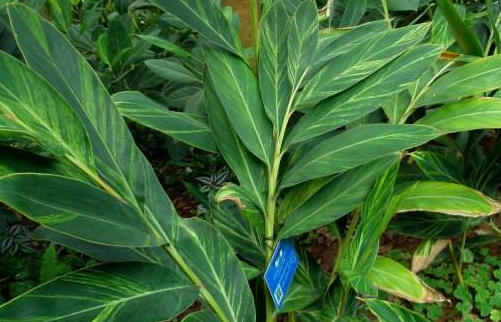
Shell ginger can reach 3 m in height. Its leaves are lanceolate, gradually narrowed at the base, with short soft hairs along the edges, and hairless on both sides; the panicle is raceme-like and drooping, the inflorescence axis is purplish red, the branches are extremely short, the bracteoles are elliptical, white, with pink tips, wrapping the flower in bud, the lobes are oblong, milky white, with pink tips, the lip is spoon-shaped and broadly ovate, and the ovary is covered with golden-yellow coarse hairs; the seeds are angular.
Amomum villosum reaches 1.5-3 m in height, with scattered stems; the rhizome creeps along the ground and is covered with brown membranous scales at the nodes. The rhizome is thick and brownish red. The seed mass is divided into 3 lobes, with 5-9 seeds per lobe. The seeds are aromatic and pungent in smell, used as a spice, slightly spicy, with a flavor resembling camphor.
2. Growth habits
Shell ginger is not cold-tolerant and can generally only tolerate temperatures around 8°C. When the temperature drops to around 10°C, wrap the plant well with paper, then put a plastic film bag over it, and keep it indoors to overwinter. If planted in the ground, it must be planted in a sunny, wind-sheltered spot, and it can resist mild frost. After the Start of Winter, the leaf clump can be cut off, and the roots covered well with dry grass to avoid severe frost damaging the roots. In this way, in the following spring, more new shoots will sprout from the roots, forming a large clump. In northern regions, it can overwinter safely as long as it is kept indoors.
Amomum villosum is cultivated or grows wild in shady, damp mountain areas. Amomum villosum var. xanthioides grows in damp places under forests at an altitude of 600-800 m; dwarf Amomum villosum grows in shady, damp places under forests at an altitude of 200 m.
How is shell ginger planted?
1. Choose a fertile, sandy plot with smooth drainage, close to a water source, and facing the sun, preferably slightly acidic land. Generally, the advantage of raising seedlings by sowing is that seedlings can emerge over a large area, so a relatively large sandy plot can be chosen.
2. After choosing the land, prepare it one month in advance. Turn the soil to a depth of 25 cm, remove impurities and level it, and add an appropriate amount of base fertilizer to supplement fertility. When deep turning, mix it directly into the soil.
Build raised beds for seedling raising. Prepare a raised bed 1 m wide and 25 cm high, with 30 cm between each row, and adjust the bed surface to be level.
3. Put the seeds into warm water at about 50 degrees to soak. When the water cools, heat it again; when it cools, heat it again. Repeat three times. Pinch the seeds; once they become soft, it is ready.
4. Sow on a raised bed. The distance between sown seeds should be 20 cm or greater. Each sowing hole can hold about 20 seeds, and cover with 2 cm of soil on top. If conditions permit, fired soil ash can be used as the surface covering soil.
5. After sowing the seeds, cover them with a straw mat. Soak the entire raised bed with water until the soil is thoroughly wet. Afterward, the timing of watering should be determined according to the moisture level of the soil. Sprouting can occur in about 20 days to one month. After that, strengthen the management of water and fertilizer.
Can shell ginger be eaten?
Shell ginger not only has good medicinal value, it can also be eaten. In the early period, the Siraya and Makatao people among the Pingpu groups of Taiwan's indigenous peoples used it to wrap zongzi. Residents of southern Taiwan, China also call shell ginger "meat zongzi leaf." It was also used to line traditional rice cakes and mochi, and its taste is not similar to bamboo leaves. The tender stems can be used as a substitute for ginger. In addition, in Luzhou, Sichuan, as well as parts of Chongqing and Guizhou, shell ginger leaves are used to wrap huangba.
The effects and functions of shell ginger
1. Shell ginger treats constipation
Shell ginger is also divided into several types, among which Chunsha is the one with relatively better quality. Shell ginger can help digestion. Adding a little shell ginger to dishes can not only enhance aroma and freshness, but also increase appetite. Shell ginger can promote bowel movement and treat constipation. People with constipation may want to eat more shell ginger to regulate the body, and pairing it with high-fiber ingredients can further help treat constipation. Shell ginger can also be mixed with honey and drunk. If constipation is very severe, one may try this method for regulation.
2. Shell ginger stimulates appetite and strengthens the spleen
Shell ginger is recorded in many medical classics. Shell ginger is beneficial to the human stomach and kidneys, helps restore the qi of the stomach and kidneys, improves stomach bloating, regulates stomach discomfort, and strengthens the spleen and stomach. Whenever there is abdominal bloating or no desire to eat, shell ginger can be used for regulation, helping improve stomach discomfort and address conditions such as lack of appetite or vomiting. Friends who want to supplement qi and nourish their appearance may want to try the ingredient Chunyan shell ginger, and use it with pork ribs to make soup, which is most suitable for regulating the body.
This plant is not only beautiful, but also edible, and even more so has medicinal value. It truly is a treasure all over. In particular, it has the effect of stimulating appetite and strengthening the spleen. When appetite is poor, adding a little shell ginger to ingredients can instantly increase appetite, and when the stomach and intestines are uncomfortable, drinking shell ginger soaked with honey can have a very good regulating effect.
The effects, functions, and contraindications of shell ginger; how to eat shell ginger
Shell ginger is not only beautiful in appearance and highly ornamental, but is also a Chinese medicinal material. Its tubers can be used as medicine, with prominent medicinal properties and good effects on treating some conditions. But many people do not know exactly what effects shell ginger has. Below, the editor will introduce in detail the medicinal value and edible methods of shell ginger for everyone.
The effects, functions, and contraindications of shell ginger
1. The effect and function of shell ginger in treating constipation
Shell ginger is also divided into several types, among which Chunsha is the one with relatively better quality. Shell ginger can help digestion. Adding a little shell ginger to dishes can not only enhance aroma and freshness, but also increase appetite. Shell ginger can promote bowel movement and treat constipation. People with constipation may want to eat more shell ginger to regulate the body, and pairing it with high-fiber ingredients can further help treat constipation. Shell ginger can also be mixed with honey and drunk. If constipation is very severe, one may try this method for regulation.
2. The effect and function of shell ginger in stimulating appetite and strengthening the spleen
Shell ginger is recorded in many medical classics. Shell ginger is beneficial to the human stomach and kidneys, helps restore the qi of the stomach and kidneys, improves stomach bloating, regulates stomach discomfort, and strengthens the spleen and stomach. Whenever there is abdominal bloating or no desire to eat, shell ginger can be used for regulation, helping improve stomach discomfort and address conditions such as lack of appetite or vomiting. Friends who want to supplement qi and nourish their appearance may want to try the ingredient Chunyan shell ginger, and use it with pork ribs to make soup, which is most suitable for regulating the body.
Contraindications: no known dietary contraindications.
How to eat shell ginger
Shell ginger not only has good medicinal value, it can also be eaten. In the early period, the Siraya and Makatao people among the Pingpu groups of Taiwan's indigenous peoples used it to wrap zongzi. Residents of southern Taiwan, China also call shell ginger "meat zongzi leaf." It was also used to line traditional rice cakes and mochi, and its taste is not similar to bamboo leaves. The tender stems can be used as a substitute for ginger. In addition, in Luzhou, Sichuan, as well as parts of Chongqing and Guizhou, shell ginger leaves are used to wrap huangba.
Main values
1. Landscaping value
Variegated shell ginger has broad leaves and dazzling, charming colors, making it an excellent foliage plant. Set off beneath wax stones, it gives a sense of full vitality. Planted beside a stream or under tree shade, it can also give people the joy of returning to nature and enjoying wild charm.
2. Edible value
In the early period, the Siraya and Makatao people among the Pingpu groups of Taiwan's indigenous peoples used it to wrap zongzi. Residents of southern Taiwan, China also call shell ginger "meat zongzi leaf." It was also used to line traditional rice cakes and mochi, and its taste is not similar to bamboo leaves. The tender stems can be used as a substitute for ginger. In addition, in Luzhou, Sichuan, as well as parts of Chongqing and Guizhou, shell ginger leaves are used to wrap huangba.
3. Making woven products
The Paiwan and Rukai peoples of Taiwan's indigenous peoples used the stem-like leaf sheaths of shell ginger, harvested and dried before the flowering period, and extracted fibers to weave into woven products such as ropes, storage baskets, trays, baskets, cool mats, or straw mats. Fishermen of Beifang'ao wove them into large ropes to tie iron anchors.
How is shell ginger planted?
1. Choose a fertile, sandy plot with smooth drainage, close to a water source, and facing the sun, preferably slightly acidic land. Generally, the advantage of raising seedlings by sowing is that seedlings can emerge over a large area, so a relatively large sandy plot can be chosen.
2. After choosing the land, prepare it one month in advance. Turn the soil to a depth of 25 cm, remove impurities and level it, and add an appropriate amount of base fertilizer to supplement fertility. When deep turning, mix it directly into the soil.
Build raised beds for seedling raising. Prepare a raised bed 1 m wide and 25 cm high, with 30 cm between each row, and adjust the bed surface to be level.
3. Put the seeds into warm water at about 50 degrees to soak. When the water cools, heat it again; when it cools, heat it again. Repeat three times. Pinch the seeds; once they become soft, it is ready.
The above is a summary by the editor of the effects and eating methods of shell ginger, and I hope it can be helpful to everyone! Shell ginger is truly a treasure. It is a green plant with extremely high ornamental value, and it also has certain medicinal value and can treat some diseases. In some places, there is even a custom of using shell ginger as a spice, and cooking delicious dishes is always inseparable from its assistance.