How to grow Musella lasiocarpa and things to note
Temperature
Musella lasiocarpa likes to grow in a warm environment, so in winter you need to keep the plant warm to prevent frost damage, as its cold tolerance is rather poor.
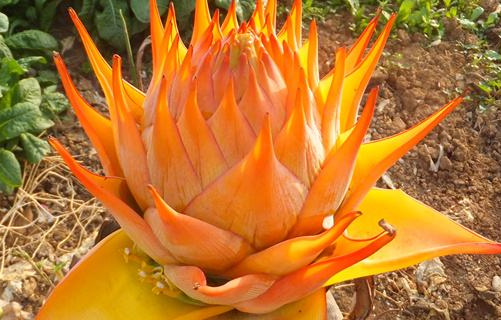
Light
Musella lasiocarpa is very fond of sunlight, and during the growing season it needs to receive enough light to grow healthily. Note that in summer the sunlight is too intense, so at this time do not let the plant be directly exposed to the sun; give the plant some shade, otherwise it will be scorched. If the temperature drops below 10°C, then the plant should be moved indoors for care, but place it in a spot where it can receive diffused light.
Soil
Musella lasiocarpa does have certain requirements for soil; it likes soil that is loose, fertile, airy and well-draining. This kind of soil can be mixed yourself, or if you find that troublesome, you can buy it at a flower shop.
Fertilizing
Musella lasiocarpa rather likes fertile soil, so it also rather likes fertilizer. Compost and barnyard manure are suitable fertilizers; fertilize at the root zone in early spring. In addition, superphosphate, plant ash, rice bran and other fertilizers should also be applied in small amounts. In late autumn, apply well-rotted organic fertilizer.
The above is an introduction to the question of how to grow Musella lasiocarpa. Below, let us look at what else needs attention with Musella lasiocarpa.
Musella lasiocarpa Musella lasiocarpa Illustrated Guide: How to grow Musella lasiocarpa / How to propagate Musella lasiocarpa
Musella lasiocarpa ProfileMusella lasiocarpa Musella lasiocarpa
How to grow Musella lasiocarpa and things to note: An introduction to Musella lasiocarpa
Musella lasiocarpa (scientific name: Musella lasiocarpa) is a perennial herbaceous plant of the genus Musella in the family Musaceae, commonly known as the thousand-petal lotus, golden lotus, and undefeated golden steel; it is a kind of ornamental banana, a perennial herbaceous plant of the genus Musella in the family Musaceae, native to central to western Yunnan Province, China. It was introduced to Taiwan, China in 1996 and is a specialty flower of our country. It flowers before leafing out; the corolla is like a golden lotus surging up from the ground, huge, brilliant and wondrously beautiful, as if from the realm of immortals, leaving people unable to do anything but marvel and be captivated. The true small flowers in the leaf axils of the pseudostem are fragrant and delicate, alternating yellow and green, adding yet another touch of exquisite beauty, and the flowering period lasts as long as half a year. Musella lasiocarpa is designated by Buddhist monasteries as one of the "Five Trees and Six Flowers," and is also an embodiment of goodness and a symbol of punishing evil in Dai literature. People in Yunnan also use its stem juice to sober up and detoxify, and to make hemostatic medicine, which can treat leukorrhea, flooding and spotting, and bloody stool. The tropical conservatory of the Beijing Botanical Garden has now introduced and cultivated this beautiful plant.
Morphological characteristics of Musella lasiocarpa
It grows creeping stems, some of which are pseudostems; the leaf surface is large, like banana leaves; the flowers are huge, with the inflorescence emerging from the pseudobulb, shaped like petal-like large yellow bracts, with six bracts forming one whorl, terminal or axillary, arranged in a rosette above the inflorescence, gradually opening layer by layer from top to bottom, and the flowering period is long without withering, about 250 days. The plant has straight stems, and the tiny flowers inside the bracts are the true flowers, beautiful and glossy, visible only when the bracts open. The flowers at the lower part of the inflorescence are female flowers, and those at the upper part are male flowers.
Musella (Franch.) C. Y. Wu ex H. W. Li, the genus Musella, family Musaceae, contains only one species, Musella lasiocarpa (Franch.) C. Y. Wu ex H. W. Li, produced in central to western Yunnan, China. It is a perennial clumping herb, with a short pseudostem not swollen at the base; leaves large, long-elliptic; inflorescence erect, growing directly on the pseudostem, densely clustered into a globose spike; bracts yellow, persistent, the flowers in the lower bracts being bisexual or female, and the flowers in the upper bracts being male; tepals connate, the free tepals slightly concave at the apex; stamens 5; ovary 3-locular, ovules numerous; fruit a berry.
Ecological habits of Musella lasiocarpa
Musella lasiocarpa is native to central Yunnan, China. It likes a warm environment and is not cold-tolerant, but in the middle and lower reaches of the Yangtze River it can still overwinter in the open ground with a little protection. In winter it is pink, and in summer it turns grassy green and glossy, giving off a sweet floral fragrance. It likes sufficient sunlight and warmth, and requires a humid summer and a slightly dry winter and spring climate. The soil should be well-draining, fertile and loose, which is best for plant growth. It likes fertile, loose soil. It is easy to transplant. At low temperatures below 0°C, the aboveground parts will be damaged by freezing.
Growth type: herbaceous (perennial root flower).
Distribution regions and suitable areas of Musella lasiocarpa: Southwest China
Origin and distribution: Native to Yunnan Province, China, and also distributed in Sichuan Province; it is a specialty flower of China. Musella lasiocarpa is cultivated especially abundantly in Xishuangbanna, and in northern regions it is only suitable for pot cultivation.
Musella lasiocarpa is cultivated especially abundantly in Xishuangbanna, because the Dai people in that region universally believe in Theravada Buddhism, and almost every village has a Buddhist monastery. Musella lasiocarpa is designated by Buddhist monasteries as one of the "Five Trees and Six Flowers" (that is, the five kinds of trees and six kinds of flowers that Buddhist scriptures stipulate must be planted in monasteries), so it is widely cultivated. In the rich and brilliant literature of the Dai people, Musella lasiocarpa appears often as an embodiment of goodness and a symbol of punishing evil.
Landscape uses and ornamental characteristics of Musella lasiocarpa
Musella lasiocarpa, also known as the thousand-petal lotus, is native to Yunnan Province, China, and also distributed in Sichuan Province; it is a specialty flower of China. Musella lasiocarpa grows in clumps, and the plant is short, generally under 1 m tall. The aboveground part is formed by leaf sheaths overlapping layer upon layer and arranged in a spiral, like a tree trunk, and is called a pseudostem. The leaves are deep green, long-elliptic, sharply pointed at the apex, shaped like banana leaves, about 50 cm long and up to 20 cm wide. The ornamental flowering period is relatively long, reaching about 250 days; six bracts form one whorl, terminal or axillary, glittering golden, shaped like petals, gradually opening layer by layer from bottom to top, able to remain unwithered for a relatively long time, and bright, beautiful and glossy, exactly like a blooming lotus, while the true flowers are fragrant, tender and tiny, alternating yellow and green, hidden inside the bracts and revealed only when the bracts open; also, because its pseudostem is short and stout, and it flowers before leafing out, suddenly surging out from the ground and quietly blooming when it flowers in early spring, astonishing people, it is called Musella lasiocarpa. Flowers mostly win by beauty, fragrance or color, but Musella lasiocarpa overwhelms all other flowers with its strangeness. It not only has a huge and wondrously beautiful corolla, but also has something even more striking: when it grows vigorously, it can also produce many small flowers in the leaf axils of the pseudostem, forming the wondrous spectacle of "many stars surrounding the moon."
Landscape uses
Indoor pot cultivation; flowerbed flowers can be planted at the center of a flowerbed, or arranged with rocks to form a scene, or planted in front of a window or in a corner.
Medicinal or dietary therapeutic value of Musella lasiocarpa
The medical information and health dietary therapy information on Huhua Network is for reference only and cannot be used as a basis for diagnosis or medical treatment. For any health problem, consult professional medical personnel, and for the treatment of any disease, follow medical advice.
The ultimate flower-protecting mission: to love yourself, start from reality and strictly follow medical advice. For illness, do not be careless, do not delay, do not give up hope; face it bravely, warm the silent world with love, and care for the flower field within your heart with your heart.
The medical content on Huhua Network is for reference only and cannot be regarded as professional advice. For any health problem, consult professional medical personnel.
Medicinal information (1)
[Chinese name] Musella lasiocarpa, golden lotus, dilian
[Chinese pinyin] Diyongjinlian
[English name] Hairyfruit Musella
[Latin scientific name] Musella lasiocarpa (Fr.) C. Y. Wu ex H. W. Li
[Family and genus classification] Musaceae, Musella
[Plant morphology] Perennial clumping herb, with horizontal rhizomes. Pseudostem short, less than 60 cm tall, about 15 cm in basal diameter, not swollen at the base, with persistent leaf sheaths. Leaf blades long-elliptic, up to 0.5 m long, about 20 cm wide, sharply pointed at the apex, nearly rounded at the base, symmetrical on both sides, with white powder. Inflorescence erect, growing directly on the pseudostem, densely clustered like a globose spike, 20-25 cm long; bracts dry and membranous, yellow or pale yellow, with flowers in 2 rows, 4-5 flowers per row; connate tepals ovate-oblong, apex with 5 (3+2) toothed lobes; free tepals slightly concave at the apex, with a short point in the depression. Berry trigonous-ovoid, about 3 cm long, about 2.5 cm in diameter, densely covered outside with stiff hairs, with numerous seeds inside; seeds large, oblate-spherical, 6-7 mm wide, blackish-brown or brown, smooth, with a large white hilum on the ventral side.
[Habitat and distribution] Growing on mountain slopes at an altitude of 1500-2500 m or planted in courtyards. Distributed from central to western Yunnan.
[Medicinal part] The flowers are used as medicine. Chinese medicine name: Musella lasiocarpa.
[Harvesting and processing] Harvested during the flowering period in summer and autumn, sun-dried or used fresh.
[Main components] The aboveground parts contain n-tetracosane, stearic acid, 2,4-dihydroxybenzoic acid, etc.
[Pharmacological effects] Antibacterial activity.
[Nature, flavor and functions] Bitter, astringent, cold. Check leukorrhea, stop bleeding.
[Indications and usage] Leukorrhea, abnormal uterine bleeding, bloody stool. Oral use: decocted in water, 10-15 g.
Medicinal information (2)
[Synonyms] Golden lotus, dilian ("Yunnan Chinese Herbal Medicine").
[Source] The flowers of the Musaceae plant Musella lasiocarpa.
[Plant morphology] Musella lasiocarpa is a tall herb, about 1 m tall. The stem is thick and stout, formed by overlapping leaf sheaths. Leaves gigantic, long-elliptic, with white powder, entire. Flowers 4-6, clustered in the bright yellow bract leaves on the flower stem, yellow. The bract leaves are shaped like a lotus. The fruit is fleshy and does not split open. Growing on mountain slopes. Distributed in Yunnan and other places.
[Collection] Collected in summer. Sun-dried.
[Nature and flavor] "Southern Yunnan Materia Medica": "Nature cold, flavor bitter and astringent."
[Functions and indications] "Southern Yunnan Materia Medica": "Treats women's prolonged leukorrhea and flooding, and bloody stool. Also, for prolonged blood syndromes verging on collapse, using it can also secure against collapse."
[Usage and dosage] Oral use: decocted in water, 3-5 qian.
Medicinal information (3)
[Drug name]: Musella lasiocarpa
[Aliases]: Golden lotus, dilian
[Chinese pinyin]: di yong jin lian
[English name]: airyfruit Musella, Flower of Hairyfruit Musella
[Latin plant, animal and mineral name]: Musella lasiocarpa (Franch.) C. Y. Wu ex H. W. Li [Musa lasiocarpa Franch.; Ensete lasiocarpum (Franch.) Cheesm.]
[Meridian tropism]: Large intestine meridian
[Efficacy]: Check leukorrhea; stop bleeding
[Textual research]: From "Southern Yunnan Materia Medica"
[Family and genus classification]: Musaceae
[Latin name]: Flos Musellae Lasiocarpae
[Indications]: Leukorrhea; abnormal uterine bleeding; bloody stool
[Ecological environment]: Growing on mountain slopes at an altitude of 1500-2500 m or planted in courtyards.
[Harvesting and storage]: Harvested during the flowering period in summer and autumn, sun-dried or used fresh.
[Resource distribution]: Distributed from central to western Yunnan.
[Plant and animal morphology]: Musella lasiocarpa, a perennial clumping herb, with horizontal rhizomes. Pseudostem short, less than 60 cm tall, about 15 cm in basal diameter, not swollen at the base, with persistent leaf sheaths. Leaf blades long-elliptic, up to 0.5 m long, about 20 cm wide, sharply pointed at the apex, nearly rounded at the base, symmetrical on both sides, with white powder. Inflorescence erect, growing directly on the pseudostem, densely clustered like a globose spike, 20-25 cm long; bracts dry and membranous, yellow or pale yellow, with flowers in 2 rows, 4-5 flowers per row; connate tepals ovate-oblong, apex with 5 (3+2) toothed lobes; free tepals slightly concave at the apex, with a short point in the depression. Berry trigonous-ovoid, about 3 cm long, about 2.5 cm in diameter, densely covered outside with stiff hairs, with numerous seeds inside; seeds large, oblate-spherical, 6-7 mm wide, blackish-brown or brown, smooth, with a large white hilum on the ventral side.
[Nature and flavor]: Bitter in flavor; astringent; cold in nature
[Usage and dosage]: Oral use: decocted in water, 10-15 g.
[Source]: "Chinese Materia Medica"
Propagation methods of Musella lasiocarpa
Propagation is mainly by division, carried out in spring or autumn; cut the young plants that have grown from tillers at the roots, together with the underground creeping stems, from the mother plant and plant them separately. In late spring, dig up the tiller seedlings sprouting from the roots together with their roots and plant them separately. It can also be propagated by sowing. Seeds are not easy to store for long, so it is best to sow them as soon as they are harvested.
Cultivation techniques of Musella lasiocarpa: Cultivation
In southern China, underground cultivation methods are commonly used; divide in spring and autumn, and water immediately after planting. In late autumn and early spring, dig a trench around the plant and apply well-rotted organic fertilizer, and earth up fertile soil at the base of the pseudostem to promote growth and flowering. Water appropriately during droughts, and drain promptly during the rainy season. After flowering, the aboveground pseudostems will gradually die; cut them off, and only the following year can new shoots emerge again.
Open-ground cultivation is best done in spring; for ground planting, choose a wind-sheltered, high and dry spot in a courtyard corner or a corner in front of a patio window, and avoid planting in low-lying places or places where water accumulates after rain. In spring, ensure a sufficient water supply, and drain promptly after rain. In late autumn and early spring, apply well-rotted organic fertilizer and earth up fertile soil at the base of the pseudostem to promote growth and flowering. After flowering, the pseudostems die; cut them off promptly. In South China in winter, wrap the stems with rice straw or plastic film to prevent frost damage. When spring comes, remove the wrapping, prune the dead branches and rotten leaves, and apply fertilizer.
For the soil, use a mix of 5 parts garbage mud, 3 parts garden soil and 2 parts compost, or use a mix of peat soil and plain sand. The plant rather likes fertilizer; compost and barnyard manure are suitable, applied at the root zone in early spring. Superphosphate, plant ash, rice bran, etc. should also be applied in small amounts. In late autumn, apply well-rotted organic fertilizer. Water appropriately in dry seasons; in summer, when temperatures are high, water demand increases, so on sunny days water early and water thoroughly in the afternoon to keep the leaves fresh and full. But avoid rain exposure or overwatering that causes waterlogging. When dead leaves are seen on ordinary days, remove them promptly so as not to spoil its beauty. In hot summer seasons, avoid direct sunlight. It is not cold-tolerant; when the temperature is below 10°C, it should be moved indoors, preferably placed near a glass window where sunlight can reach. Control water appropriately, and when room temperature is high, spray clear water on the leaves. Repot every spring.
Pot cultivation techniques
When cultivated indoors with poor air circulation, it is prone to damage by scale insects, which can be controlled by spraying with a 1000-fold dilution of 40% omethoate emulsifiable concentrate.
In northern regions it is only suitable for pot cultivation. For the potting soil, use 6 parts peat soil, 2 parts garden soil and 2 parts river sand, plus a small amount of cake fertilizer powder as base fertilizer. During the growing season, water so that dry and wet alternate, and apply dilute cake fertilizer water about 1-2 times a month. In spring, autumn and winter, place it in a sunny spot for cultivation; in summer and early autumn, the sunlight intensity is high around midday, so take care to shade it appropriately, and then it will grow vigorously and flower well. In winter, keep room temperature above 6°C and control watering, and it can overwinter safely. Because Musella lasiocarpa grows relatively fast, it needs repotting once every spring.
Introduction to the family and genus of Musella lasiocarpa: Overview of the family
This family has 8 genera and about 140 species, mainly produced in tropical and subtropical regions. China has 7 genera (including 3 introduced genera) and about 19 species, of which 1 genus is endemic
Musaceae
Monocotyledonous plants, belonging to the order Zingiberales. 3 genera, more than 60 species. Mainly distributed in tropical and subtropical regions of Asia and Africa. China has 3 genera and 12 species, distributed from the southwest to Taiwan, China.
A family of the subclass Zingiberidae in the class Monocotyledoneae. Perennial tall herbs, solitary and unbranched, fruiting once or several times. Leaves spirally arranged, with a thick midrib and numerous pinnate parallel veins. Flowers usually unisexual, occasionally bisexual, clustered in 1 or 2 rows within colored large bracts. Inflorescence erect, pendulous or semi-pendulous. Male flowers borne in the upper bracts, female flowers (occasionally bisexual flowers) borne in the lower bracts. Connate tepals located in the outer whorl, apex with 5 (3+2) teeth or deeply divided into 3 strips, with or without a small lobe on each side of the middle lobe, the outer teeth or tooth lobes with or without appendages. Free tepals located in the inner whorl, oblong to nearly rounded, entire or with a caudate tip or with 3 points. Stamens 5, the sixth stamen absent or a smaller staminode. Inferior ovary, 3-locular, each locule with numerous ovules. Berry fleshy. There are 3 genera and more than 60 species, mainly distributed in tropical regions of Asia and Africa. China has 3 genera and 12 species; except for 1 species (the Japanese banana) which can be cultivated in the open ground as far north as the Qinling Mountains and the Huai River, all the other species are produced in the tropical and subtropical regions from the southwest to the southeast and Taiwan, China.
Among the plants of this family, the most economically valuable are the cultivated banana and the Japanese banana. The fruits of the banana and Japanese banana are used as fruit or made into dried banana or powder as food, or used to produce alcohol. The pseudostems and fruit peels of the Japanese banana can be fed to pigs, the male flowers can be used as a vegetable, the dried core of the Japanese banana can be used to brew wine or make powder, and the stem fiber can be used as hemp and woven into cloth (called banana cloth).
Perennial tall herbaceous plants, with block-like sympodial corms. Leaves large, with long petioles, spirally arranged, unidirectionally rolled in the bud stage. Leaf blades with an obvious midrib and pinnate parallel lateral veins. The subsidiary cells of the stomatal apparatus are nearly like normal epidermal cells. The inflorescence axis grows from the corm and extends out through the hollow tube of the pseudostem, often curved or pendulous to one side. Flowers unisexual; the lower bracts contain female flowers with staminodes, and the upper bracts contain male flowers with a rudimentary ovary. Tepals 6. Functional stamens 5, rarely 6; staminodes opposite the free petals. Ovary inferior, 3 carpels, 3-locular, stigma 3-lobed. Axile placentation. Ovules numerous, anatropous. Endosperm nuclear type. Fruit a fleshy berry, with a leathery exocarp. Seeds with endosperm and perisperm. Chromosome x=9, 10, 11, 16, 17.
The banana (Musa nana) widely cultivated in southern and southwestern China is used for food; abaca (Musa textilis) is a famous cultivated fiber plant; and the bird of paradise (Strelitzia reginae) is a common ornamental plant.
Musaceae classification Musaceae
1. Subfamily Musoideae K. Schum.
1. Genus Ensete Bruce ex Horan.
2. Genus Musella (Franch.) C. Y. Wu ex H. W. Li
3. Genus Musa Linn.
2. Subfamily Strelitzoideae K. Schum.
4. Genus Ravenala Adans.
5. Genus Strelitzia Ait.
6. Genus Heliconia Linn.
3. Subfamily Lowioideae K. Schum.
7. Genus Orchidantha N. E. Brown
Cultural background and culture of Musella lasiocarpa
It is a plant revered by the ethnic minorities of Yunnan, and among the Buddhist Dai people it is listed as one of the five trees and six flowers that must be planted in monasteries, and is honorably called the thousand-petal lotus. Later the flower also spread to Buddhist countries such as Thailand and Laos, where it is also widely planted in local Buddhist temples, and its ever-changing and strange form has also become a design element in architecture and sculpture.
Awards
On December 30, 2008, at the Fifth China Potted Flower Trade Fair, after joint selection by flower experts and flower enterprises from all over the country, five flower species including Musella lasiocarpa stood out from more than 1,000 submitted works and won the Golden Flower Award.
[Our newspaper report] On December 30, the annual highest award in China's flower industry, the "Golden Flower Award," was announced in advance one day before the opening of the Fifth China Potted Flower Trade Fair. After joint selection by flower experts and flower enterprises from all over the country, the "five golden flowers" - "Paphiopedilum," "Phalaenopsis," "Musella lasiocarpa" (see photo), "Begonia fimbristipula," and "Cymbidium 'Guolan Rixiang'" - stood out from more than 1,000 submitted works and won the "Golden Flower Award." ■Xinhua News Agency
Buddhist flower
The Buddhist sacred flower Musella lasiocarpa
Legend says that when the Buddha was born, every step he took produced a glittering golden lotus from beneath his feet, that is, Musella lasiocarpa. There is a Dai legend that when the Buddha preached sutras, at the most wonderful points, "heavenly flowers fell in profusion, and golden lotuses surged from the earth." What is referred to is this flower.
Musella lasiocarpa is one of the "Five Trees and Six Flowers," and is a flower that Buddhist scriptures stipulate must be planted in monasteries.
The Five Trees and Six Flowers include
Five trees: Sacred fig (Ficus religiosa), lofty fig (Ficus altissima), talipot palm (Corypha umbraculifera), areca palm (Areca catechu), palmyra palm (Borassus flabillifer)
Six flowers: Lotus (Nelumbo nucifera), grand crinum lily (Crinum amabile), yellow ginger lily (Hedychium chrysoleucum), frangipani (Plumeria rubra), champaca (Michelia champaca), Musella lasiocarpa (Musella lasiocarpa)
Temples named after this flower
Yongjin Temple: Founded during the Jiaxi era of Emperor Lizong of the Song Dynasty (AD 1237-1240), located at the top of Luofeng on Xiushan, commonly known as Dading Temple, named after the Buddhist phrase "golden lotuses surge from the earth."
Yang Ruifen Chinese painting
"Musella lasiocarpa"
Art genre: Chinese gongbi flower-and-bird painting
Artist: Yang Ruifen
Year of creation: 1987
Award: 1988, Third Prize in the China Cup Chinese Painting Competition
Collection institution: China Artists Association
Year of collection: 1988
Exhibitions:
February 1988, the 3rd New Artists New Works Exhibition, at the National Art Museum of China.
May 1988, China Cup Chinese Painting Competition, at the National Art Museum of China.
1989, selected by the Ministry of Culture of China for the 23rd Monte Carlo International Contemporary Art Exhibition in Monaco.
Musella lasiocarpa image
How to grow Musella lasiocarpa? Cultivation methods and precautions for Musella lasiocarpa
[Common question] How to grow Musella lasiocarpa? What are the cultivation methods and precautions for Musella lasiocarpa?
[Expert answer] Musella lasiocarpa is native to Yunnan and is a specialty flower of our country. It is easy to transplant and mostly grows on mountain slopes or is planted in courtyards, at an altitude of 1500-2500 m. It is especially abundant in Xishuangbanna, and in the north there are only a few potted plants. Musella lasiocarpa likes sufficient light and warmth; at low temperatures below 0°C, the aboveground parts will freeze. It likes fertile, loose soil. Below, the First Agriculture Economics editor introduces the cultivation methods and precautions for Musella lasiocarpa:
Musella lasiocarpa
1. Propagation:Musella lasiocarpa is mainly propagated by division. In early spring or autumn, take the small plants grown from tillers at the root, along with their stolons, cut them off from the mother plant and plant them separately. It can also be propagated by seed.
2. Watering:In the warm regions of the south, Musella lasiocarpa is often cultivated in the open ground. After division and planting in spring and autumn, attention should be paid to watering to keep the soil moist. Water appropriately in the dry season, and drain promptly in the rainy season.
3. Fertilizing:For Musella lasiocarpa, in early spring and late autumn, dig trenches around the plant and apply decomposed organic fertilizer, and mound fertile soil at the base of the pseudostem. Apply an appropriate amount of topdressing during the vigorous growth period, which can promote growth and flowering.
4. Pruning:After flowering, the aboveground pseudostem of Musella lasiocarpa gradually dies. It should be cut down promptly to facilitate regrowth the following year.
5. Temperature:In cold regions, Musella lasiocarpa should be cultivated in a greenhouse, and the overwintering temperature should not be lower than 1°C.
6. Pests:When cultivated indoors in the north, if ventilation is poor, it is prone to damage by scale insects, which can be controlled by spraying with a 1000-fold dilution of 40% omethoate emulsifiable concentrate.
Potted Musella lasiocarpa
[Editor's conclusion] Musella lasiocarpa is also called thousand-petal lotus, ground golden lotus, undefeatable golden steel, etc. It is one of the Buddhist “five trees and six flowers.” The First Agriculture Economics editor above introduced its cultivation methods and precautions for you. If you want to learn more, you can follow our website for articles such as "How many years does Musella lasiocarpa take to bloom" and "How much does one Musella lasiocarpa plant cost?"