How to grow Crocosmia? Detailed growing methods and precautions
Light
Crocosmia loves sunlight, so make sure to give the plant plenty of sunlight during the growth stage, but when the sunlight is intense, be careful to shade the plant to prevent the leaves from being scorched.
Temperature
Crocosmia has a very notable characteristic, which is its extremely strong cold tolerance. Therefore, in the middle and lower reaches of the Yangtze River, the corms can safely overwinter in the open ground. But note that in the northern winter, it is best to move the plant indoors for care, and simply place the plant in a spot where it can receive light.
Soil
The plant still has certain requirements for soil. It prefers loose, breathable, fertile sandy loam with good drainage. Take special note that during the plant's growth period, the soil must be given sufficient water to keep it in a moist state.
Water
During the plant's growing period, ensure sufficient water to keep the soil in a moist state, especially during Crocosmia's growth period. The soil must have sufficient water so the plant can grow healthily.
The above is an introduction to the question of how to grow Crocosmia. Below, let us look at what else needs attention.
Crocosmia Crocosmia crocosmiflora N. E. Br. Crocosmia profile: how to grow Crocosmia / how to propagate Crocosmia
Crocosmia cardCrocosmia Crocosmia crocosmiflora N. E. Br.
Crocosmia growing methods and precautions, introduction to Crocosmia
Crocosmia is native to southern Africa, also known as montbretia, and is a hybrid of the plants in this genus, Parson's Crocosmia and Yellow Crocosmia. It likes full sunlight and is cold tolerant. In the middle and lower reaches of the Yangtze River, the corms can overwinter in the open ground. It is suitable for growing in well-drained, loose and fertile sandy loam, and during the growth period the soil must have sufficient water. It grows on shaded and moist hillsides. In midsummer the flowers bloom continuously, making it a good material for arranging flower borders, flower beds and for cut flowers.
Morphological characteristics of Crocosmia
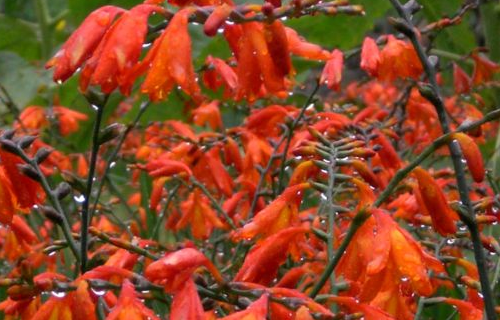
Perennial herb, with corms and stolons. The corms are flat and round, like water chestnuts, covered outside with a brown fibrous membrane. The aboveground stem is about 50 cm tall, often branched. The leaves are linear and sword-shaped, with leaf sheaths at the base that clasp the stem. The flowers are numerous, arranged in a compound panicle, emerging from the verdant leaf clusters, with varied heights and well-spaced density. The flowers are funnel-shaped and orange-red; horticultural varieties come in red, orange and yellow. The perianth tube is slender and slightly curved, with spreading lobes. The capsule contains several seeds.
Ecological habits of Crocosmia
It likes full sunlight and is cold tolerant. In the middle and lower reaches of the Yangtze River, the corms can overwinter in the open ground. It is suitable for growing in well-drained, loose and fertile sandy loam, and during the growth period the soil must have sufficient water.
Cultivation techniques for Crocosmia
Because of the elongating growth of the stolons, the plant has a relatively strong trailing ability. Before planting, the soil should be thoroughly plowed, sufficient base fertilizer applied, and high beds formed. The planting depth is 3-5 cm. Generally, corms bloom from June to August of the same year, while small corms can only bloom the following year. During the growing period, pay attention to watering to keep the soil moist. After sprouting in mid-March, apply 1 topdressing each during the bud stage and after the flowers fade, so that the leaves are lush and the flowers abundant, forming plump renewal corms.
Propagation methods for Crocosmia
The corms have a relatively strong natural propagation ability, and division of corms is commonly used. Generally, divide the corms once every 3 years. In spring, before the new buds sprout, dig up the corms and plant them after division.
Crocosmia corms have a relatively strong natural propagation ability, and division of corms is commonly used. Generally, divide the corms once every 3 years. In spring, before the new buds sprout, dig up the corms and plant them after division. Because of the elongating growth of the stolons, the plant has a relatively strong trailing ability. Before planting, the soil should be thoroughly plowed, sufficient base fertilizer applied, and high beds formed. The planting depth is 3-5 cm. Corms. Generally, corms bloom from June to August of the same year, while small corms can only bloom the following year.
Disease and pest control for Crocosmia
The main problems are leaf spot and root mites. For leaf spot, spray with 75% chlorothalonil wettable powder at 700 times dilution; for root mites, spray with 40% dicofol emulsifiable concentrate at 1000 times dilution.
Distribution range of Crocosmia
Native to South Africa. In northern China it is mostly grown in pots, while in the south it can be cultivated in the open ground.
Uses of Crocosmia: ornamental value
Crocosmia has 3 flower colors: red, orange and yellow, and it also resists severe heat. In midsummer, the flowers bloom continuously, making it a good material for arranging flower borders, flower beds and for cut flowers. It is also suitable for planting in patches on street green islands, in front of buildings, on lawns, beside lakes, and can also be used as cut flowers.
Crocosmia pictures
Gymnocalycium calochlorum profile: how to grow Gymnocalycium calochlorum / how to propagate Gymnocalycium calochlorum, Cactaceae, Gymnocalycium
Chinese scientific name: HuoxingwanLatin name: Gymnocalycium calochlorum (Boed.) Ito 1952
Korean and Japanese name: Huoxingwan
Family and genus: Cactaceae, Gymnocalycium
Introduction: Huoxingwan, family name: Cactaceae, genus Gymnocalycium, Latin name: Gymnocalycium calochlorum (Boed.) Ito 1952.
Family name: Cactaceae
Gymnocalycium
Latin name: Gymnocalycium calochlorum (Boed.) Ito 1952
Chinese name: Huoxingwan
Korean and Japanese name: Huoxingwan
Synonym: Echinocactus calochlorus Boed. 1932
Echinocactus prolifer Backeb. 1932
Gymnocalycium calochlorum var. proliferum (Backeb.) Backeb. 1959
Gymnocalycium papschii H. Till 2001
Habitat: Argentina - Cordoba, rare
Shape: Huoxingwan
Flower: pink