How to grow Agrostemma githago (corn cockle)? Detailed guide to growing methods and precautions
Light
Agrostemma githago is not a flower that needs elaborate care; it loves sunlight very much, so during the plant's growing season, let it receive enough light so it can grow healthily. But in summer, remember to shade the plant to prevent the sun from scorching the leaves. Do not shade it excessively either, otherwise the plant will become leggy, which affects its ornamental appearance.
Temperature
Agrostemma githago likes a warm environment, but it still has a certain degree of cold tolerance. The most suitable growing temperature for the plant is 15°C-35°C. Although the plant can tolerate cold, when the temperature is too low in winter, it should still be moved indoors for care. Generally, the indoor temperature should be around 10°C, not too high, but not too low either.
Watering
Agrostemma githago has certain requirements for watering, and watering must be reasonable. Agrostemma githago is drought-tolerant, but during the growing period the potting soil needs to be kept moist, following the watering principle of "water when dry, stop when wet." In the hot summer, more watering is needed to prevent the plant from wilting, and when flower buds are forming, the amount of watering should also be appropriately increased.
Fertilizing
Always apply thin fertilizer, with a top dressing every 10-15 days. Before flowering and after the flowers fade, phosphorus and potassium fertilizer should be applied as a top dressing.
The above is an introduction to the question of how to grow Agrostemma githago. Below, let us take a look at what else needs attention with Agrostemma githago.
Agrostemma githago L. Agrostemma githago illustrated guide: how to grow Agrostemma githago / how to propagate Agrostemma githago
Agrostemma githago profileAgrostemma githago L.
Alias: corn cockle
Classification: herbaceous flower
Family and genus: Plantae, Angiosperms, Dicotyledoneae (also known as Magnoliopsida), Caryophyllales (also known as Centrospermae), Caryophyllaceae, Agrostemma
Full bloom period: summer
Agrostemma githago, Latin name: Agrostemma githago L. Caryophyllaceae, Agrostemma, annual herb, 60-90 cm tall, the whole plant densely covered with long white stiff hairs. The stem of Agrostemma githago is solitary, upright, unbranched or branched above. The leaves are linear or linear-lanceolate, slightly connate at the base, stem-clasping, acuminate at the apex, with a prominent midvein. The stamens of Agrostemma githago are slightly exserted, the filaments hairless; the styles are exserted, covered with long hairs. The capsule of Agrostemma githago is ovoid, slightly longer than the persistent calyx, outcurved; the seeds are irregularly ovoid or round-kidney-shaped, black, with spiny protuberances. The flowering period of Agrostemma githago is June-August, and the fruiting period is July-September.
Growing methods and precautions for Agrostemma githago: an introduction to Agrostemma githago
Agrostemma githago, Latin name: Agrostemma githago L. Caryophyllaceae, Agrostemma, annual herb, 60-90 cm tall, the whole plant densely covered with long white stiff hairs.
The stem of Agrostemma githago is solitary, upright, unbranched or branched above. The leaves are linear or linear-lanceolate, slightly connate at the base, stem-clasping, acuminate at the apex, with a prominent midvein.
The stamens of Agrostemma githago are slightly exserted, the filaments hairless; the styles are exserted, covered with long hairs.
The capsule of Agrostemma githago is ovoid, slightly longer than the persistent calyx, outcurved; the seeds are irregularly ovoid or round-kidney-shaped, black, with spiny protuberances.
The flowering period of Agrostemma githago is June-August, and the fruiting period is July-September.
Morphological characteristics of Agrostemma githago
Agrostemma githago, leaves linear or linear-lanceolate, 4-11 cm long, 2-10 mm wide, connate or slightly joined at the base, acuminate at the apex, with the midvein raised on the underside.
Flowers large, about 3 cm in diameter, solitary at the top of the stem and branch tips; calyx 5-lobed, the calyx tube oblong-cylindrical, 12-14 mm long, with 10 raised veins, slightly narrowed at the top,
after flowering the calyx tube thickens, the calyx lobes linear, spreading, longer than the calyx tube, up to 3 cm long, with 1 vein;
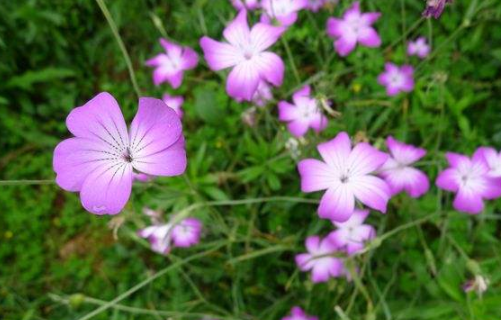
petals 5, much shorter than the calyx lobes, the limb red-purple, obovate to wedge-shaped, gradually narrowed at the base into a claw, the claw white, slightly notched at the apex;
stamens 10, in two whorls, the base of the outer whorl stamens united with the petals;
ovary 1-locular, styles 5, slender, upright, covered with long stiff hairs, nearly equal in length to the stamens.
Capsule ovoid, slightly longer than the calyx tube, dehiscing with 5 teeth, the teeth recurved outward, alternating with the calyx lobes;
seeds slightly irregularly ovoid or round-kidney-shaped, black when mature, 2.5-3 mm long, the surface densely covered with rather pointed, elongated wart-like protuberances.
Flowering period June-August, fruiting period July-September.
Mature plant: 30-80 cm tall, the whole plant with long white stiff hairs, the stem upright, single or branched.
Leaves linear or linear-lanceolate, 3-13 cm long, 2-10 mm wide, connate at the base, with semi-appressed long white hairs on both surfaces, the midvein raised on the underside.
Flowers large, about 3 cm in diameter, solitary at the top of the stem and branch tips; the calyx tube oblong-cylindrical, 1.5-2 cm long, covered outside with long soft hairs, with 10 raised veins; after flowering the calyx tube thickens, lobes 5, linear, up to 3 cm long;
petals 5, dark rose-colored, shorter than the calyx lobes, truncate at the apex, without small scales at the throat, with a long claw at the base; stamens 10, shorter than the petals; styles 5, thread-like.
Fruit: capsule ovoid, slightly longer than the calyx tube, enclosed by the persistent calyx tube, 1-locular, containing several seeds;
seeds triangular-kidney-shaped, 2.5-3.5 mm long and wide, black or nearly black, lusterless, the surface with spiny protuberances of irregular size arranged in concentric circles.
The hilum is located at the lower end, with its two sides slightly concave inward, forming a shallow notch. The embryo runs around the back, surrounding the endosperm, pale yellow; the endosperm is abundant and pure white.
Ecological habits of Agrostemma githago
Agrostemma githago grows in wheat fields or roadside grassland, and is a field weed.
Agrostemma githago blooms in summer. It has strong adaptability, can self-sow and reproduce, and grows vigorously.
Variety classification of Agrostemma githago
Agrostemma githago (Illustrated Flora of China) corn cockle (Flora Herbarium of Northeast China) Plate 64: 1-4
Agrostemma githago L., Sp. Pl. 435. 1753; Hook., Fl. Bor.-Amer. 1: 92. 1840; Kom. in Act. Hort. Petrop. 22(Fl. Mansh. 2): 191. 1903; Hegi, Illustr. Fl. MittelEurop. 3: 273. taf. 98. fig. 3u. fig. 564a-c. 1912; Pax et Hoffm. in Engler u. Prantl, Nat. Pflanzenfam. 2. Aufl. 16c: 339. 1934; Muravjeva in Kom. Fl. USSR 6: 575. 1936; Байтенов и Попов вПопов, Φπ. Каэахст. 3: 363. табπ. 35. рис. 6. 1960; Tutin et al., Fl. Europ. 1: 157. 1964; Illustrated Flora of China 1: 636. fig. 1272. 1972; Flora Herbarium of Northeast China 3: 41. Plate 16. fig. 1-3. 1975.
Distribution range of Agrostemma githago
Agrostemma githago is produced in Heilongjiang, Jilin, Inner Mongolia, **.
Agrostemma githago also occurs in Europe, Asia, northern Africa, and North America.
Plant hazards of Agrostemma githago
Agrostemma githago often grows in wheat fields and is a weed introduced along with wheat seed in earlier years. Specimens were collected in Northeast China in the 19th century. Because its flowers are brightly colored, it has also been introduced and cultivated.
In northern China, Agrostemma githago often harms crops such as wheat, corn, and soybeans, as well as turf;
because the whole plant of this species, especially the seeds, is toxic, when mixed into grain it can damage the health of humans, livestock, and poultry,
and escaped Agrostemma githago can directly pose a threat to horses, pigs, calves, and birds.
Medicinal or dietary therapeutic value of Agrostemma githago
The medical information and health dietary information on Hugarden are for reference only and cannot be used as a basis for diagnosis or medical treatment. For any health problem, consult professional medical staff, and for the treatment of any disease, please follow doctor's orders.
Ultimate flower-protecting mission: love yourself, start from reality, and strictly follow doctor's orders. For illness, do not be careless, do not delay, do not give up hope; face it bravely, warm the silent world with love, and care for the flower field in your heart with your heart.
Medicinal value
The whole herb is used medicinally to treat whooping cough and other conditions. The stems, leaves, and seeds are toxic.
Pharmacological effects
Chemical constituents of traditional Chinese medicine: the seeds contain saponins, raffinose, sucrose, 3-(2,4-dihydroxy-6-methylphenyl),
alanine [3-(2,4-dihydroxy-6-methylphenyl) alanine] and nitrate reductase.
Effects: relieve cough and calm panting, warm the meridians and stop bleeding.
Indications: used for recent and chronic cough, whooping cough, consumptive cough, etc., and for metrorrhagia and metrostaxis in women and excessive menstruation; especially suitable for bleeding of the deficiency-cold type.
Nature, flavor, and meridian entry: sweet, bitter, warm. Enters the lung and kidney meridians.
Usage and dosage: oral administration: decocted in water, 3-10 grams.
Uses: corn cockle can be used as medicine to treat whooping cough and bleeding disorders in women.
The seeds, stems, and leaves are all toxic, and livestock can be poisoned if they eat them by mistake.
If the seeds are mixed into flour at 0.5%, it tastes bitter, and there is a risk of poisoning.
Agrostemma githago is also used as a raw material for laundry detergent and toothpaste.
Toxicity
This species is a toxic plant included in the Chinese plant spectrum database. Its toxicity lies in the seeds, and its toxicity is related to the growing soil and maturity period.
The exocarp is not very toxic; the toxic substances are mainly concentrated in the kernel and embryo, and the toxicity is greatly reduced after heating.
Because this plant is a field weed, it is often mixed with crop seeds during the harvest season, thus often causing poisoning in humans and livestock.
In humans, poisoning causes abdominal pain, vomiting, diarrhea, dizziness, low fever, severe spinal pain, and difficulty moving, sometimes coma or death.
Animals eating 0.1-1.0% of their own body weight in seed powder can cause death. Among them, calves, pigs, and dogs are more sensitive to its toxicity, while cats, sheep, rabbits, and adult cattle are not sensitive to its toxicity,
and some animals can also develop a certain immunity. Subcutaneous injection of extracts of 0.5 g, 0.5 g, and 5 g of seeds into rats, mice, and guinea pigs, respectively, can cause death.
Continuous small amounts of seeds eaten by animals can lead to chronic poisoning, generally called "Agrostemma githago poisoning." The main symptoms include salivation, nausea, vomiting, diarrhea, dizziness, difficulty breathing, and even coma and paralysis.
Large amounts eaten continuously cause more severe symptoms, such as intense muscle pain, spasms, respiratory depression, and even death. In acute poisoning in horses, there are also rapid and weak pulse, elevated body temperature, muscle rigidity, and death from convulsions.
In dogs, in the later stage of poisoning, vomiting is frequent; after 45 minutes, muscle tremors appear, progressing from excitement to lethargy, dull sensation, and uncoordinated movement, with rapid death due to circulatory failure and respiratory depression.
After poisoning in birds and poultry such as chickens, there is increased milky secretion in the mouth, diarrhea, slowed breathing, and reduced heartbeat.
After death from poisoning in animals, necropsy shows significant gastrointestinal inflammation, congestion of the brain and spinal cord, frequent exudate in the ventricles and medullary cavity, softening of the gray and white matter of the spinal cord, and sometimes destruction of red blood cells and fatty degeneration of the liver and kidneys.
Constituents
The seeds of Agrostemma githago contain 19 amino acids, among which phenylalanine has the highest content, followed by proline, valine, and alanine, with ornithine and arginine having the lowest content. The whole herb contains 17 amino acids, among which proline has the highest content, followed by Y-aminobutyric acid, valine, and alanine, with ornithine and methionine having the lowest content.
Activity test results show that the total amino acid fractions of Agrostemma githago seeds and whole herb significantly promote the growth of field wheat, and both significantly promote the growth of wheat coleoptiles in laboratory culture solutions, with no significant difference between the two effects. The content of individual amino acids in the two total amino acid fractions differs greatly: proline accounts for 62.09% of all 17 amino acids in the whole herb total amino acids, while phenylalanine accounts for 55.95% of all 19 amino acids in the seeds, followed by proline, but accounting for only 8.90%. Proline has stress-resistance effects, and it has long been reported that its use together with uracil can increase crop yield, while no similar effect of phenylalanine has been reported.
By classifying amino acids according to the structure of their side-chain R groups and then comparing the contents of various types of amino acids, some preliminary patterns can be found:
a. Nonpolar side-chain R group amino acids (nonpolar amino acids) account for 88.75% of the total amino acids in the seeds, and 78.79% of the total amino acids in the whole herb;
b. The content proportions of the four types of amino acids in the seeds and whole herb are basically consistent: nonpolar side-chain R group amino acids > uncharged polar side-chain R group amino acids > negatively charged polar side-chain R group amino acids > positively charged side-chain R group amino acids;
and the proportions of the first two types of amino acids in the total amino acids of the whole herb and seeds are e8.48 and 97.72 respectively. This proportional relationship also exists in research reports on various amino acids that promote crop growth.
C. Comparing the above analysis results of the content proportions of various types of amino acids and the research results on the effects of amino acids on plant growth, it is inferred that the active amino acid fraction in Agrostemma githago seeds and whole herb that promotes wheat yield increase is mainly composed of nonpolar side-chain R group amino acids, combined with the other three types of amino acids in a certain proportion. Their effect on increasing wheat yield may be the synergistic result of multiple effects exerted by different types of amino acids under certain ratio conditions.
Chemical constituents
The seeds contain saponins, raffinose, sucrose, 3-(2,4-dihydroxy-6-methylphenyl), alanine (3-(2,4-dihydroxy-6-methylphenyl)alanine) and nitrate reductase.
Agrostemma githago pictures
Precautions for growing Agrostemma githago
Potting
When potting, place some broken tiles at the bottom of the flowerpot to facilitate drainage, then add a layer of decomposed fertilizer, and finally add soil.
That is the end of today's content. I hope this article can help friends who want to grow Agrostemma githago, so that they can grow abundant and healthy Agrostemma githago.