What are the precautions for growing Agrostemma githago?
Potting
When potting, you need to place some broken tiles at the bottom of the flower pot to help with drainage, then add a layer of decomposed fertilizer, and finally add the soil.
That is all for today's content. I hope this article can help friends who want to grow Agrostemma githago, so they can grow plenty of healthy Agrostemma githago.
How to grow Agrostemma githago and precautions
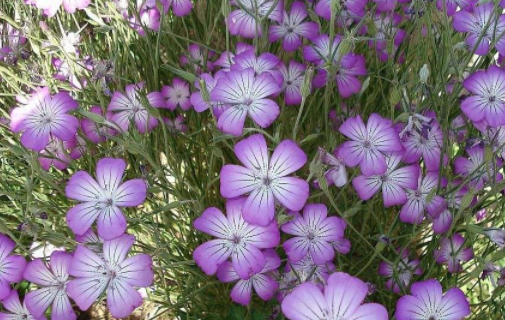
Chinese scientific name Agrostemma githagoLatin scientific name Agrostemma githago L.Also known as corn cockleBinomial name Agrostemma githagoKingdom PlantaeDivision AngiospermsClass DicotyledoneaeSubclass ArchichlamydeaeOrder CentrospermaeFamily CaryophyllaceaeSubfamily CaryophylloideaeTribe SileneaeGenus AgrostemmaSpecies Agrostemma githagoAgrostemma githago, also known as corn cockle, Latin name: Agrostemma githago L. Caryophyllaceae, Agrostemma, an annual herb, 60-90 cm tall, the whole plant densely covered with white long stiff hairs. Stems solitary, erect, unbranched or branched above. Leaves linear or linear-lanceolate, base slightly connate, stem-clasping, apex acuminate, midvein obvious. Stamens slightly exserted, filaments glabrous; styles exserted, covered with long hairs. Capsule ovoid, slightly longer than the persistent calyx, recurved; seeds irregularly ovoid or round-kidney-shaped, black, with spiny tubercles. Flowering period June-August, fruiting period July-September.1. Morphological characteristics
Annual herb, 60-90 cm tall, the whole plant densely covered with white long stiff hairs. Stems solitary, erect, unbranched or branched above. Leaves linear or linear-lanceolate, 4-13 cm long, (2-) 5-10 mm wide, base slightly connate, stem-clasping, apex acuminate, midvein obvious. Flowers solitary, about 30 mm in diameter, pedicels very long; calyx long-elliptic-ovoid, 12-15 mm long, slightly enlarged in later stages, calyx lobes linear, leaf-like, 20-30 mm long; petals purplish red, shorter than the calyx, claw narrowly cuneate, white, glabrous, limb obovate, slightly emarginate; stamens slightly exserted, filaments glabrous; styles exserted, covered with long hairs. Capsule ovoid, 12-18 mm long, slightly longer than the persistent calyx, teeth 5, recurved; seeds irregularly ovoid or round-kidney-shaped, 2.5-3 mm long, black, with spiny tubercles. 2n=48. Flowering period June-August, fruiting period July-September.2. Growth habits
It grows in wheat fields or roadside grassland, and is a field weed. It blooms in summer, has strong adaptability, can self-sow and reproduce, and grows vigorously.3. Geographical distribution
Produced in Heilongjiang, Jilin, Inner Mongolia, **. Also found in Europe, Asia,northern Africa and North America.
4. Taxonomy
Agrostemma githago, also known as corn cockle, Latin name: Agrostemma githago L. Angiosperms; Dicotyledoneae; Centrospermae; Caryophyllaceae; Agrostemma; Agrostemma githago.5. Species under the genus
Agrostemma githago(Illustrated Handbook of Chinese Plants) Corn cockle (Flora Herbarium of Northeast China) Plate 64: 1-4 Agrostemma githago L., Sp. Pl. 435. 1753; Hook., Fl. Bor.-Amer. 1: 92. 1840; Kom. in Act. Hort. Petrop. 22 (Fl. Mansh. 2): 191. 1903; Hegi, Illustr. Fl. MittelEurop. 3: 273. taf. 98. fig. 3u. fig. 564a-c. 1912; Pax et Hoffm. in Engler u. Prantl, Nat. Pflanzenfam. 2. Aufl. 16c: 339. 1934; Muravjeva in Kom. Fl. USSR 6: 575. 1936; Байтенов и Попов вПопов, Φπ. Каэахст. 3: 363. табπ. 35. рис. 6. 1960; Tutin et al., Fl. Europ. 1: 157. 1964; Illustrated Handbook of Higher Plants of China 1: 636. fig. 1272. 1972; Flora Herbarium of Northeast China 3: 41. Plate 16. fig. 1-3. 1975.How to plant Agrostemma githago: planting methods and precautions
Agrostemma githago itself is a kind of wild grass in the countryside, but as people's understanding of its value continues to deepen, Agrostemma githago has gradually become a cultivated plant. This can both control its impact on people and the natural environment, and also effectively bring its efficacy and functions into play.
How to plant Agrostemma githago
1. Sowing time
Agrostemma githago can be sown all year round, but sowing from February to May in spring or from August to October in autumn can effectively increase the seed germination rate and make the plants grow more vigorously.
2. Choosing soil
Agrostemma githago does not have strict soil requirements, but its plants are relatively robust and its root system is very developed, so it is best to choose loose and fertile soil for planting. In order to effectively avoid pests and diseases, it is best to deeply plow the land and disinfect the soil before planting.
3. Maintain suitable temperature and sufficient light
The most suitable growth temperature for Agrostemma githago is about 15 to 35 degrees, but it can also tolerate severe cold. During its vigorous growth period it needs sufficient light, and even in the hot summer it does not need shading treatment. In short, in terms of temperature and light, Agrostemma githago does not need any special care.
4. Watering and fertilizing
Agrostemma githago is relatively drought-tolerant, but it still needs frequent watering during its growth process, and it is best to keep the soil moist. During its flowering period, the number of waterings should be increased even more, but to avoid problems such as root rot, it is best not to water too much at one time; as for fertilizing, it needs to be topped up about every 10 to 15 days, so as to ensure the number and quality of the flowers.
How to grow Agrostemma githago and precautions
1. Potting soil selection
Agrostemma githago is relatively robust by nature and can tolerate poor soil. Its root system is relatively developed. When potting, you can choose a clay pot of suitable size. For the soil in the flower pot, you can choose a mixture of leaf mold, garden soil and mountain soil, and sprinkle in some dry mixed fertilizer. This kind of soil is loose and fertile, and breathable, suitable for the growth of Agrostemma githago.
2. Light and temperature
Agrostemma githago is managed relatively extensively. It likes direct sunlight, and the suitable growth temperature is between 15℃——35℃, and it can tolerate cold. During the vigorous growth period of Agrostemma githago, it needs to be given sufficient light. In general home cultivation, a sunny balcony can meet its light needs. In terms of temperature, in winter Agrostemma githago needs to be placed indoors to overwinter, with the temperature kept at about 10℃, but not too high.
3. Watering and fertilizing
During the cultivation period of Agrostemma githago, it needs reasonable watering and fertilizing. Agrostemma githago can tolerate drought, but during the growth period the potting soil needs to be kept moist, following the watering principle of seeing dry and seeing wet. In the hot summer, more watering is needed to prevent the plant from wilting, and when the flower buds form, the amount of watering should also be appropriately increased. Fertilizing should be done with thin fertilizer, applied once every 10 days——15 days, and before flowering and after flowering, phosphorus and potassium fertilizer should be applied.
4. Potting
When potting, you need to place some broken tiles at the bottom of the flower pot to help with drainage, then add a layer of decomposed fertilizer, and then add the soil.
5. Propagation
Agrostemma githago is propagated by sowing seeds. Agrostemma githago has a strong self-sowing ability, and can also be sown in early spring.
The toxicity of Agrostemma githago
According to records included in the Chinese plant atlas database, we can know that Agrostemma githago is a toxic plant, and its toxicity is mainly in the seeds.
Because the soil it grows in is good field soil, and because the growth and maturity period of Agrostemma githago is earlier than that of field plants, its toxicity is related to these aspects. The toxicity is greatest in the kernel and embryo of the seeds, but after heating, its toxicity will weaken, so this toxicity is afraid of heat.
The medicinal value of Agrostemma githago
The main effects are: relieving cough and calming asthma, warming the meridians and stopping bleeding. It can be used for new and chronic coughs, whooping cough, tuberculosis cough and other symptoms, and can also be used for women's uterine bleeding and excessive menstruation.
Planting Agrostemma githago requires respecting its growth habits and providing a suitable growing environment, so that Agrostemma githago can show its original appearance. In addition, the seeds of Agrostemma githago contain a certain degree of toxicity, so special attention must be paid during planting and other processes, especially since Agrostemma githago is a plant whose main method of propagation is sowing.