A detailed guide to Chinese bayberry care, easy for beginners to get started
Improve the drainage system
The Chinese bayberry harvest period often falls in the hot, rainy summer season, when short cloudbursts or even torrential rains frequently occur, washing away the soil around the tree roots, causing the loss of base fertilizer and exposing the roots, which affects the normal growth of the trees. Therefore, we should strengthen orchard management and improve the drainage system.
Prevent and control pests and diseases
Normally, hot and humid weather leads to the outbreak of various pests and diseases, especially around the time the fruit ripens, when fruit flies and other pests damage the ripe fruit and affect quality, so monitoring and control are necessary. For control, trapping and killing should be the main method; be sure not to use pesticides.
Chinese bayberry growing methods and points to note
Chinese scientific name: Chinese bayberryLatin scientific name: Myrica rubra (Lour.) S. et Zucc.Other names: Sheng Sheng Mei, Bai Di Mei, Shu MeiKingdom: PlantaePhylum: AngiospermsClass: Magnoliopsida (Dicotyledons)Subclass: MagnoliidaeOrder: MyricalesFamily: MyricaceaeGenus: MyricaSpecies: Chinese bayberry (M. rubra)Distribution: East China and Hunan, Guangdong, Guangxi, Guizhou and other places in ChinaEnvironmental distribution: sunny slopes or valleys in low hillsEcological habit: terrestrial plantLife form: evergreen treeSunlight: shade-tolerant fruit treeWater: over 1000 mmTemperature: average temperature 15-21°CSoil: prefers acidic soilAltitude: 125-1500 m above sea levelEdible value: eaten fresh, can be processed into dried Chinese bayberry, sauce, and candied fruitMedicinal value: quenches thirst, promotes fluid production, aids digestion and other functionsIndustrial value: an additive for cosmetics, can be used to brew wineSpecial uses: used as a reddish-brown dye, and as an astringent in medicineToxicity: non-toxicSymbolic meaning: hailed as a "green enterprise" and a "money tree"Place of origin: Yuyao, Zhejiang, ChinaThe Chinese bayberry is a small tree or shrub of the genus Myrica in the family Myricaceae, also known as Sheng Sheng Mei, Bai Di Mei and Shu Mei. It has high medicinal and edible value and is distributed in East China and Hunan, Guangdong, Guangxi, Guizhou and other regions of China. The Chinese bayberry originated in Yuyao, Zhejiang, China. In 1973, when the Neolithic Hemudu site was excavated within Yuyao, Myrica pollen was found, indicating that Chinese bayberry grew in this area more than 7000 years ago. The genus has more than 50 species; those known in China include Chinese bayberry, white bayberry, hairy bayberry, green bayberry and dwarf bayberry, and commercial cultivation is mainly of Chinese bayberry. The Chinese bayberry has luxuriant branches and leaves and a rounded crown, and in early summer it is very lovely with abundant red fruit. It is an excellent tree species for landscaping combined with production. It is suitable for specimen planting or group planting on lawns and in courtyards, or for row planting along roadsides; if densely planted to divide space or provide screening, it is also ideal. Economic uses: the fruit is moderately sweet and sour, can be eaten directly, and can also be processed into dried Chinese bayberry, sauce, candied fruit, etc., and can be brewed into wine; it has functions such as quenching thirst, promoting fluid production and aiding digestion.1. Morphological characteristics
TrunkEvergreen tree, height can reach more than 15 m, diameter at breast height more than 60 cm; bark gray, longitudinally shallowly fissured when old; crown spherical. Branchlets and buds hairless, lenticels usually few and inconspicuous, when young only covered with round, peltately attached glands.
Leaves
Leaves leathery, hairless, persisting for 2 years before falling, often densely clustered at the upper part of branchlets; those mostly borne on sprouting shoots are long-elliptic or cuneate-lanceolate, more than 16 cm long, apex gradually acute or abruptly acute, margin with sparse sharp serrations above the middle, often entire below the middle, base cuneate; those borne on fertile branches are cuneate-obovate or long-elliptic-obovate, 5-14 cm long, 1-4 cm wide, apex rounded-obtuse or with a short tip to abruptly acute, base cuneate, entire or occasionally with a few sharp serrations above the middle, dark green and glossy above, light green below, hairless, only sparsely covered with golden-yellow glands; after drying, the midrib and lateral veins are prominent on both surfaces, more raised below; petiole 2-10 mm long.
Flowers
Flowers dioecious. Male inflorescences solitary or several clustered in leaf axils, cylindrical, 1-3 cm long, usually unbranched and single-spicate, rarely with inconspicuous very short branching at the base; basal bracts sterile, fertile bracts nearly round, entire, hairless on the back, only glandular, about 1 mm long, each bract axil bearing 1 male flower. Male flowers with 2-4 ovate bracteoles and 4-6 stamens; anthers elliptic, dark red, hairless. Female inflorescences often solitary in leaf axils, shorter and more slender than male inflorescences, 5-15 mm long; bracts similar to those of male flowers, closely overlapping in an imbricate arrangement, each bract axil bearing 1 female flower. Female flowers usually
with 4 ovate bracteoles; ovary ovate, very small, hairless, apex with a very short style and 2 bright red slender stigmas, the inner side of which is the papillose stigma surface. In each female inflorescence, only the upper 1 (rarely 2) female flower can develop into fruit.
Fruit
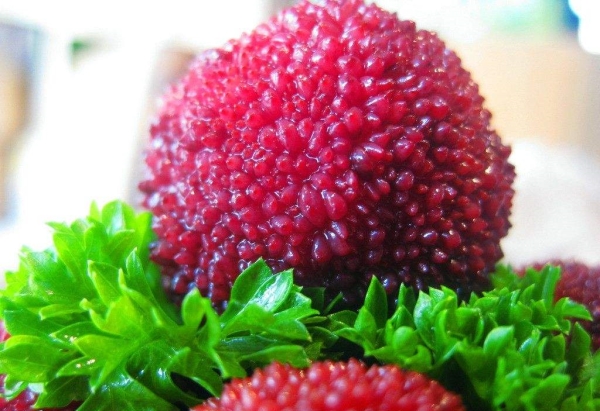
Drupe spherical, outer surface with papillate protrusions, 1-1.5 cm in diameter, cultivated varieties can reach about 3 cm; exocarp fleshy, juicy and resinous, sweet and sour, dark red or purplish red when ripe; stone usually broadly elliptic or round-ovate, slightly flattened, 1-1.5 cm long, 1-1.2 cm wide, endocarp extremely hard, woody. Flowers in April, fruit ripens in June-July.
2. Growing environment
The Chinese bayberry prefers acidic soil and originated in the temperate and subtropical humid climate of China, on slopes or in valley forests at 125-1500 m above sea level. It is mainly distributed south of the Yangtze River basin and north of Hainan Island, that is, between 20 degrees and 31 degrees north latitude, similar to the distribution of citrus, loquat, tea and moso bamboo, but its cold resistance is stronger than that of citrus and loquat.3. Distribution range
The provinces in China where Chinese bayberry is distributed include Yunnan, Guizhou, Zhejiang, Jiangsu, Fujian, Guangdong, Hunan, Guangxi, Jiangxi, Sichuan, Anhui, Taiwan, China and others. Abroad, there is a small amount of cultivation in Japan and South Korea, and it is also distributed in Southeast Asian countries such as India, Myanmar, Vietnam and the Philippines.What are the benefits of Chinese bayberry? An analysis of the effects and functions of Chinese bayberry
I remember that in elementary school, one text was titled "I Love the Chinese Bayberry of My Hometown." It said that the Chinese bayberry is round, the same size as a longan, and covered all over with small spines. As the Chinese bayberry gradually ripens, the spines gradually soften and flatten. Pick one and put it in your mouth; when the tip of the tongue touches the smooth spines of the Chinese bayberry, it feels delicate and soft. It can be seen that the Chinese bayberry is indeed a fruit that people love.
When Chinese bayberries ripen
Chinese bayberry is abundantly produced in the Jiangsu-Zhejiang area of China and is one of China's specialty fruits, enjoying the reputation of "at first you doubt a single fruit is worth a thousand in gold." The Chinese bayberry fruit is bright in color, rich in juice, sweet and sour and palatable, and very high in nutritional value.
Therapeutic food effects of Chinese bayberry
Chinese bayberry is sweet and sour in taste, warm in nature, non-toxic, and enters the lung and stomach meridians;
It has the effects of promoting fluid production and quenching thirst, astringing the intestines and stopping diarrhea, harmonizing the stomach and stopping vomiting, and promoting digestion and diuresis;
For dizziness and pain in the muscles and joints all over the body caused by overwork: 30-60 grams of Chinese bayberry wine, taken once in the morning and once in the evening.
Points to note
Everyone probably knows about food incompatibilities, and the Chinese bayberry is the same. Meng Shen of the Tang Dynasty said: "Chinese bayberry must absolutely not be eaten in large amounts; it can greatly damage the teeth and tendons, and it is taboo to eat it with raw scallions." Chinese bayberry should not be eaten with raw scallions or duck meat. After eating Chinese bayberry, rinse the mouth or brush the teeth promptly to avoid damaging the teeth. Chinese bayberry has a certain irritating effect on the gastric mucosa, so patients with ulcers should eat it cautiously; people with excess internal heat should not eat much, and diabetics should avoid it.
Ornamental value
The above is a brief introduction to the Chinese bayberry. In addition, the Chinese bayberry also has very high ornamental value in gardens. Its trunk is quaint and distinctive, and its branches and leaves are luxuriant, just like a natural stump bonsai. At the summer solstice, Chinese bayberries turn the hills red, bright and pleasing to the eye, set off among the lake and mountain scenery, becoming a gorgeous scenic line on Dongting Mountain, too beautiful to take in all at once.
More information:
|What does a white rose symbolize|What plants protect against computer radiation|Geranium|Azalea growing methods and points to note|Spider plant 'Golden Heart'|
|Lavender flowering period|Indoor foliage plants|Boston ivy|How to fold a lily|Effects and functions of mint|How to grow mimosa|
|How to grow succulents|Osmanthus|Effects and functions of Jiaogulan|Handmade roses|Effects and functions of honeysuckle|Kumquat|