Propagation Methods and Key Techniques for Scarlet Sage
1. Seed propagation
For tall scarlet sage, prepare the potting soil before sowing and planting. The usual planting time is March; in areas with lower temperatures, sow indoors. Water the potting soil thoroughly and let it sit for 1-2 days before sowing. Scatter the seeds evenly on the soil surface and cover with 1-2 cm of soil. No watering is needed; you can cover the pot with plastic film to increase humidity.
Sowing dwarf scarlet sage is usually done in August as an outdoor potted plant. Prepare the potting soil in advance, choosing a well-drained, loose and fertile soil, and add a small amount of organic fertilizer to the soil. Water thoroughly and set aside. Scatter the seeds evenly in the pot and cover with 1-2 cm of fine sand. After 2-3 days, cover with another layer of fine sand. They can germinate after 6-7 days, and seedlings appear in 10 days.
If rainy weather occurs, cover with another layer of soil to avoid rain damage. By late September, 5-6 leaves will have grown, and at this point move the plant indoors for care.
2. Cutting propagation
Choose healthy plants and cut 12-15 cm branches in June-July, placing them in a cool place. Prepare the potting soil and insert the branches into the pot, usually 1-2 branches per pot. Water immediately after inserting and shade to reduce water evaporation. Keep the temperature at around 20°C and spray water 2-3 times during the day. The branches will take root and sprout in 3-5 days, at which point gradually move them into sunlight.
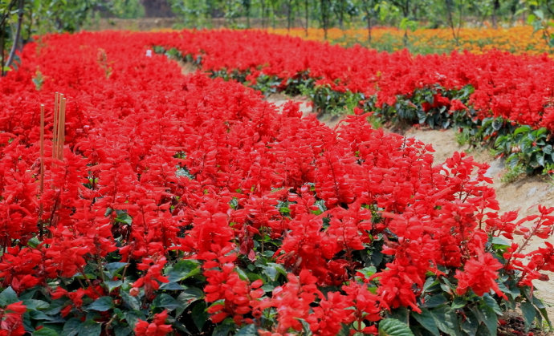
Propagation Methods for Scarlet Sage: When Does Scarlet Sage Bloom?
Scarlet sage, also known as firecracker red, is a plant in the Lamiaceae family, Salvia genus. When does scarlet sage bloom? Let's take a look at the answer and the propagation methods for scarlet sage below.
Propagation methods for scarlet sage:
1. Cutting method
Propagating scarlet sage by cutting can be done in summer and autumn from May to August. Take plump, well-developed young branches as cuttings, remove the terminal bud before inserting, and rooting is easy. In the hot, dry summer season, pay attention to shading and cooling, spray water frequently to keep moist, and they can be transplanted in about 15 days. This is a relatively fast and simple propagation method for scarlet sage.
2. Cultivation method
Scarlet sage can also be propagated by cultivation. Plant at a spacing of about 40 cm, with fertile, loose soil rich in humus or sandy soil being suitable. During the peak growing season, apply phosphorus-containing liquid fertilizer 1 to 2 times to promote abundant blooming. Scarlet sage generally does not like excessive water; otherwise, yellowing leaves and leaf drop easily occur, resulting in large but sparse plants with few flowers. During the growing period, pinch and shape frequently to control plant height and branching, promoting long, plump flower spikes and neat blooming.
3. Sowing method
The sowing method is also a commonly used propagation method for scarlet sage. In southern regions, late March to early April is usually the best time for open-field sowing of scarlet sage. Choose a wind-sheltered, sunny seedbed with well-drained sandy soil. Turn over the bed surface, break up clods and level it, let it bake in the sun for several days, then disinfect the seedbed soil with potassium permanganate solution. Scatter scarlet sage seeds on the seedbed, then sprinkle an appropriate amount of carbofuran on the seedbed (this pesticide can kill ants, earthworms and various other pests, and causes no harm to the seeds). Keep the seedbed moist at all times. At 16°C-21°C, seedlings can emerge in 6-7 days, and they can be transplanted into pots when they have 3-4 true leaves.
When does scarlet sage bloom:
Scarlet sage is a perennial herb or subshrub, cultivated as an annual. The flowers are red, and the flowering period is summer and autumn. Scarlet sage can be controlled in its flowering period through short-day treatment and pinching. Short-day conditions favor flower bud differentiation in scarlet sage. Early spring sowing means short daylight favors reproductive growth, while for seedlings sown later, to promote earlier blooming, shading treatment can be applied in the morning and evening. Generally, with 8 hours of light per day, it takes 57 days to bloom. If given 16 hours of light per day, it takes 82 days to bloom.
In addition, timely pinching can also control the flowering period. Generally, pinching can be done twice, with the second time in late August, keeping 16-20 branches, which should allow it to bloom by National Day.
More informationPropagation Methods for Scarlet Sage
Seed propagation method
Sowing tall scarlet sage
Prepare the potting soil before planting. The usual planting time is March; in areas with lower temperatures, sow indoors.
Water the potting soil thoroughly and let it sit for 1-2 days before sowing.
Scatter the seeds evenly on the soil surface and cover with 1-2 cm of soil. No watering is needed; you can cover the pot with plastic film to increase humidity.
Sowing dwarf scarlet sage
Usually sown in August as an outdoor potted plant. Prepare the potting soil in advance, choosing a well-drained, loose and fertile soil, and add a small amount of organic fertilizer to the soil. Water thoroughly and set aside.
Scatter the seeds evenly in the pot and cover with 1-2 cm of fine sand. After 2-3 days, cover with another layer of fine sand. They can germinate after 6-7 days, and seedlings appear in 10 days.
If rainy weather occurs, cover with another layer of soil to avoid rain damage. By late September, 5-6 leaves will have grown, and at this point move the plant indoors for care.
Cutting propagation
Choose healthy plants and cut 12-15 cm branches in June-July, placing them in a cool place.
Prepare the potting soil and insert the branches into the pot, usually 1-2 branches per pot. Water immediately after inserting and shade to reduce water evaporation. Keep the temperature at around 20°C and spray water 2-3 times during the day.
The branches will take root and sprout in 3-5 days, at which point gradually move them into sunlight.