How to Grow Pocketbook Flower (Calceolaria) at Home and Key Care Tips
1. Sowing Time
The seeds of Calceolaria are tiny, with about 25,000 seeds per gram, and the optimum germination temperature is 18-21°C. Therefore, Calceolaria should be sown when the weather turns cool after the hot season, that is, from late August to early September. Sowing too early when temperatures are high makes seedlings prone to damping-off and rot, while sowing too late affects flowering.
2. Sowing Method
The soil used for pot sowing must be sterilized at high temperature. When sowing in pots, the potting soil should be pressed firm, the seeds lightly scattered in and pressed flat. Because the seeds are tiny, sowing should not be too dense and the soil covering should not be too thick (it may even be left uncovered). After soaking the bottom of the pot in water, cover with glass or plastic film and place in a semi-shaded spot. Room temperature should be maintained at around 20°C, and germination occurs 7-10 days after sowing. When the seedlings grow to 2-3 leaves, thin or transplant them in time, and pay attention to ventilation and maintaining humidity. Keep room temperature at around 15°C.
3. Transplanting Method
When the seedlings have 2-3 true leaves, they can be transplanted. Once they grow 4 to 6 true leaves, they can be potted individually. 30 days after transplanting, when the seedlings are 5 cm tall, plant them in 10-15 cm pots. Room temperature of 10-12°C is best.
For the growing medium, mix 2 parts leaf mold, 1 part farmyard manure, 1 part sand and 6 parts garden soil, with a pH of 6.5.
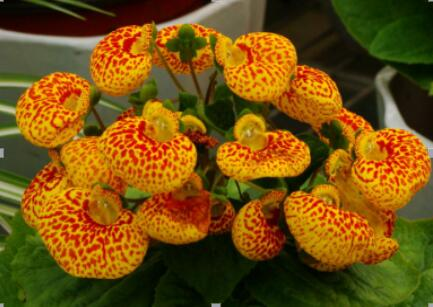
The Flower Language and Legends of Calceolaria
Orange Calceolaria
Flower language: symbolizes wealth and assistance
Legend: Once upon a time, there was an old small village that had been drought-stricken for a long time, and the crops in the fields were almost withered to death. When the village chief's daughter learned of this, she wept at home every day. One day, her tears accidentally fell on a little elf, and the elf asked her why she was crying. So she told him what had happened. After hearing this, the elf asked her if she was willing to sacrifice herself for everyone. The little girl agreed without hesitation, so the elf turned her into an orange Calceolaria by the well. By the next day, the dried-up well was full of well water, and the villagers used this well water to revive the crops. From then on, the village enjoyed favorable weather and bountiful harvests.
White Calceolaria
Flower language: symbolizes loss
Legend: Long, long ago, there was a poor scholar who studied hard every day, hoping that one day he could pass the imperial examination and change his life. Sadly, however, he failed every time, and gradually became more and more disappointed. He also fell ill and passed away not long after. Afterwards, an unknown little flower grew on his grave, its pure white blossoms giving off a very faint fragrance.
Purple Calceolaria
Flower language: symbolizes parting
Legend: Long ago, a princess fell in love with a very brave warrior on the hunting ground. After the hunt ended, the princess met this warrior. Afterwards the two fell in love. However, they had not been together long when the warrior was sent to the battlefield. At parting, the warrior picked a purple flower by the roadside and placed it in the princess's hair. After kissing her tear-streaked face, he rode his horse off to the battlefield.
So, how about it? After reading the above methods for growing Calceolaria at home, have you managed to grow beautiful Calceolaria at home? If you also like Calceolaria, then come and follow our Four Seasons Plants website! There is more Calceolaria information waiting for you here!
Home Flower Growing, Indoor Flower Growing Methods
How do you grow indoor flowers? How can you grow indoor flowers well? Take a look at the following introductions on indoor flower growing methods:
1. Home Indoor Flower Growing Methods
According to experts, to make indoor flowers grow well, you must grasp the ecological habits of the flowers and properly manage the light, water, fertilizer, temperature, humidity and pest and disease control needed for home flower growth. Below are some suggestions from experts:Most homes cannot reach the humidity of a greenhouse, and most plants native to the tropics like a moist environment. In a greenhouse, flowers can receive sunlight through shade netting all day so that they are not exposed to direct sunlight, while at home there is often insufficient light or direct sun exposure. Many flowers like semi-shaded conditions, but winter sunlight is too weak, so you can let the flowers receive full sunlight. Most flowers have a suitable growing temperature between 15°C and 20°C. If the temperature is too high, flowers bloom quickly and problems are also more likely.
In a greenhouse, fertilizer is applied regularly and watering is moderate, and compound fertilizers suitable for each growth stage are needed. At home, however, due to insufficient gardening knowledge, either no fertilizer is applied, causing malnutrition, or too much fertilizer is applied at once, burning the flowers. In particular, note that during the flowering period you may skip fertilizing or apply only a small amount of compound fertilizer; "too much fertilizer" is bad for flowering.
Most flowers prefer neutral or slightly acidic soil. If tap water is alkaline, long-term watering will make the soil alkaline and also affect flower quality. If the soil is heavy and not breathable, it also affects root respiration and can even cause root rot. Watering should basically follow the principle of alternating between moist and dry. In winter, evaporation is low, so do not water too frequently; too much water easily causes root rot. Before watering, be sure to touch the potting soil with your hand so you can judge the degree of dryness and moisture and avoid blind watering.
Most flowers like an environment with high air humidity, so spray more water around the flowers to increase air humidity. Try to place the flowers in a sunny and well-ventilated spot, which can help avoid pests and diseases. The room temperature should preferably not be lower than 5°C, nor higher than 25°C. Too much water, low air humidity and excessively high temperature are often the main factors causing problems for flowers.
In addition, when growing flowers you should also pay attention to the following aspects:
1. Dry air. When indoor air is excessively dry, flowers often show symptoms such as withered leaf tips or scorched leaf edges. You should take measures such as spraying water and covering with plastic film to increase air humidity.
2. Excessive fertilizing. Too much fertilizer will cause new leaves to become thick and fleshy and mostly uneven, while old leaves develop dry tips, scorch and yellow and fall off. You should immediately stop fertilizing, increase the amount of water changed to leach out the fertilizer, or immediately repot, rinse the bulbs with water and replant them in the pot.
3. Hot high temperatures. If flowers are placed in a high-temperature spot and exposed to strong direct sunlight, it can very easily cause the leaf tips and edges of young leaves to scorch, or leaves to yellow and fall off. They need to be moved promptly to a well-ventilated, shady place.
4. Excessive shading. If flowers are kept for a long time in a shaded place or a spot with insufficient light, the branches and leaves will turn yellow.
5. Too dense and unventilated. If too much nitrogen fertilizer is applied, the branches and leaves grow excessively lush, and combined with a long period without pruning, the inner branches and leaves lack light, which easily causes leaves to yellow and fall off. Fertilize reasonably and strengthen pruning so as to improve ventilation and light penetration.
2. Complete Collection of Indoor Flower Pictures
Bulbous flowers: such as narcissus, amaryllis, tulips and hyacinths, all belong to seasonal flowers with very short flowering periods, generally only 1 to 2 weeks. Indoors they can be placed in a sunny spot with lower temperatures; if the temperature is too high, they bloom quickly and the flowering period is shortened.
Orchid-type flowers: such as clivia, cymbidium, phalaenopsis, cattleya and dendrobium, in nature grow under trees in the tropics, liking moisture and shade and avoiding direct sunlight, growing well in bright semi-shaded spots. Therefore at home you should spray more water to increase air humidity. In winter they can be given soft sunlight so they can carry out photosynthesis and gain more nutrients. Orchid-type flowers are easily affected by snails and scale insects; scale insects can be brushed off with a toothbrush. Take the common clivia as an example. It is native to the subtropical forests of South Africa, where it is warm like spring all year round, with an average minimum temperature not lower than 10°C and a maximum temperature not exceeding 22°C. Clivia likes to grow in a warm, moist natural environment with moderate dryness and moisture, and homes should also create a similar environment. Clivia likes soft light and avoids scorching sun exposure. Clivia has fleshy roots and a certain drought resistance; too much watering will cause root rot. The water content of clivia potting soil should be at the state where it can be pinched into a ball by hand and crumbles apart with a light press.
Maranta-type and fern plants: maranta-type plants such as peacock plant and purple-backed maranta, and ferns such as Boston fern, like semi-shaded, warm, high-humidity and well-drained environments, like bright light and cannot tolerate strong direct sunlight.
Calla lily: likes light, water and fertilizer, and prefers moist soil and high air humidity.
Anthurium: also called flamingo flower, likes a shady, moist, warm and well-drained environment. Scale insects are its common pests, so attention should be paid to control; brushing with a brush is enough.
Cineraria: likes sun, moisture and fertilizer, but fertilization should be reduced during the flowering period. Watering should keep a balance between dry and wet, preventing both excessive dryness and excessive moisture. At low temperatures watering should be controlled, just keeping the soil slightly moist. Ventilation must be paid attention to; otherwise cineraria is prone to powdery mildew or damage by aphids and red spider mites.
Gloxinia: likes warmth and humidity, likes fertilizer, and avoids direct sunlight. Cyclamen likes a sunny, cool and humid climate, with 10°C to 20°C as the suitable growing temperature, and fears high temperatures.
Belgian azalea: likes cool, humid, acidic humus soil.
Christmas cactus: likes a warm, humid, semi-shaded environment. The optimum growing temperature is 15°C to 20°C, and it enters dormancy when the temperature is below 5°C.
Calceolaria: likes a warm, cool, humid and well-ventilated environment, is not cold-tolerant, and avoids moisture.
Rieger begonia: likes a warm, humid, semi-shaded environment.
Poinsettia: likes sufficient light and requires loose, fertile soil with good drainage and good aeration. It has strict water requirements: excessive soil moisture often causes root disease and then leaf drop; insufficient soil moisture leads to poor plant growth and also leaf drop.
Kumquat: likes warmth and humidity and sufficient light, and is suited to fertile, well-drained, well-aerated sandy soil. It is not cold-tolerant and avoids drought.
Ornamental bromeliads: like high temperatures, high humidity and a semi-shaded environment. Potting soil should preferably be sandy soil containing humus, and the overwintering temperature should be above 10°C.
Summary: A large collection of indoor flower pictures makes people feel they must take action after looking at them. Action is better than just desire, so follow the home flower growing methods introduced by the editor and decorate your beloved home together.