Key Maintenance and Cultivation Techniques for Calceolaria During Its Blooming Period
1. Maintenance of Calceolaria During Its Blooming Period
Calceolaria is quite sensitive to moisture, and watering must be strictly controlled during the full blooming period. During cultivation, the potting soil should be kept moist, but not overly moist. When watering, do not splash water onto the leaves. Once Calceolaria develops flower stems, the potting soil should be kept dry, but be careful not to let it dry out completely.
The temperature generally needs to be maintained between 8°C and 10°C. To improve the seed-setting rate, artificial pollination can be carried out during the full blooming period. During fruit growth, attention should be paid to ventilation and shading measures to avoid high temperature and high humidity causing the plant's fruits to die.
2. Cultivation Techniques
(1) Water and Fertilizer Management
Calceolaria prefers a warm and humid environment, but it dislikes overly wet potting soil and excessive watering during flowering. Generally, water only when the potting soil is dry. If grown in a greenhouse, frequently spraying water to increase air humidity is even better. When watering, do not directly flush the plant, as water accumulating on the leaves and buds can easily cause rot. During the pre-flowering growing season, apply decomposed cake fertilizer water once every 10 days (diluted 10 times). At the early flowering stage, increase the application of phosphorus-based fertilizer. To avoid heart rot and leaf rot, be careful to avoid the leaves when fertilizing.
(2) Ventilation and Shading
Calceolaria prefers cool conditions, with an optimal growth temperature of around 10°C. If the stems and leaves grow luxuriantly during the growing period, and the potting soil is too wet combined with muggy conditions, the plant's stem base and leaves will rot. To lower the temperature, shading measures are often taken at noon to create a cool and well-ventilated growing environment. Especially after spring flowering until the seeds mature in May to June, ventilation work should be done even better, and shading at noon will help the seeds develop and mature.
That is all we have to share about Calceolaria. We believe that with this knowledge, everyone can harvest a beautiful pot of Calceolaria during the Spring Festival! Today's introduction to Calceolaria's blooming period ends here. Friends who like Calceolaria can follow our Four Seasons Plant Network to learn more details!
Calceolaria Blooming Period Control, Maintenance and Cultivation
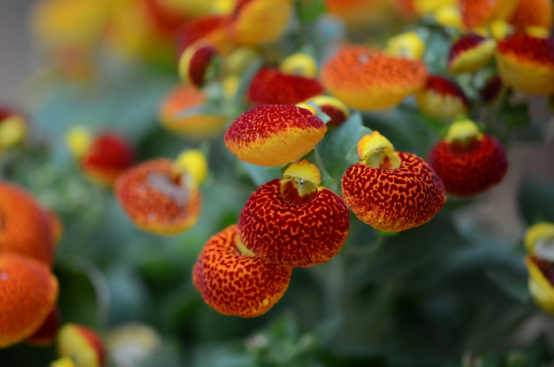
Calceolaria, also known as pocketbook flower, is a plant of the genus Calceolaria in the family Scrophulariaceae. It is a perennial herbaceous flower, often cultivated as a biennial. The entire plant is densely covered with fine hairs. The leaves are ovate to ovate-elliptic, yellow-green. The blooming period is from February to May. The flowers have two lips, with the upper lip small and the lower lip swollen like a purse, hence the name. Flower colors include creamy white, yellow, orange, etc., and the flowers are scattered with many purplish-red, dark brown, and orange-red spots. It is native to Central and South America, Australia, and New Zealand. It prefers a cool and humid environment and sufficient light, with an optimal growth temperature of 8 to 15 degrees.
1. Display
Calceolaria has peculiar flower shapes and brilliant colors. When in bloom, it can be placed on tea tables or flower stands. It can be displayed alone or in groups.
2. Four-Season Management
(1) In autumn, it is suitable for placement on east-, south-, and west-facing balconies. Sow in late August. The potting soil should preferably be rich in humus, loose, fertile, and well-drained. After sowing and germination, attention should be paid to the prevention and control of damping-off disease, with timely spraying and keeping the potting soil on the dry side. When the seedlings grow to 2 to 3 true leaves, they can be transplanted once into 9 cm pots and then planted into 14 to 16 cm pots. After the transplanted Calceolaria survives, sufficient light should be ensured. Water less during the seedling stage, keeping the potting soil slightly dry to promote root development. After the leaves grow and fill the pot, water and fertilizer management can be increased. The autumn temperature should not be too high; if it exceeds 15°C, appropriate shading can be provided at noon.
(2) In winter, it is suitable for placement on east-, south-, and west-facing balconies. Calceolaria is more cold-tolerant than other greenhouse flowers. It can grow normally when the temperature is maintained at around 10°C. Ensure sufficient light, keep the potting soil moist, and apply light fertilizer frequently. If the room temperature is below 8°C, Calceolaria grows slowly; sufficient light should be ensured, watering should be reduced, the potting soil should be kept slightly on the dry side, and fertilization should be stopped.
(3) In spring, it is suitable for placement on east-, south-, and west-facing balconies. Spring is the season for Calceolaria's growth and flowering. The potting soil should be kept moist, fertilizer should be applied regularly, and sufficient light should be ensured. Provide appropriate shading when the sunlight is strong at noon. When the temperature is too high at the end of spring (above 20°C), it is not conducive to flowering and seed setting, so appropriate shading should be provided and ventilation strengthened. When the flowers begin to fade, reduce the water supply and keep the potting soil slightly on the dry side.
(4) Summer: dies in summer.
3. Blooming Period Control
Calceolaria is a long-day plant, and increasing the light duration can advance flowering. If light is increased in November, it can bloom by the end of January of the following year. The method is: hang a 60W incandescent lamp 50 to 80 cm above the Calceolaria (each lamp has an effective area of about 3 square meters). Start supplemental lighting at around 4:30 to 5:00 PM each day, and end at around 7:30 PM (2 to 3 hours of supplemental lighting per day). Flowers can be seen after 2 months. As long as sturdy Calceolaria plants are cultivated in November, supplemental lighting can be used to force flowering.
Greenhouse Cultivation Techniques for Calceolaria
Calceolaria, also known as pocketbook flower, is a biennial herbaceous flower of the genus Calceolaria in the family Scrophulariaceae. Its flower shape is peculiar and its ornamental value is relatively high. It is mostly used as a small potted flower for indoor display and is one of the main flowers for greenhouse pot cultivation in northern winters. Because its blooming period coincides with the Spring Festival, it is also one of the main seasonal flowers of early spring.I. Biological Characteristics Plant height 18 to 25 cm, stems and leaves with fine hairs, leaves yellow-green, ovate to elliptic, opposite. Umbel terminal, corolla with two lips, each lip swollen like a kidney shape, upper lip small, upright and extending forward, lower lip enlarged and purse-shaped, curved downward, resembling the purse used by ancient people, hence also called pocketbook flower. The style is relatively short, located between the upper and lower lips, with one stamen on each side of the style. Flower colors are rich; single-color varieties include white, yellow, red and other shades, while bi-color varieties have orange, pink, brown, red and other spots distributed on the single color. The blooming period is from February to May, and the fruit is a capsule, maturing from April to May. The seeds are brown, extremely small, with about 20,000 to 34,000 seeds per gram.II. Ecological Habits Calceolaria is native to Chile, Peru, Mexico and other places in Central and South America. It prefers a warm, humid, cool and well-ventilated environment. It is not cold-tolerant and fears summer heat, so it is mostly cultivated as a biennial in greenhouses. The optimal growth temperature for Calceolaria is 8 to 20°C, with a minimum temperature requirement above 5°C. Below 15°C can induce flower bud differentiation, and above 25°C the plant is prone to death. Calceolaria is a long-day plant and requires sufficient light. Under long-day conditions, flowering can be advanced, while under short-day conditions flower bud development is inhibited. However, its flower bud differentiation is unrelated to day length and is related to temperature. At 10°C, flower bud differentiation can occur after 4 to 6 weeks. Calceolaria likes fertilizer but fears excessive application. It grows well in sandy loam rich in humus and loose and breathable, with a pH value of around 6.
III. Common Cultivated Varieties Calceolaria is an interspecific hybrid. The genus has about 300 species, and the common cultivated varieties mainly fall into 2 types:
1. Grandiflora group: Bred around the early 20th century. Plant height 20 to 25 cm, flower diameter about 3 to 4 cm, rich flower colors, mostly with colored spots.
2. Small-flowered multiflora group: Plant height 18 to 20 cm, flower diameter about 2 to 3 cm. Bred by a German seed company, flower colors mostly vary between vermilion and golden yellow. Strong cold resistance, suitable for pot cultivation. Calceolaria has many fixed varieties, among which the early-flowering multiflora hybrid F1 has strong growth vigor and excellent traits, and is widely used in greenhouse cultivation.
IV. Cultivation Management
1. Sowing and Seedling Raising:
(1) Time: Generally carried out from late August to early September. At this time the weather gradually turns cool, which is favorable for seedling growth. Sowing too early, when the temperature is high, makes seedlings susceptible to damping-off disease, while sowing too late results in short plants and poor growth. However, if the ecological factors in the greenhouse are properly regulated, it can be carried out year-round. Under normal circumstances, to supply flowers for New Year's Day and the Spring Festival, northern regions mostly sow in greenhouses in early September.
(2) Culture soil: Calceolaria prefers sandy loam rich in humus and requires loose and breathable soil. It can be prepared with 6 parts leaf mold and 4 parts river sand. For large-scale production, peat, vermiculite, and perlite can be used in a 6:3:1 ratio, then disinfected with a 500-fold dilution of 70% dexon wettable powder, spraying 15 to 20 kg per cubic meter.
(3) Sowing method: Before sowing, the breeding container (shallow seedling tray or seedling plug tray) should first be disinfected, which can be done by spraying with a 500-fold dilution of 50% carbendazim wettable powder. Because Calceolaria seeds are very small, when sowing, first mix the seeds evenly with fine sand, then evenly scatter them on the thoroughly moistened seedbed; no soil covering is needed. Pay attention to moisture retention; film or glass can be used to cover and shade.
(4) Seedling management: The optimal germination temperature is 18 to 20°C, and seedlings generally emerge 1 week after sowing. After the seedlings emerge completely, promptly remove the covering to provide ventilation and light, which benefits seedling growth. When there are 2 to 3 true leaves, carry out the first transplant; the container can be a 10 cm × 10 cm nutritional pot, with the same culture soil as for sowing. When the seedlings produce 5 to 6 true leaves, carry out the second transplant, that is, final planting. The potting soil can be prepared by mixing 6 parts leaf mold, 3 parts garden soil, and 1 part river sand, or prepared with peat, perlite, and vermiculite in a 6:3:1 ratio, with a small amount of base fertilizer added. The final planting container should preferably be a flower pot with a diameter of 16 cm.
2. Maintenance Management:
(1) Temperature: During greenhouse cultivation, attention should be paid to temperature changes. High temperature weather is especially likely in the early stage, which can be regulated by shading, misting, and ventilation to keep the air temperature below 25°C. In the later stage, attention should be paid to heat preservation, maintaining the minimum temperature above 8°C.
(2) Light: Calceolaria is a long-day plant and needs more than 16 hours of light per day. To extend the light duration to promote flowering development and earlier blooming, artificial supplemental lighting can be carried out 1 week after final planting, with one 100W incandescent lamp per 2 sq m, adding light for 3 to 4 hours after sunset each day. Continuous treatment for 20 days can promote flowering.
(3) Fertilizer and water management: Calceolaria has moderate fertilizer needs. In the early stage, mainly dilute N fertilizer is used; in the middle and later stages, mainly P fertilizer, supplemented by K fertilizer, generally applied once every 10 days. Spraying 0.1% to 0.2% KH2PO4 3 to 4 times before bud appearance has an especially good effect. After final planting, Calceolaria only needs the potting soil kept moist, not overly wet, otherwise root rot easily occurs; alternate between dry and wet. When watering, be careful not to water from the top or onto the leaf surface, to prevent heart rot and leaf rot.
V. Pest and Disease Control Common diseases include damping-off, verticillium wilt, gray mold, etc., among which damping-off is the most serious. The main causes are overly wet potting soil and poor air permeability. Therefore, under the condition of strict soil disinfection, attention should be paid during the seedling stage to ventilation, cooling, and water control, and regular spraying of fungicides such as chlorothalonil and carbendazim at 800 to 1000-fold dilutions, generally once every 7 to 10 days. When the air is too dry and the temperature is high, red spiders, aphids, etc. are prone to occur, which can be controlled by spraying dimethoate, while appropriately increasing air humidity and lowering the temperature.
VI. Seed Collection Calceolaria does not easily set seed through self-pollination and requires artificial supplementary pollination. After flowering, provide shading and ventilation so that the capsules fully mature; otherwise, the plant is very likely to die from excessive temperature. Seeds gradually mature in early May, and timely harvesting should be noted.