How to Grow Black-Eyed Susan and Things to Note
1. Soil
Because black-eyed Susan has strong adaptability, it is not demanding about soil; the soil only needs to be loose, airy and well-draining. We generally choose sandy soil, which is very suitable for the growth of black-eyed Susan.
2. Temperature
Black-eyed Susan likes a warm and well-ventilated growing environment. The most suitable temperature for its seeds to germinate is between 21-30 degrees, while the general suitable growing temperature is about 10 to 30 degrees. It is relatively cold-tolerant, but not tolerant of high temperatures. During the day, the growing temperature must not exceed 26 degrees, while at night the temperature needs to be maintained between 10 and 15, so that the plant can continue to bloom continuously.
3. Light
Black-eyed Susan loves ample light. Like many plants, in summer black-eyed Susan is very averse to strong sunlight, so the plant needs appropriate shading and cooling, because long hours of sunlight and strong light will scorch the plant. In winter, light is weaker, and insufficient light may affect plant growth, so it needs to be placed indoors in a sunny spot for careful care.
4. Water and Fertilizer
Black-eyed Susan has strong adaptability and is not very strict about water and fertilizer, and it is also fairly drought-tolerant, so daily watering should not be excessive. Generally, we should water only after the soil has dried out, and water until the soil is thoroughly soaked, but be careful not to let excess water remain in the flowerpot, as this will cause the plant's roots to rot, which is very harmful to the plant's growth. As for fertilizing, it is only necessary to apply some fertilizer containing nitrogen, phosphorus and potassium at the appropriate time, and in appropriate amounts rather than too much.
Black-eyed Susan has very strong vitality and very good adaptability. From the above, we can see that its growing method is not difficult, so everyone can choose to grow a pot of it, to lift our mood when work is busy and frustrating.
Black-Eyed Susan How to Grow Black-Eyed Susan What Are the Uses of Black-Eyed Susan
?`?.??.?′′ˉ`?Related Recommendations:
?Mucuna Birdwoodiana
?Potentilla Discolor
?Scutellaria Barbata Pictures and Benefits
?Baohua Magnolia Picture Appreciation Collection
?When Does Osmanthus Bloom
?`?.??.?′′ˉ`?Decorate your little home and enjoy every minute of life! This article comes from Aiyouwo!
..........................................................................................
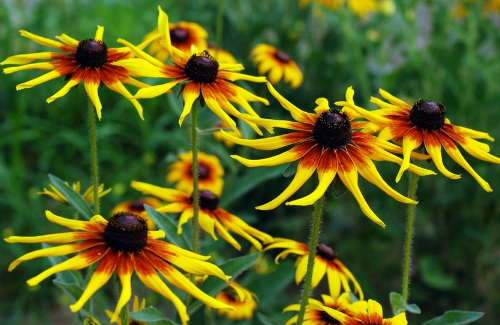
People who are familiar with chrysanthemum varieties must also know black-eyed Susan. The alias of black-eyed Susan is black-eyed coneflower, because the center of the black-eyed Susan flower is black-green, and the petals beside it are golden yellow, particularly brilliant and dazzling, and very beautiful. It is generally seen in scenic tourist areas or in courtyards, and has high ornamental value. Below, let us learn about how to grow black-eyed Susan and what uses black-eyed Susan has!
Introduction to Black-Eyed Susan
Black-eyed Susan, also known as black-eyed coneflower, is a perennial herbaceous plant, generally cultivated as a 1-2 year plant. The plant height can reach 2 m, with many branches. The stems of black-eyed Susan are rough, the leaves are spoon-shaped and broadly lanceolate, and the flower heads are golden yellow, bicolored, and hemispherical. Its place of origin is the eastern United States. It can be cultivated in ordinary soil, has strong adaptability, is drought-tolerant, is not strongly cold-tolerant, likes a sunny and ventilated environment, and its flowering period is from June to October.
Planting Methods for Black-Eyed Susan
Black-eyed Susan can be planted in both spring and autumn. The planting site should be fertile soil with ample sunlight and good drainage for good growth; partial sun can also allow normal growth. After it survives, it should be watered appropriately. During the flowering period and in hot weather, appropriate shading should be provided to keep the colors of black-eyed Susan vivid. After flowering, cutting off the remaining branches and leaves can encourage regrowth. Be careful to prevent poor drainage, which can cause root rot.
What Uses Does Black-Eyed Susan Have
1. Black-eyed Susan has bright colors, greatly enhancing its visual appeal, and it especially draws attention.
2. Black-eyed Susan keeps blooming for a very long time, increasing sales opportunities.
3. It is an award-winning variety in European gardens, and its excellent characteristics have been widely recognized.
4. There is a wide choice of growth habits and flowering forms, which gives it the possibility of wide use.
5. It is heat-resistant and long-lasting, increasing consumer satisfaction.
6. It can be used as a windowsill plant, park potted plant, regional planting or background plant, and can also be grown as a main flower or cultivated in large concentrated plantings.
Summary: The center of the black-eyed Susan flower is not only black, but can also be green, so some people call black-eyed Susan the "Irish Eyes." Don't you think this name is very poetic? Because black-eyed Susan looks especially beautiful, it is also loved by people all over the world. Well, today's sharing from the editor on the planting methods of black-eyed Susan and the uses of black-eyed Susan ends here.
▂▃▄▅Recommended Reading
⊙Aluminum Alloy Dust-Proof Mat ⊙Colorful Cross-Stitch ⊙Curtain Fabric Wholesale Prices ⊙When Does Osmanthus Bloom ⊙Does Mimosa Bloom
⊙Wealth and Prosperity Cross-Stitch ⊙Eight-Degree Space Decorative Painting ⊙What Does Carnation Represent ⊙How to Grow Phalaenopsis Orchids ⊙Fast Cross-Stitch Methods
⊙Great Prospects Cross-Stitch ⊙Dendrobium Planting Techniques ⊙How to Grow Scented Lilies ⊙How to Grow Hibiscus ⊙Top Ten Electric Blanket Brands
How to Grow Black-Eyed Susan What Uses Does Black-Eyed Susan Have
❤`•.¸¸.•´´¯`•Related Recommendations:
❤Mucuna Birdwoodiana
❤Potentilla Discolor
❤Scutellaria Barbata Pictures and Benefits
❤Baohua Magnolia Picture Appreciation Collection
❤When Does Osmanthus Bloom
❤`•.¸¸.•´´¯`•Decorate your little home and enjoy every minute of life! This article comes from Aiyouwo!
..........................................................................................
People who are familiar with chrysanthemum varieties must also know black-eyed Susan. The alias of black-eyed Susan is black-eyed coneflower, because the center of the black-eyed Susan flower is black-green, and the petals beside it are golden yellow, particularly brilliant and dazzling, and very beautiful. It is generally seen in scenic tourist areas or in courtyards, and has high ornamental value. Below, let us learn about how to grow black-eyed Susan and what uses black-eyed Susan has!
Introduction to Black-Eyed Susan
Black-eyed Susan, also known as black-eyed coneflower, is a perennial herbaceous plant, generally cultivated as a 1-2 year plant. The plant height can reach 2 m, with many branches. The stems of black-eyed Susan are rough, the leaves are spoon-shaped and broadly lanceolate, and the flower heads are golden yellow, bicolored, and hemispherical. Its place of origin is the eastern United States. It can be cultivated in ordinary soil, has strong adaptability, is drought-tolerant, is not strongly cold-tolerant, likes a sunny and ventilated environment, and its flowering period is from June to October.
Planting Methods for Black-Eyed Susan
Black-eyed Susan can be planted in both spring and autumn. The planting site should be fertile soil with ample sunlight and good drainage for good growth; partial sun can also allow normal growth. After it survives, it should be watered appropriately. During the flowering period and in hot weather, appropriate shading should be provided to keep the colors of black-eyed Susan vivid. After flowering, cutting off the remaining branches and leaves can encourage regrowth. Be careful to prevent poor drainage, which can cause root rot.
What Uses Does Black-Eyed Susan Have
1. Black-eyed Susan has bright colors, greatly enhancing its visual appeal, and it especially draws attention.
2. Black-eyed Susan keeps blooming for a very long time, increasing sales opportunities.
3. It is an award-winning variety in European gardens, and its excellent characteristics have been widely recognized.
4. There is a wide choice of growth habits and flowering forms, which gives it the possibility of wide use.
5. It is heat-resistant and long-lasting, increasing consumer satisfaction.
6. It can be used as a windowsill plant, park potted plant, regional planting or background plant, and can also be grown as a main flower or cultivated in large concentrated plantings.
Summary: The center of the black-eyed Susan flower is not only black, but can also be green, so some people call black-eyed Susan the "Irish Eyes." Don't you think this name is very poetic? Because black-eyed Susan looks especially beautiful, it is also loved by people all over the world. Well, today's sharing from the editor on the planting methods of black-eyed Susan and the uses of black-eyed Susan ends here.
▂ ▃ ▄ ▅