What are the common propagation methods for petunia?
1. Seed propagation
Before sowing, fill the pot with soil and water it thoroughly. After sowing, mist finely to moisten the seeds. The seeds must not be covered with any medium, otherwise germination will be affected. After sowing, maintain the soil temperature at 22-24°C, and seedlings emerge in 4-7 days.
2. Cuttings
Stems can be cut into small sections of 5-10 cm. After the cut surface dries, insert them into the soil. Just make sure not to plant them upside down.
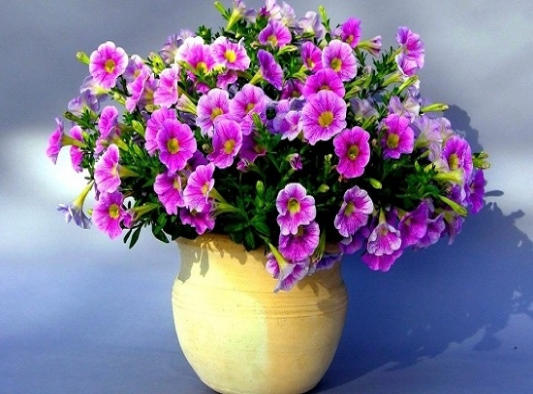
After reading the editor's sharing, have you thought about planting a pot of petunias to decorate your little world when the right season comes? Aren't you also tempted by such beautiful and lovely petunia flowers? Well, that's all for today's content! If you want to learn more about petunia cultivation methods, then follow our Four Seasons Plants website, where there is more content you want!
Petunia cultivation methods
Petunia, Solanaceae, Petunia genus. Official name Petunia. Perennial herb, often grown as an annual or biennial, height 20—45 cm; stems prostrate, covered with sticky soft hairs; leaves soft, ovate, entire, alternate, upper leaves opposite; flowers solitary, funnel-shaped, double-flowered forms spherical, flowers white, purple or various reds, edged with other colors, very beautiful, flowering period from April to frost; capsule; seeds tiny. Distributed in South America, now widely popular in various countries. Commonly propagated by sowing, cuttings and tissue culture.1. Seed propagation: Petunia is often grown as an annual. The sowing time depends on the market time. If flowers are needed in May, sow in a greenhouse in January. For flowers in October, sow in July. The sowing time should also be adjusted according to different varieties. Petunia seeds are tiny, with 9000-10000 seeds per gram. The suitable germination temperature is 20-22°C. Use indoor pot sowing, with a mixture of high-temperature sterilized culture soil, leaf mold and fine sand. After sowing, no soil covering is needed, just press lightly, and germination occurs in about 10 days. When true leaves appear, the room temperature should be 13-15°C.
2. Cutting propagation: Indoor cultivation can be carried out all year round. After flowering, cut the germinated tender top shoots, 10 cm long, and insert them into a sand bed. The cutting medium temperature is 20-25°C. Roots form 15-20 days after cutting, and they can be transplanted into pots after 30 days.
3. Tissue culture propagation: Explants use seeds, leaves and fertilized ovaries, etc. If using seeds, soak them in detergent solution for 5 minutes, take them out and rinse clean with water. Under sterile conditions, first soak in 75% alcohol for 8 minutes, then soak in 0.1% mercuric chloride solution for 7 minutes, take them out and rinse with sterile water, then inoculate on MS medium (with 6-benzylaminopurine 0.5-1.0 mg/L and naphthaleneacetic acid 0.1 mg/L added). After 15 days of inoculation, small buds appear. Cut the small buds and transfer them to the original medium for subculture. After 20 days, one small bud can produce more than 10 buds. Insert 1 cm strong buds into 1/2 MS medium containing naphthaleneacetic acid 0.05-0.2 mg/L. After 10 days, 100% root, becoming complete small plantlets.
Petunia propagation methods and petunia effects and functions
Petunia is a familiar flowering plant, used very widely. It can be seen in many places and occasions such as homes, roadside flower beds, event venue arrangements, etc. Today we will introduce to you the propagation methods of petunia and knowledge about petunia's effects and functions.
Petunia propagation methods:
The main propagation methods of petunia are cuttings and sowing, while tissue culture propagation is not commonly used. Tissue culture propagation is carried out in a sterile environment, and attention should be paid to sterilization before culture. Let's look at the two propagation methods of petunia, cuttings and sowing:
1. Petunia cutting propagation method: Petunia cuttings are best carried out from late spring to the plum rain period when the temperature is not very hot. Cut the germinated tender top shoots, 10 cm long, and insert them into a sand bed. The cutting medium temperature is 20-25°C. Note that except for the first watering after cutting, which can be slightly more, subsequent watering should be frequent and light. Otherwise, the stem sections inserted underground are very prone to rotting and dying. Roots form 15-20 days after cutting, and they can be transplanted into pots after 30 days.
2. Petunia seed propagation method: Petunia seeds are very small. With proper sowing and care, the germination rate can reach over 60%. Petunia seed propagation is suitable for indoor pot sowing, using a mixture of high-temperature sterilized culture soil, leaf mold and fine sand. After sowing, no soil covering is needed, just press lightly. The suitable germination temperature is 20-22°C. After sowing, germination occurs in 7-10 days. When true leaves appear, the room temperature should be 13-15°C.
Petunia effects and functions:
1. Decorating the home
Petunia has large flowers and bright colors, with rich flower colors. As a vigorous ornamental flower, it can be widely used in flower bed arrangements, flower trough configurations, scenic spot displays, windowsill decoration, home decoration, etc. In the home, whether as a potted ornamental plant or as a hanging basket planting decoration, it will have a very good beautifying effect, and it is a good helper for beautifying the home.
2. Gift-giving
Petunia can also be given as a gift to express feelings. The flower language of petunia is peace of mind, of one heart with you; with you I feel warm; the flower language of white petunia is existence; the flower language of purple petunia is broken love. Different flower color varieties of petunia also have different meanings, but the meanings of petunia flowers are all relatively beautiful, and giving them as gifts to express feelings is also a good choice.
3. Medicinal use
Many people know that the biggest use of petunia is to arrange and beautify the environment, but in fact petunia can also be used medicinally. The seeds of morning glory are also called morning glory seed, black morning glory seed, white morning glory seed, and can be used as medicine. They have purgative, diuretic, swelling-reducing and deworming effects, and have a certain effect on treating chronic nephritis complicated with edema, facial freckles, and facial acne.