How to grow petunias? Keep these care tips in mind
1. Watering
When summer temperatures are too high, spray water more often to keep the soil moist.
2. Light
In winter, make sure petunias receive plenty of sunlight; although petunias have some ability to withstand low temperatures, you still need to ensure the temperature stays above 5°C.
3. Temperature
During winter care, water less and maintain a good temperature. It is best to water at noon when sunlight is plentiful, and do not use too much water each time. Prevent frost damage!
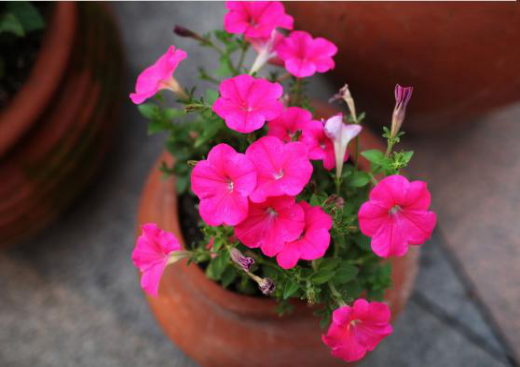
After reading the editor's sharing, do you know a little more about petunias? I hope these tips are helpful to you. When petunias bloom, their colors are vivid and dazzling, with very high ornamental value, so flower lovers must make the most of the petunia blooming season and take in the beautiful sight of petunias in bloom; it must be a wonderful pleasure! Well, that is all for today's introduction. Thank you for your patient reading!
Petunia cutting propagation methods, petunia care methods
Petunia is a hybrid variety with a short, neat plant and rich flower colors, and it is also highly adaptable, making it a common variety for garden planting and landscaping. Below, the editor will show you the cutting propagation methods and care methods for double petunias.
Petunia cutting methods
First, selection and preparation of petunia branches: choose healthy branches, cut below the node on the stem, let the wound dry, remove all flower buds and fruits from the cutting branch, and remove 2/3 of the leaves.
Second, choose the cutting medium. Ideally, use coarse-structured media such as coarse sand and perlite, because such media have good water permeability and help rooting; of course, other media can also be used.
Third, cutting season. Generally speaking, the survival rate of petunia cuttings in spring and autumn is higher than in summer.
Fourth, pay attention during the cutting process. The cutting site can be in a place with diffused light. The best temperature during cutting is 18°C-20°C. Keep it moist. Generally, roots will form in about 2 weeks.
Propagation methods for double petunias
Double petunias are generally formed through hybridization, but it is not easy to collect seeds, so cutting propagation is mostly used, with a higher survival rate in early spring and mid-autumn.
The specific method is to take young shoots that sprout after flowering and insert them into sterilized plain sand or vermiculite. The insertion depth is 1/2 or 1/3 of the length of the cutting. After inserting, place them in a sheltered, shady place. At a soil temperature of 10~22°C, they will root in about 2 weeks.
Care methods for double petunias
Although petunias are very easy to cultivate, to achieve the double-flowered effect and improve ornamental value, pay attention to the following points in care and management:
1. Pinch back multiple times.
To make the plant shape compact and the petals overlapping, start pinching back multiple times from the seedling stage to encourage more branching. In addition, the plant should also be dwarfed to prevent its branches and leaves from growing excessively.
2. The clever use of phosphorus and potassium fertilizers.
The soil for planting petunias should not be given too much nitrogen fertilizer, so more phosphorus and potassium fertilizers are needed. During the flowering period, phosphorus and potassium fertilizers can extend the flowering period and make the flowers more abundant.
3. Prevent pests and diseases.
The main pests attacking petunias include aphids, mites, flower thrips, and others, among which aphids are the most serious. Therefore, a good cultivation environment should be created to prevent the occurrence of pests and diseases.
That is all for today's introduction to petunia cutting propagation methods and petunia care methods. I hope the editor's article can help everyone. If you want to learn about other agricultural knowledge, please continue to follow our Huobao Nongzi website.
Autumn petunia care methods
When petunias bloom, the colorful flowers compete in beauty like little trumpets. When petunia flowers bloom in patches, the whole courtyard is captivated by petunia flowers, extremely stunning. Petunia care differs in every season. Autumn is almost here, so the editor will introduce autumn petunia care methods to everyone.
Temperature and environment
In autumn, petunias are suitable for sowing when the temperature is 20°C. Seedlings can only be transplanted when they grow 5-6 small leaves. Pay attention to temperature control. Only seedlings planted out in a 15-20°C environment can grow more robustly!
At the end of autumn and the beginning of winter, the temperature drops sharply, so cold protection measures should be taken in advance to ensure petunias grow in an environment above 0°C. Proper low temperatures also help make petunias develop a thick, low plant shape.
Soil
For autumn petunia care, note that the soil should be loose, well-drained sandy soil. After the seedlings are successfully planted out, keep the soil moist, provide sufficient light, and avoid water accumulation.
Watering and fertilizing
Autumn is the season petunias like most, and no fertilizing is needed. Water in the morning and evening to keep the soil moist, and give plenty of sun.
Placement
In autumn, petunias are suitable for placement on balconies facing south, east, or west, avoiding exposure to strong sun while ensuring sunlight.
If you want plants to grow well, the owner's careful care is naturally indispensable. Remember to take good care of your petunias in autumn~