How to grow air plants? Detailed guide to cultivation methods and precautions
Cultivation environment
Temperature: 15°C to 25°C is the standard. In winter, above 5°C. In summer, if the temperature must not exceed 25°C, if it exceeds this, ventilation and sprinkling/watering need to be increased.
Water: generally water once or twice a week. In addition, air plants have high requirements for air humidity, and misting is also very important. Two or three times a week is suitable; during drought, once a day. Do not let too much water accumulate in the leaf center, as it easily causes rot.
Light: choose light according to the variety; gray-leaved types like strong light, while green-leaved types have good shade tolerance.
Fertilizing: once a week; pause fertilizing in winter and during the flowering period.
Disease control
The disease most likely to affect air plants is sunscald. It is prone to occurring when there is too much water on the leaf surface and the light is too strong. Pay attention to ventilation to speed up evaporation. After watering or misting, do not place them in a place with strong light.
Pest control
The main pest of air plants is red spider mites. Red spider mites suck moisture from the leaves, causing the leaves to dry up. After discovery, spray the targeted pesticide and appropriately increase humidity.
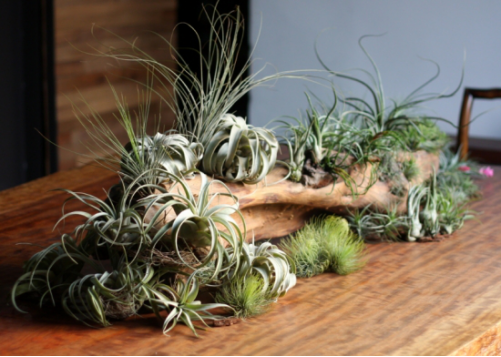
Throughout the four seasons, people adjust their condition according to the weather, and plants are no exception! So how is the seasonal care of air plants carried out?
Air plant growing conditions Air plant cultivation precautions
Air plants are very magical plants. They can grow luxuriantly without soil and can bloom with bright flowers, and they have high ornamental value. Therefore, they have become a good choice for many people to grow as indoor plants. Below we will take a detailed look at air plant growing conditions and air plant cultivation precautions.
Air plant living habits
Air plants do not need to be planted in soil, nor do they need to be grown in water. They are a special plant that can grow as long as they are misted. The hairs on the leaf surface can absorb moisture and nitrogen compounds from the air, and they can live very well without special care, though they grow quite slowly.
Growing environment: air plants grow in tropical and subtropical rainforests or arid mountainous areas at altitudes of 100 m-5000 m, attached to tree trunks, rocks, or cliff crevices, with a few growing on cacti. Their greatest difference from terrestrial plants is that their roots have no function of absorbing water and nutrients; they merely serve to fix the plant and carry out a small amount of air exchange. Nutrients and water are absorbed through the silver-gray hairy scales on the leaf surface, and they basically cannot survive when planted in water or soil.
Most air plant varieties are native to the tropical or subtropical regions of Central and South America, growing on flat ground or in high mountain areas at altitudes of 1000 m-3000 m. Here there is little rain and drought, strong sunlight, and great temperature variation, but there is moisture from fog all year round. The unique ecological environment gives air plants their distinctive habits. In their places of origin, these plants mostly attach to cacti, stone walls, rotten wood, utility poles, eaves, and other places to grow. Therefore, when planting, flower pots and soil are not needed; they can be hung up or stuck to dead wood, walls, and other objects, or placed in other shallow containers. If potted, coarse gravel, stones, and the like can be used as the growing medium to fix the plant.
Air plants are tolerant of drought and strong light. Their root systems are very underdeveloped, and some varieties even have no roots. Even if they have roots, they can only serve to fix the plant and cannot absorb water and nutrients. So how do air plants absorb water? If you observe carefully, you will find that there are many small white scales on the leaf surface. These scales are mostly shield-shaped and sunken. Moisture or rainwater in the air is captured by the stomata in the sunken areas and penetrates into the plant body through the gaps between parenchyma cells. Usually, the stomata in these scales are half-closed during the day when the temperature is higher and the air is relatively dry, to reduce water evaporation; at night when the temperature drops and air humidity increases, they open completely and absorb moisture from the air.
Most air plant varieties grow in dry environments, while a small number prefer humid environments. Varieties that grow in rainforest climates or other relatively humid, shady areas have broad, green leaves and produce larger flowers, but the flower colors are rather monotonous. They live epiphytically on another plant or tree trunk, and over time they gradually grow roots to fix the plant itself. They can reproduce the next generation from seeds or offsets. Varieties from dry areas have a completely different appearance. Their plants are smaller, with needle-like or hard leaves, and usually grow in whole clusters to reduce water evaporation. They rely on the large number of hairs on the leaf surface to absorb rainwater, dew, fog, and nutrients. Because they all survive by absorbing moisture from the air through the leaf surface, their bodies have made many changes, including water-storage tissue, complex water-absorbing hairs, reduced leaf number, root degeneration, reduced body size, and increased seed number. Most of the more advanced air plants look gray-white because the leaf surface is covered with hairs, which serve to reflect light, avoid sunburn, and prevent water evaporation. The more exposed to sunlight they are, the denser their hairs become.
The greatest difference between these plants and ordinary plants is that they have no root system. The water and nutrients they need are completely absorbed through the stomata on the leaf surface. If planted in soil or water, they cannot survive instead. Both flowers and leaves are very special. The leaves have evolved into special forms, including water-storage tissue, scales on the leaves, reduced leaf number, and root degeneration. They have extremely strong adaptability to adverse conditions and can tolerate drought, light, wind, shade, heat, and cold; they need no pot, no soil, and do not breed mosquitoes; they are plants that grow epiphytically on tree trunks, stone walls, and even cacti.
Air plants are drought-tolerant aerial species in the genus Tillandsia of the pineapple family, and are perennial epiphytic or aerial herbaceous plants.
Cultivation methods
The main cultivation containers for air plants include shells, stones, dead wood, tree fern boards, rattan baskets, and so on. For fixing, they can be tied with wire or rope, or glued to the container with all-purpose glue or hot melt adhesive, or cultivated by hanging, tied with copper wire or rope and suspended in the air.
Temperature
Air plants are native to the highlands of Central and South America. They can tolerate a low temperature of 5°C, and the suitable growing temperature is 15°C-25°C. When above 25°C, ventilation and humidity need to be increased.
Watering
Air plants can be misted with a spray bottle 2-3 times a week, and in dry seasons should be misted once a day. When misting, spray until the leaf surface is completely wet, and be careful not to let water accumulate in the leaf center. If too much water is sprayed, the plant can be turned upside down to let the excess water flow out.
Light
Varieties with grayer leaves, more white scales, and thicker, harder leaves need stronger light; varieties with greener leaves, fewer scales, and softer leaves are more shade-tolerant. When cultivated indoors, they should be placed in a place with bright light. If there is insufficient light, the plant will become leggy and weak.
Fertilizing
Under artificial cultivation conditions, you can spray with Huabao or monopotassium phosphate plus urea diluted 1000 times with water, once a week, or soak the plant in a fertilizer solution diluted 3000-5000 times for 1-2 hours. Fertilizing can be stopped in winter and during the flowering period.
Precautions
1. Strictly speaking, it is not necessarily required to keep above 5°C in winter. If there is good light during the day, even below 0°C is no problem;
2. Also, I want to remind everyone that you must never plant it in a tank. Air plants need a large amount of air circulation, and they will rot in a stuffy tank. If the weather is too dry, just soak the plant in water for about an hour, then shake off the water on the leaves. Also, when the leaves are wet, never expose them to the sun, or the leaves will be damaged by the sun. All air plants are relatively drought-tolerant, and it is absolutely no problem to go several days without water;
3. Varieties of the silver-leaf type are even more drought-tolerant than others. Please appropriately reduce watering frequency to avoid rot;
Most air plants do not have as high a requirement for air humidity as imagined, and even in their places of origin, air humidity is not high during the day when there is light, but at night, due to the temperature difference caused by cooling, water vapor condenses on the plant to form water, which is then absorbed by the leaves. As long as you grasp this characteristic, you can adjust the water supply according to different cultivation environments. Generally speaking, air plants only need to be given water at night. The specific amount depends on the environment and the condition of the plant, and this requires growers to control it flexibly according to the situation.
Air plants have extremely strong stress resistance. When they look slightly dry, their resistance can reach its peak. Plants that look tender have very low resistance and are prone to disease and rot at the slightest disturbance. Therefore, in cultivation, it is better to let the plant be a little dry so that it can maintain a healthy state.
The above is the relevant introduction in this article. I believe that after reading it, you also have a simple understanding of this. If needed, you can continue to follow No. 1 Home Network to learn more information.
Key points for growing air plants in summer How air plants get through summer
Summer and winter are the times that test the toughness of air plants. Many people ask me how air plants should safely get through summer. I was busy for the past few days, and my answers to everyone were also hasty. Now I will tell everyone my experience.
1. Pay attention to ventilation
Ventilation is a very important point in any season, spring, summer, autumn, or winter. Especially after watering, ventilation must be provided to let the air plant dry as soon as possible. Because summer is very hot, after water accumulates, air plants easily rot in the center and die. And the signs of death are not easily noticed.
2. Watering
After 7 p.m. every day, mist lightly. Giving the air plant a layer of water mist is enough, and you can mist like this every day. If too much water is sprayed, turn it upside down as soon as possible or use a small electric fan to blow it dry as soon as possible. I do not approve of soaking in water, but those who are confident can try it.
3. Light
Avoid the midday sun and pay attention to shading. If it is scattered light, shading is unnecessary; if it is direct sun, be careful. If your air plant is grown outdoors, then it may already have adapted to the outside environment, so do not change it easily; if you are only just preparing to grow it outdoors, then bring it back quickly and grow it outdoors again in autumn. You must let them adapt to the environment slowly.
4. Dormancy period
In winter, they generally enter dormancy at 5°C, so at what temperature do they enter dormancy in summer? Generally above 35°C. Therefore, after entering this temperature, there is no need to fertilize. For water, just pay attention according to the points above.
5. Judging death
There are 2 kinds of death in summer: one is that the base becomes very soft; the other is rotting in the center. The common point of these 2 is that the surface of the plant shows no change at all.