How to grow Schizanthus pinnatus? Remember these care tips
Pruning
Pruning Schizanthus pinnatus needs frequent pruning during its growth to keep the plant looking attractive. When transplanting the plant into a pot, pinch it back once so it produces more new branches; afterward, to keep the plant ornamental, it can be pruned several times. After Schizanthus pinnatus finishes blooming, the spent flowers can also be cut off. This way it can still send out new branches and bloom again.
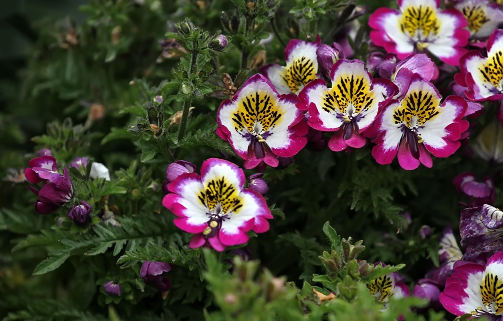
Schizanthus pinnatus is a very beautiful flower. If you are careful and attentive when growing it, you will soon see its lovely blooms.
How to grow Schizanthus pinnatus and care tips
Chinese scientific name: Schizanthus pinnatusLatin scientific name: Schizanthus pinnatusAlso known as: Schizanthus, butterfly flower, poor man's orchidKingdom: PlantaeDivision: AngiospermsClass: DicotyledonsOrder: SolanalesFamily: SolanaceaeGenus: SchizanthusSchizanthus pinnatus, a native of Chile (Chile) with eight varieties, is an annual or perennial herbaceous plant. This plant can grow up to 3 feet (90 cm) tall. Its leaves are dark green, covered with short, sticky fine hairs. The large funnel-shaped flowers come in purple, blue, red, yellow or white, with golden-yellow veins.1. Morphological characteristics
Biennial herb, plant height 60-120cm, sparsely covered with slightly sticky glandular hairs. Leaves simple, alternate, 1-2 times pinnately parted, segments entire or coarsely toothed. Panicle terminal, flowers numerous, about 3cm in diameter, calyx tubular, 5-parted deeply, corolla tube shorter than the calyx, limb labiate, upper lip pale, with a yellow blotch on the middle lobe extending toward the stem and with violet spots, lower lip purple, flower color intensity and shape highly variable.2. Growing environment
Likes light and a cool environment, requires well-drained and fertile soil, and has weak cold tolerance.3. Distribution
Native to Chile. Distributed in Japan, Korea and southern China, southwestern China, and the Taiwan region of China, and cultivated in greenhouses in various places.Morphological characteristics and habits of Schizanthus pinnatus. How to grow and propagate Schizanthus pinnatus
Schizanthus pinnatus is a biennial herb native to Chile (Chile) with eight varieties, and this plant can grow up to 3 feet (90 cm) tall.
The leaves of Schizanthus pinnatus are dark green, covered with short, sticky fine hairs. The large funnel-shaped flowers come in purple, blue, red, yellow or white, with golden-yellow veins.
The flowering period of Schizanthus pinnatus is April-June.
Morphological characteristics of Schizanthus pinnatus
Schizanthus pinnatus is a biennial herb, plant height 60-120cm, sparsely covered with slightly sticky glandular hairs. Leaves simple, alternate, 1-2 times pinnately parted, segments entire or coarsely toothed. Panicle terminal, flowers numerous, about 3cm in diameter, calyx tubular, 5-parted deeply, corolla tube shorter than the calyx, limb labiate, upper lip pale, with a yellow blotch on the middle lobe extending toward the stem and with violet spots, lower lip purple, flower color intensity and shape highly variable.
The flowering period of Schizanthus pinnatus is April-June.
Ecological habits of Schizanthus pinnatus
Schizanthus pinnatus likes light and a cool environment, requires well-drained and fertile soil, and has weak cold tolerance.
How to grow Schizanthus pinnatus
Sow Schizanthus pinnatus indoors in pots in August-September; the seeds are tiny, so there is no need to cover them with soil.
Seedling raising
1. Sowing time: sow from late August to early October
2. Seedbed: refer to cineraria
3. Sowing rate: about 1600 seeds per gram, sow 2 grams per square meter, which can raise about 2000 or more seedlings
4. Covering depth: 3-4mm. Seedlings emerge 7-10 days after sowing.
5. Points to note in seedling raising:
(1) The seeds are relatively large, so the soil covering should be slightly deeper than for cineraria;
(2) The seedbed must be watered thoroughly before or after sowing. After sowing, water with a fine mist or water under a shade net;
(3) Keep the seedbed moist before seedling emergence;
(4) Before emergence, a net can be placed over the seedbed for shade to retain moisture and lower temperature, but after emergence full-light management is required;
(5) Seedlings are very prone to leggy growth (mainly because the hypocotyl tends to elongate). Therefore, after emergence the net must be removed promptly, sowing density must not be too high, and thinning should be done appropriately early; in the early seedling stage, water should be properly controlled, and pricking out should be done promptly. 120ppm 15% paclobutrazol (8 grams/10 kilograms water) can also be used to control height.
Pricking out
Prick out when there are 3-4 true leaves. Although Schizanthus pinnatus has a relatively developed root system and pricking out can be done in open ground, the roots are easily damaged when digging up seedlings; if pricking out is too dense, the pricking-out bed soil is poor, potting up is too late, or seedlings are handled improperly when lifted and moved, or if light and water are managed improperly during the recovery period after potting, serious transplant shock may still occur after potting, leading to stunted seedlings and affecting later growth and flowering. Therefore, it is recommended to prick out into 10X8cm nutrition pots. The pricking-out soil is compost soil: decomposed sawdust at 4:1. Plant slightly deep so that the cotyledon node is just exposed. During pricking out, remove weak, spindly seedlings and leggy seedlings. After pricking out, shade with a shade net for 4-5 days, covering in the morning and uncovering in the evening, and use full light after recovery. Fertilize 3-4 times during the seedling stage; the fertilizer is 45% high-concentration compound fertilizer or urea at a concentration of 1‰, or cake fertilizer water diluted about 15 times.
Potting up
Pot up at 6-7 leaves; if the pots are spaced once (one row taken out from every two rows and placed elsewhere), potting up can be delayed until 8-9 leaves, with a pot diameter of 14-16cm. The potting soil is compost soil: decomposed sawdust = 3:1, plus 1.5kg/cubic meter of compound fertilizer. The potting depth is slightly over the original root ball (the cotyledon node buried 0.5cm).
Watering and fertilizing
Watering after potting should follow the principle of "water when dry, withhold when wet," that is, there must be a process in which the potting soil dries out between two waterings. The degree of dryness is judged by leaves being slightly wilted. Schizanthus pinnatus has relatively strong growth and some drought tolerance, so, considering controlling plant height, improving cold resistance, and lowering humidity to prevent disease, watering under protected cultivation conditions should generally be moderately on the dry side. The following is for reference:
On the wet side: seedbed after sowing, after true leaves appear, after pricking out, during the period of vigorous seedling growth, during the period of vigorous growth after potting
On the dry side: after full stand, before pricking out, after recovery, before potting up, mid-bud stage
Notes on watering and fertilizing:
1. Dry and wet are not absolute; the "degree" should be grasped. Wet but not soggy, dry but not parched.
2. Consider the specific situation. If leggy growth appears during the vigorous growth period, water and fertilizer should be properly controlled.
Schizanthus pinnatus has a low fertilizer requirement; fertilize about once every 10 days, mainly nitrogen in the early stage and mainly phosphorus and potassium in the middle and late stages. The fertilizers are mainly urea and 45% high-concentration compound fertilizer, at a concentration of about 2‰ (slightly lighter during the seedling stage and flowering stage, slightly stronger during the vigorous growth period).
Propagation methods of Schizanthus pinnatus
Schizanthus pinnatus is usually propagated by sowing; sown in spring, it blooms in summer.
Suitable germination temperature: 15-20℃ Sowing period: autumn, winter
Suitable growth temperature: 15-25℃ Flowering period: spring
Seedling raising: the seeds are light-sensitive, so after sowing they must be covered with fine soil, kept at an appropriate temperature, and germinate in about 10-15 days; the seedlings are fertilized 1-2 times, and when the seedlings are about 10-15CM tall they are transplanted into flower pots or flower beds.
The flower language of Schizanthus pinnatus
The flower language of Schizanthus pinnatus: natural love.
Gift recipients: friends, someone you admire.
After reading the above introduction to the growing and propagation methods of Schizanthus pinnatus, do you have a better understanding of growing and propagating it? To learn more about Schizanthus pinnatus, please keep following.