How to Grow and Care for Schizanthus pinnatus: Methods and Precautions
Pot and Soil Selection
Schizanthus pinnatus has its own requirements when it comes to planting. It is best to choose a 10-15 cm pot. When transplanting seedlings, remember to keep soil around the roots. The soil should be loose, airy, fertile and well-draining. You can mix this kind of soil yourself according to the proportions, but if you find that too troublesome, you can simply go to a flower shop and buy a specialized potting mix for the plant.
Watering
Schizanthus pinnatus grows very vigorously and has strong drought tolerance, but it is afraid of waterlogging. So when watering, wait until the soil has dried out before watering, and once you water, soak the soil thoroughly. How can you tell whether the soil is dry or wet? If you notice the leaves are slightly wilted, that means the soil is dry and the plant needs watering.
Light and Temperature
Schizanthus pinnatus is a light-loving plant and prefers a warm environment. During its growing period, give it plenty of sunlight, especially in winter when daylight hours are shorter, provide as much light as possible. The growing temperature can be kept between 15°C and 25°C, and in winter it should also be kept at a relatively high temperature; below 0°C the plant is prone to cold damage.
That covers how to grow Schizanthus pinnatus. Now let us look at what needs attention with Schizanthus pinnatus.
Schizanthus pinnatus Schizanthus pinnatus Illustrated Guide: How to Grow Schizanthus pinnatus / How to Propagate Schizanthus pinnatus
Schizanthus pinnatus ProfileSchizanthus pinnatus
Aliases: Schizanthus, butterfly flower, poor man's orchid, butterfly flower, shepherd's purse flower
Classification: Biennial herbaceous flower
Family and Genus: Plantae Angiosperms Dicotyledons Solanales Solanaceae Schizanthus
Peak Blooming Period: Summer
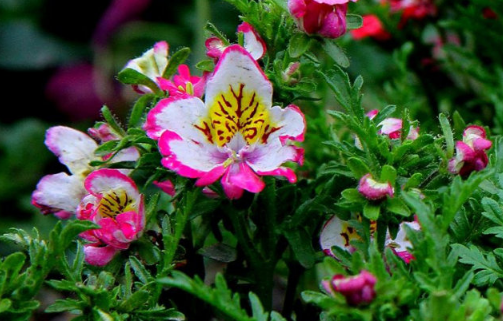
Schizanthus pinnatus is a biennial herb native to Chile (Chile) with eight varieties, and this plant can grow up to 3 feet (90 cm) tall. The leaves of Schizanthus pinnatus are dark green, covered with short, sticky fine hairs. The large funnel-shaped flowers come in purple, blue, red, yellow or white, with golden-yellow veins. Schizanthus pinnatus blooms from April to June.
How to Grow and Care for Schizanthus pinnatus: An Introduction to Schizanthus pinnatus
Schizanthus pinnatus is a biennial herb native to Chile (Chile) with eight varieties, and this plant can grow up to 3 feet (90 cm) tall.
The leaves of Schizanthus pinnatus are dark green, covered with short, sticky fine hairs. The large funnel-shaped flowers come in purple, blue, red, yellow or white, with golden-yellow veins.
Schizanthus pinnatus blooms from April to June.
Morphological Characteristics of Schizanthus pinnatus
Schizanthus pinnatus is a biennial herb, 60-120 cm tall, sparsely covered with slightly sticky glandular hairs. Leaves are simple and alternate, 1-2 times pinnately parted, with segments entire or coarsely toothed. The panicle is terminal, with numerous flowers about 3 cm in diameter; the calyx is tubular, 5-parted to the base; the corolla tube is shorter than the calyx; the limb is two-lipped, the upper lip pale in color with a yellow blotch on the middle lobe extending toward the stem and purple-violet spots, the lower lip purple; flower color intensity and shape are highly variable.
Schizanthus pinnatus blooms from April to June.
Ecological Habits of Schizanthus pinnatus
Schizanthus pinnatus loves light and prefers a cool environment, requires well-draining and fertile soil, and has weak cold hardiness.
Cultivation Techniques for Schizanthus pinnatus Planting
A fertile sandy loam or leaf mold rich in organic matter is best. For pot cultivation use a 10-15CM pot. For flower beds, space plants 30-40CM apart. Drainage must be good and sunlight must be sufficient. In winter it is best grown in a greenhouse. After the plants are established, pinch out the growing tips once to encourage more branching. After the flowers fade, cut off the spent blooms to encourage new shoots and more flowers. It likes warmth and dislikes high temperature and humidity; when muggy weather occurs, take measures to ventilate and cool down to prevent withering.
Winter Management
The seedling stage can tolerate -3°C. In southern regions it can be grown in the open ground or in a single-layer greenhouse; in the middle and lower reaches of the Yangtze River it can be grown in a single-layer or double-layer greenhouse. In northern regions below -10°C, if grown in a greenhouse, three layers of insulating cover are advisable. When potted flowers are first moved into the greenhouse or the frame is covered with film, this should be done before the lowest temperature in autumn and winter drops to 0°C. Temperature management in protected cultivation: 18-20°C during the day and 0-1°C at night is ideal (if the night temperature is too low, growth is slow, the growing period is prolonged, flowering is delayed, and cultivation costs increase). With prolonged low temperatures below -3°C, leaves will suffer cold damage, and flower buds may suffer severe freezing damage, resulting in blind buds.
For other matters such as opening the greenhouse for ventilation and cold protection and insulation, please refer to cineraria.
Plant Adjustment
High-quality potted flowers should have a good plant shape and appearance: short, sturdy and full, with leaves spread out, dark green and thick, and with many sturdy, compact branches. This can only be achieved on the basis of selecting excellent varieties and paying attention to every aspect of management. In addition to sowing appropriately thinly, pricking out seedlings in time, and potting up in time, also note the following:
1. Move the pots apart in time
Schizanthus pinnatus pots should be moved apart early and spaced thinly, because good ventilation and light, along with moderate dryness of the potting soil and air, are very beneficial for controlling its plant shape and preventing disease.
2. Height control with growth retardants
Under normal cultivation and management conditions, growth retardants are generally unnecessary. In certain special situations, such as during the peak growing season after potting up, under continuous rainy days, or under low humidity and scant light when there is a tendency to grow leggy; or when, due to weather, holidays and other reasons, moving pots apart and ventilation may be delayed, it can be used as a preventive and remedial measure. Spraying foliage with 15% paclobutrazol at 150ppm (10 g/10 kg water) not only has a good dwarfing effect, but also improves the plant's cold resistance, drought resistance and disease resistance.
3. Pay attention to ventilation and air exchange in the greenhouse
The optimum growing temperature for Schizanthus pinnatus is slightly lower than that of cineraria, so ventilation should be started earlier and be more generous. On rainy days, ventilation should also be maintained to prevent leggy, spindly growth.
How to Grow Schizanthus pinnatus
Schizanthus pinnatus is sown indoors in pots in August-September; the seeds are very small, so covering with soil is unnecessary.
Seedling Raising
1. Sowing time: sow from late August to early October
2. Seedbed: refer to cineraria
3. Sowing rate: about 1,600 seeds per gram; sow 2 grams per square meter, which can produce more than 2,000 seedlings
4. Depth of soil covering the seeds: 3-4 mm. Seedlings emerge 7-10 days after sowing.
5. Points to note in seedling raising:
(1) The seeds are relatively large, so the soil covering should be slightly deeper than for cineraria;
(2) Water thoroughly before or after sowing in the seedbed. After sowing, water with a fine mist or water under a shade net;
(3) Maintain seedbed moisture before emergence;
(4) Before emergence, to retain moisture and lower temperature, a shade net may be placed over the seedbed, but after emergence full-light management must be used;
(5) Seedlings are very prone to becoming leggy (mainly because the hypocotyl tends to elongate). Therefore, after emergence, remove the net promptly, do not sow too densely, and thin the seedlings appropriately and early; in the early seedling stage, control water appropriately and prick out seedlings in time. You can also use 120ppm 15% paclobutrazol (8 g/10 kg water) to control height.
Pricking Out
Prick out seedlings when they have 3-4 true leaves. Although Schizanthus pinnatus has a relatively well-developed root system and pricking out can be done in the open ground, digging up the seedlings easily damages the roots; if seedlings are pricked out too densely, if the soil in the pricking-out bed is of poor quality, if potting up is too late or if the seedlings are handled improperly when lifted and transported, or if the recovery period after potting up is mismanaged in terms of light and water, severe transplant shock can still occur after potting up, leading to stunted seedlings and affecting later growth and flowering. Therefore, it is recommended to prick out seedlings into 10X8cm nutrition pots. The pricking-out mix is compost soil: decomposed sawdust at 4:1. Set the seedlings slightly deeper so that the cotyledon node is just exposed. When pricking out, remove thin, weak seedlings and leggy seedlings. After pricking out, shade with a shade net for 4-5 days, covering in the morning and uncovering in the evening, and use full light after the seedlings recover. Fertilize 3-4 times during the seedling stage; the fertilizer is 45% high-concentration compound fertilizer or urea at a concentration of 1‰, or cake fertilizer water diluted about 15 times.
Potting Up
Pot up when there are 6-7 leaves. If the pots are moved apart once (pulling out one row from every two rows and placing it elsewhere), potting up can be postponed until there are 8-9 leaves, using a 14-16cm pot. The potting mix is compost soil: decomposed sawdust = 3:1, plus 1.5kg/cubic meter of compound fertilizer. The planting depth is slightly above the original root ball (with the cotyledon node buried 0.5cm).
Watering and Fertilizing
After potting up, watering should follow the principle of "water when dry, stop when wet," meaning there must be a period between two waterings during which the potting soil dries out. The degree of dryness is judged by slight wilting of the leaves. Schizanthus pinnatus has fairly strong growth and a certain drought tolerance, so considering height control, improved cold resistance and lower humidity to prevent disease, watering under protected cultivation should generally be moderately on the dry side. The following can serve as a reference:
On the wetter side: seedbed after sowing, after true leaves appear, after pricking out, during vigorous seedling growth, during vigorous growth after potting up
On the drier side: after full emergence, before pricking out, after seedlings recover, before potting up, mid-bud stage
But note:
1. Dry and wet are not absolute; one should grasp the "degree." Wet but not soggy, dry but not parched.
2. Consider the specific situation. If during the vigorous growth period there is a tendency to grow leggy, then water and fertilizer should be appropriately controlled.
Schizanthus pinnatus does not need much fertilizer. Fertilize about once every 10 days, mainly nitrogen in the early stage and mainly phosphorus and potassium in the middle and late stages. The fertilizers are mainly urea and 45% high-concentration compound fertilizer, at a concentration of about 2‰ (slightly weaker during the seedling and flowering stages, slightly stronger during the vigorous growth period).
Propagation Methods for Schizanthus pinnatus
Schizanthus pinnatus is usually propagated by sowing; sown in spring, it blooms in summer.
Optimum germination temperature: 15-20°C Sowing period: autumn, winter
Optimum growing temperature: 15-25°C Flowering period: spring
Seedling raising: The seeds are photophobic, so after sowing they must be covered with fine soil and kept at an appropriate temperature. They germinate in about 10-15 days. After the seedlings have been fertilized 1-2 times and reach about 10-15CM in height, transplant them into flower pots or flower beds.
Disease Prevention and Control for Schizanthus pinnatus
Apart from occasional underground pests during the seedling stage, no insect pests have been observed on Schizanthus pinnatus.
The main diseases are sclerotinia rot (mainly infecting stems and often causing the whole plant to die) and gray mold (mainly infecting flowers). Paying attention to field sanitation, moving pots apart in time, improving ventilation, watering reasonably, and not using old potting soil containing pathogens can effectively prevent disease.
Usually inspect and observe frequently, and remove diseased plants early to prevent them from spreading the infection.
Distribution Range of Schizanthus pinnatus
Schizanthus pinnatus is native to Chile and is distributed in Japan, Korea and the South China, Southwest China and Taiwan regions of China; it is cultivated in greenhouses in various places.
Uses and Purposes of Schizanthus pinnatus Ornamental Value
Schizanthus pinnatus blooms profusely and has brilliant colors; it is a beautiful cut flower and potted flower for spring, and can also be grown indoors in pots for viewing.
Flower Bed Decoration
Schizanthus pinnatus is an excellent material for early-spring flower beds.
Cultural Background of Schizanthus pinnatus Origin of the Name
The flower shape of Schizanthus pinnatus closely resembles a dancing butterfly, hence the name.
Flower Language of Schizanthus pinnatus
Flower language of Schizanthus pinnatus: natural love.
Gift-giving occasions: friends, someone you admire.
Schizanthus pinnatus Pictures
How to Grow Schizanthus pinnatus in Winter
Temperature for Growing Schizanthus pinnatus in Winter
Schizanthus pinnatus is quite cold-hardy and can generally tolerate low temperatures of minus three degrees Celsius, but when caring for it in winter, insulation measures should still be taken. It can be moved indoors for cultivation, and the room temperature should not be too low; it is best kept above 0°C, especially at night, when the temperature must be controlled even more carefully. If it is too low, it can easily cause slow plant growth and later flowering. The most suitable daytime temperature is 18-20°C. If the temperature stays below -3°C for a long time, it will cause freezing damage.
Light for Growing Schizanthus pinnatus in Winter
Schizanthus pinnatus likes a sunny environment. Although it needs to be cared for indoors in winter, in such a shaded environment it needs the supply of light even more to ensure normal growth activity. If it gets no light or the light is relatively weak, many problems will arise.
Water for Growing Schizanthus pinnatus in Winter
After winter arrives, water evaporates relatively slowly, so the water supply should be appropriately reduced. Moreover, Schizanthus pinnatus has a certain drought tolerance, so slightly dry soil is fine; of course, it must not be too dry. The main thing is to avoid long-term dampness of the soil, and especially avoid water accumulation, otherwise root rot is very likely. In addition, it is best not to water the flowers directly with tap water, as the large temperature difference may damage its root system.
Fertilizer for Growing Schizanthus pinnatus in Winter
After autumn, Schizanthus pinnatus enters its dormant period, so fertilization should be reduced or stopped, because at this time its root system grows very slowly. Even if fertilizer is applied, much of it cannot be absorbed, and it may even in turn interfere with the plant's normal absorption and, in severe cases, cause root rot.
The most important thing in growing Schizanthus pinnatus in winter is temperature management. Of course, other aspects also need attention. We hope everyone's Schizanthus pinnatus can get through the winter safely.