What are the main pests and diseases of Russelia equisetiformis?
Damage from aphids, cottony cushion scale, circular armored scale, and black hairy caterpillars, etc.
That's all for today's content! Thank you all for your patient reading! Friends interested in Russelia equisetiformis, do you know how to grow it now? I hope everyone can grow Russelia equisetiformis with abundant blooms!
Russelia equisetiformis Schlecht. et Cham. Russelia equisetiformis guide: how to grow Russelia equisetiformis / how to propagate Russelia equisetiformis
Russelia equisetiformis profileRusselia equisetiformis Schlecht. et Cham.
Russelia equisetiformis growing methods and precautions, introduction to Russelia equisetiformis
Russelia equisetiformis blooms profusely and lasts long with bright red flowers; the flowers resemble firecrackers, making it an ideal trailing greenery plant for balconies. In warm regions it can bloom continuously all year round, and it already shows flowers at Spring Festival time, making it even more beloved.
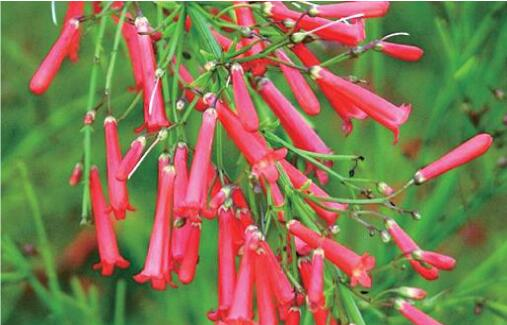
Russelia equisetiformis has bright red flowers, hanging down in large clusters just like firecrackers, quite spectacular. In warm regions it blooms almost continuously all year round, and already shows flowers at Spring Festival time, making it even more beloved. It can be potted for display, and can also be used in flower beds, beside rocks, and in lawns. Russelia equisetiformis has slender, trailing branches and leaves, blooms profusely, persists long, and is bright red; the flowers resemble firecrackers, making it an ideal trailing greenery plant for balconies, and it can be used for greening cultivation in balcony flower pools, dam tops, slope edges, and other places.
Russelia equisetiformis belongs to the genus Russelia in the family Plantaginaceae, also known as "firecracker flower" and "lucky grass," native to Mexico and Central America. Russelia equisetiformis is a perennial herbaceous plant in the family Scrophulariaceae, genus Russelia. Under suitable conditions, it can bloom all year round.
Morphological characteristics of Russelia equisetiformis
Russelia equisetiformis is a multi-branched, clumping semi-vine flowering plant, about 1 m tall; the stems are initially erect, with the tips bending and drooping, hanging down under gravity when in flower. The branchlets are whorled, slender, with obvious nodes. The leaves are ovate or linear-lanceolate, mostly reduced and very small. The large panicle composed of cymes bears many flowers, bending downward; the flowers are bright red, the corolla tubular, slightly two-lipped, about 2.5 cm long. The capsule is spherical. The flowering period is mainly from March to June, and in warm regions it often blooms continuously all year round.
Russelia equisetiformis plants are 60-100 cm tall, with slender stems and branches that have longitudinal ridges and are green, whorled at the nodes, and much branched. The small leaves are opposite or whorled, mostly reduced to small scales. The cymes bear long tubular red corollas, with an indistinct two-lipped apex, the upper lip 2-lobed and the lower lip 3-lobed.
Russelia equisetiformis is an erect, horsetail-like semi-shrub, up to 1 meter tall, entirely hairless. The stems are branched and whorled, slender, with ridges. The leaves are whorled, reduced to lanceolate scales. The cymose panicle is narrow and long, the small cymes have 1-3 flowers, the peduncle up to 3 cm long, the bracts subulate; the pedicels nearly 1 cm long; the calyx is small, only 2-3 mm long, deeply cleft more than halfway into 5 lobes, the lobes ovate-triangular, acute, imbricate; the corolla up to 2 cm long, red, with a long tube, indistinctly 2-lipped, the upper lip 2-lobed, the lower lip 3-lobed; there are 4 stamens, included, and the staminodes are very small, located behind the base of the corolla tube. The capsule is spherical, dehiscing loculicidally.
The Russelia equisetiformis plant is semi-trailing, 1-1.3 meters long. The leaves are opposite or whorled, reduced to narrowly lanceolate or linear, papery, green, with young leaves tinged purplish-red, entire; the branches are slender, soft, dense, ridged, and green. The raceme is borne at the tips of the branchlets, the flowers are relatively small, long-tubular, 3 cm long, deep red, and drooping.
Russelia equisetiformis can bloom all year round, with the peak flowering period from May to August. The capsule is spherical, dehiscing loculicidally.
Original morphology
Russelia equisetiformis is a herb, erect, up to 1 m tall. Horsetail-like, almost leafless. The whole plant is hairless. The stems are four-angled, the branches slender and whorled, with drooping tips. The leaves are small, scattered; the blades are oblong to oblong-ovate, less than 1.5 cm long, mostly reduced to scales on the branches. The cymose panicle is narrow and long, the small cymes have 1-3 flowers; the peduncle up to 3 mm long, deeply cleft more than halfway into 5 lobes, the lobes ovate-triangular, acute, imbricate; the corolla is bright red, about 2.5 cm long, with a long tube, indistinctly 2-lipped, the upper lip 2-lobed, the lobes ovate or long-ovate, about 3 mm long, the lower lip 3-lobed; there are 4 stamens, included, and the staminodes are very small, located behind the base of the corolla tube.
Ecological habits of Russelia equisetiformis
Russelia equisetiformis is native to tropical Central America. It prefers a climate environment of high temperature, high humidity, and ample sunlight, and prefers fertile soil; it tolerates shade, and avoids poor barren soil, drought, waterlogging, and cold; the suitable growth temperature is 18-30°C.
Russelia equisetiformis likes warmth and is not cold-tolerant; it requires well-drained, loose, fertile soil. The minimum overwintering temperature for greenhouse cultivation is 12°C.
Cultivation techniques of Russelia equisetiformis: cultivation environment
Russelia equisetiformis is a light-loving sun plant, preferring a warm, high-temperature, and humid climate. It is suitable for planting in sunny and ventilated places, and the soil is best as well-drained sandy loam. It has strong vitality, grows vigorously, and is easy to cultivate. It is often planted in courtyards, trellises, flower gates, and fences as vertical greening.
Cultivation substrate
Field-planted Russelia equisetiformis requires deep soil layers and good soil permeability. It has strong adaptability, and can grow normally even in ordinary soil. Seedlings from layering are planted in the same year and bloom the next year. Never let fertilizer and water run short; keep the soil moist, and water twice a day in hot seasons. Apply dilute liquid fertilizer 1-2 times a month. For shaping and maintenance, vertical greening requires setting up supports to guide growth. Do not turn the vines during the growth period, so as not to damage the tendrils and cause poor growth and weak flowering.
Cultivation key points
For cultivating Russelia equisetiformis, choose an environment with sufficient light and heat and abundant fertilizer and water. If the cultivation environment is too shady, the plants grow slender and only produce long branches without flowering; while if the climate is too hot and dry, the plants will show premature aging. The cultivation soil should be loose, fertile, and rich in organic matter. In the peak growth season, liquid fertilizer should also be applied 1-3 times a month. Early overly thin and overly dense branches should be pruned off, and at the same time the plant height should be controlled to prevent excessive rampant growth.
Potted management
Potting
When potting small seedlings or repotting large plants that have been grown for several years, first place 2-3 cm thick coarse-grained substrate at the bottom of the pot as a drainage layer, sprinkle a layer of fully decomposed organic fertilizer on top as base fertilizer, about 1-2 cm thick, then cover with a thin layer of substrate about 1-2 cm thick, and then place the plant in, so as to separate the fertilizer from the root system and avoid burning the roots.
Pruning
In winter, when Russelia equisetiformis enters dormancy or semi-dormancy, cut off weak, diseased, pest-infested, dead, and overly dense branches. Branch organization can also be combined with cuttings.
Repotting
As long as it is maintained properly, it will grow very fast. When it grows to a certain size, consider giving it a larger pot so that it can continue to grow vigorously. For the potting soil and component ratio used for repotting, one of the following can be chosen: vegetable garden soil: cinder = 3:1; or garden soil: medium-coarse river sand: sawdust (mushroom residue) = 4:1:2; or one of paddy soil, pond mud, or leaf mold.
Depotting
Place the flower to be repotted on the ground, first pat the sides of the pot gently with the palm so that the root system is shaken and separates from the pot wall, then turn the flower pot upside down on the left hand, gently clamp the plant between the index finger and middle finger of the left hand, brace the wrist and fingertips against the pot rim, pat the bottom of the pot with the right hand, and then use the thumb to push the root soil downward from the bottom hole to let the plant come out. After it comes out, gently pat the pot soil with both palms to let excess soil fall off.
Flower pot preparation
Choose a flower pot of appropriate size, and cover the bottom hole of the pot with two pieces of tile or thin foam pieces, ensuring both that the pot soil is not washed out by water and that excess water can flow out in time. On the tile or foam, place a layer of ceramsite or crushed red bricks as a drainage layer, about 2-3 cm thick. On the drainage layer, place organic fertilizer, about 1-3 cm thick, and on the fertilizer place a thin layer of substrate, about 2 cm thick, to separate the root system from the fertilizer, and finally put the plant in, fill with nutrient soil, leaving about 2-3 cm from the pot rim.
For the substrate used for potting, one of the following can be chosen: vegetable garden soil: cinder = 3:1; or garden soil: medium-coarse river sand: sawdust (mushroom residue) = 4:1:2; or one of paddy soil, pond mud, or leaf mold. After potting, water thoroughly once, and keep it in a shaded environment for one week. When transplanting small seedlings, first dig the planting hole, sprinkle a layer of organic fertilizer at the bottom of the planting hole as base fertilizer (base manure), about 4-6 cm thick, then cover with a layer of soil and place the seedling in, so as to separate the fertilizer from the root system and avoid burning the roots. After placing the seedling in, backfill the soil, cover the root system, and press the soil firm with your foot, then water thoroughly once.
For cultivating Russelia equisetiformis, choose an environment with sufficient light and heat and abundant fertilizer and water. If the cultivation environment is too shady, the plants grow slender and only produce long branches without flowering; while if the climate is too hot and dry, the plants will show premature aging. The cultivation soil should be loose, fertile, and rich in organic matter. In the peak growth season, liquid fertilizer should also be applied 1-3 times a month. Early overly thin and overly dense branches should be pruned off, and at the same time the plant height should be controlled to prevent excessive rampant growth.
Management key points
Humidity
Russelia equisetiformis likes a humid climate environment and requires the relative air humidity of the growing environment to be 70-80%. If the relative air humidity is too low, the lower leaves turn yellow and fall off, and the upper leaves lose their luster.
Temperature
Because Russelia equisetiformis is native to tropical regions and likes a high-temperature, high-humidity environment, it has very strict requirements for winter temperature. When the ambient temperature is below 10°C, growth stops, and it cannot overwinter safely when frost occurs.
Light
Russelia equisetiformis likes a semi-shady environment. In autumn, winter, and spring, it can be given ample sunlight, but in summer it should be shaded by more than 50%. When kept indoors, place it in a place with bright light as much as possible, such as a well-lit living room, bedroom, study, and other places. After keeping it indoors for a period (about one month), move it outdoors to a shaded place (with winter insulation conditions) for a period (about one month), and alternate back and forth in this way.
Fertilizer and water
For potted plants, in addition to adding organic fertilizer when potting, appropriate fertilizer and water management should also be carried out during usual maintenance.
Spring, summer, and autumn
These three seasons are its peak growth seasons. Fertilizer and water management follows the cycle of "Huabao" - clear water - "Huabao" - clear water, with an interval of about 1-4 days; on sunny days or during high temperatures the interval is shorter, and on rainy days or during low temperatures the interval is longer or no watering is done.
Winter
During the winter dormancy period, the main work is to control fertilizer and water. Fertilizer and water management follows the cycle of "Huabao" - clear water - clear water - "Huabao" - clear water - clear water, with an interval of about 3-7 days; on sunny days or during high temperatures the interval is shorter, and on rainy days or during low temperatures the interval is longer or no watering is done.
For field-planted plants, in spring and summer, according to drought conditions, apply fertilizer and water 2-4 times: first open a small ditch in a circle 30-100 cm away from the root crown (the larger the plant, the farther from the root crown), with the ditch width and depth both 20 cm. Sprinkle 25-50 jin of organic fertilizer into the ditch, or 1-5 liang of granular compound fertilizer (chemical fertilizer), then water thoroughly. After winter begins and before spring begins, apply fertilizer once more in the above manner, but do not water.
Growing methods of Russelia equisetiformis: maintenance key points
Firecracker flower is native to Mexico and likes a warm, humid environment with ample sunlight; the stronger the light, the better it blooms. Therefore, during cultivation, let it receive as much light as possible, and there is no need to shade it even in midsummer. Firecracker flower fears waterlogging and is slightly drought-tolerant. Water so that it is dry before watering and wet after, neither allowing long-term water accumulation nor excessive drought; it is best to keep the pot soil moist without water accumulation. When the air is dry, spray water on the plant to increase humidity. During the growth period, apply decomposed thin cake fertilizer about once every 10 days. In winter, place it indoors in a sunny place, stop water and fertilizer, and keeping it above 8°C is enough for safe overwintering.
Firecracker flower is tolerant of pruning, and the flowers mostly open on tender branches, so during cultivation it should be pruned frequently to prompt the plant to produce more tender branches, so as to achieve the goal of more flowering.
Repot once every spring. When repotting, prune the plant, cutting off overly long and messy branches, and appropriately trim the root system, then plant it into fertile sandy soil with good drainage and aeration. Propagation of firecracker flower can be done by division combined with spring repotting, or by cuttings at 15°C to 25°C.
The cuttings should have the tender top shoots and the lower already lignified old branches removed, with three leaf axils as the standard, about 7-10 cm long, with side branches cut off, and inserted into the soil by 1/3. Place in a semi-shady place, keep the pot soil moist and maintain a certain air humidity, and roots will form in 20-30 days. The tubular flowers of firecracker flower closely resemble firecrackers about to be lit.
Blooming on the emerald green and slender branches, they give people a festive and warm feeling. They can be potted or grown in hanging baskets, decorating balconies, courtyards, or hung under corridors, all with good effect.
For cultivating Russelia equisetiformis, choose an environment with sufficient light and heat and abundant fertilizer and water. If the cultivation environment is too shady, the plants grow slender and only produce long branches without flowering; while if the climate is too hot and dry, the plants will show premature aging. The cultivation soil should be loose, fertile, and rich in organic matter. In the peak growth season, liquid fertilizer should also be applied 1-3 times a month. Early overly thin and overly dense branches should be pruned off, and at the same time the plant height should be controlled to prevent excessive rampant growth.
Propagation methods of Russelia equisetiformis
Russelia equisetiformis can be propagated by cuttings, division, or layering. Cut thick and thin branches into 10-15 cm pieces, insert them into plain sand, shade them, and maintain 80%-90% humidity; the survival rate can reach over 90%; or press the drooping branches of the plant into the soil, and they will root and grow into independent new plants; division is best done during the rainy season from July to September.
Cutting propagation
Softwood cuttings are often taken from current-year branches in late spring and early autumn, or hardwood cuttings are taken from last-year branches in early spring. For home cuttings, it is difficult to obtain an ideal cutting substrate due to limited conditions, so it is recommended to use a ready-made and sterilized cutting substrate; medium-coarse river sand can also be used, but it should be rinsed several times with clear water before use. Do not use sea sand or river sand from saline-alkali areas; they are not suitable for the growth of flowering plants.
When doing softwood cuttings, during the vigorous growth of the plant from late spring to early autumn, select robust current-year branches as cuttings. After cutting the branches off, select the sturdy parts and cut them into sections 5-15 cm long, each section bearing more than 3 leaf nodes. When cutting the cuttings, note that the upper cut should be made horizontally about 1 cm above the topmost leaf node, and the lower cut should be made diagonally about 0.5 cm below the bottommost leaf node; both the upper and lower cuts should be smooth (the knife must be sharp). When doing hardwood cuttings, after the temperature rises in early spring, select robust branches from last year as cuttings. Each cutting usually retains 3-4 nodes, and the cutting method is the same as for softwood cuttings.
Management after cutting
Temperature
The optimum temperature for rooting of cuttings is 20°C-30°C. Below 20°C, the cuttings root with difficulty and slowly; above 30°C, the upper and lower cuts of the cuttings are easily infected by pathogens and rot, and the higher the temperature, the greater the proportion of rot. When low temperatures are encountered after cutting, the main measure for heat preservation is to wrap the flower pot or container used for cuttings with plastic film; when the temperature is too high after cutting, the main measure for cooling is to shade the cuttings, blocking out 50-80% of sunlight, and at the same time spray the cuttings 3-5 times a day; on sunny days with higher temperatures, spray more often, and on rainy days with lower temperatures and higher humidity, spray less often or not at all.
Humidity
After cutting, the relative air humidity must be maintained at 75-85%. The basic requirement for rooting of cuttings is that before the cuttings root, it must be ensured that the cuttings remain fresh and tender so they can carry out photosynthesis to produce rooting substances. But cuttings that have not yet rooted cannot absorb enough water to maintain their internal water balance. Therefore, spraying must be used to reduce water evaporation from the cuttings: under shaded conditions, spray the cuttings 3-5 times a day; on sunny days with higher temperatures, spray more often, and on rainy days with lower temperatures, spray less often or not at all. However, excessive spraying makes the cuttings easily infected by pathogens and rot, because many kinds of pathogens exist in water.
Light
Cutting propagation cannot do without sunlight, because the cuttings still need to continue photosynthesis to produce nutrients and rooting substances to supply their rooting needs. However, the stronger the light, the higher the temperature inside the cuttings, the more vigorous the transpiration of the cuttings, and the more water they consume, which is not conducive to the survival of the cuttings. Therefore, after cutting, 50-80% of sunlight must be blocked, and after the root system grows out, gradually remove the shading net: on sunny days, remove the shading net at 4:00 p.m. each day, and cover it again before 9:00 a.m. the next day.
Layering propagation
Select robust branches, and from about 15-30 cm below the top shoot, peel off a ring of bark, with the width of the wound after peeling about one cm and the depth limited to just removing the epidermis. Cut a piece of plastic film 10-20 cm long and 5-8 cm wide, place some moistened garden soil on it, and wrap the girdled part as if wrapping a wound, tying the upper and lower ends of the film tightly, with the middle bulging. Roots form after about four to six weeks. After rooting, cut off the branch together with the root system, and it becomes a new plant.
Propagation and seedling raising
Mainly cuttings and layering. Cuttings are done in spring and summer. Old stem cuttings are a good way to quickly form plants: use old stems 2 meters long sprouting from the base as cuttings, which root after 2 months, then let them grow freely and transplant the next year. Layering is done all year round, best in spring and summer. Select short-noded, sturdy branches, keep the leaves, wound below the node, press them into the soil or a pot nearby, keep moist, they root in 30 days, and can be cut from the mother plant in 60 days.
Disease and pest control of Russelia equisetiformis
The main pests and diseases of Russelia equisetiformis are: damage from aphids, cottony cushion scale, circular armored scale, and black hairy caterpillars, etc.
Distribution area of Russelia equisetiformis
Russelia equisetiformis is native to Mexico and Central America. It is cultivated in various places in China, mostly used as potted plants, and in the north it needs to be brought indoors.
Dietary or medicinal value of Russelia equisetiformis
The medical information and health dietary information on Huhua Wang are for reference only and cannot be used as a basis for diagnosis or medical treatment. Any health problem should be consulted with professional medical personnel, and the treatment of any disease should follow doctor's orders.
Ultimate flower-protecting mission: love yourself, start from reality, and strictly follow doctor's orders. For illness, do not be careless, do not delay, do not give up hope, face it bravely, use love to warm the silent world, and use your heart to care for the flower field within.
Medicinal effects
[Aliases]: lucky grass, horse mane flower, guanyin willow, huadingzi, horse mane flower
[Latin plant animal mineral name]: RusseliaequisetiformisSchlecht. EtCham.
[Effects]: reconnect tendons and bones; activate blood and remove stasis.
[Textual research]: first recorded in "Essential Records of North China Economic Plants."
[Indications]: falls, sprains, and strains; knife wounds and metal-inflicted sores, fractures and tendon injuries.
[Various discussions]: "Outline of New China Materia Medica": externally used to treat fractures.
[Harvesting and storage]: harvested in summer, used fresh or dried in the sun.
[Resource distribution]: it is a beautiful ornamental garden plant. Often cultivated in Fujian and Guangdong.
[Efficacy classification]: bone-setting medicine.
[Nature and flavor]: sweet in taste; neutral in nature.
[Medicinal material source]: the aboveground part of the Scrophulariaceae plant Russelia equisetiformis.
[Usage and dosage]: external use: appropriate amount of fresh product, mashed and applied. Internal use: decocted in water, 10-15 g.
[Source]: "Chinese Materia Medica"
Uses and purposes of Russelia equisetiformis: home decoration
Russelia equisetiformis has slender, trailing branches and leaves, blooms profusely, persists long, and is bright red; the flowers resemble firecrackers, making it an ideal trailing greenery plant for balconies, and it can be used for greening cultivation in balcony flower pools, dam tops, slope edges, and other places. In warm regions it blooms almost continuously all year round, and already shows flowers at Spring Festival time, making it even more beloved.
Potted uses
Edited: the bright red flowers of firecracker flower bloom on slender branches, looking like firecrackers ready to ignite one by one, giving people a festive and warm feeling. It can be potted to decorate balconies, courtyards, and interiors, and can also be grown in hanging baskets, hung under corridors, in front of windows, and other places for viewing. In relatively warm regions, it can also be planted in the ground in flower beds, beside rockeries, beside rocks, and other places.
Landscape uses of Russelia equisetiformis
Russelia equisetiformis is native to Central America, and is cultivated in gardens in Guangdong and Fujian.
Russelia equisetiformis has slender, trailing branches and leaves, blooms profusely, persists long, and is bright red; the flowers resemble firecrackers, making it an ideal trailing greenery plant for balconies, and it can be used for greening cultivation in balcony flower pools, dam tops, slope edges, and other places.
Russelia equisetiformis has bright red flowers, hanging down in large clusters just like firecrackers, quite spectacular. It can be potted for display, and can also be used in flower beds, beside rocks, and in lawns.
Cultural background of Russelia equisetiformis: flower notes
Firecracker vine is named because the shape of its flowers resembles firecrackers. It also has another alias called golden coral. Whenever it blooms in spring, the little golden-yellow flowers dot the green wall like strings of firecrackers, and also as if a spark has exploded into a patch, adding much festive color to the garden and environment.
Firecracker vine clings to the wall; a single flowering tree can cover half a hundred-meter wall, and strings of firecracker vine, like firecrackers welcoming spring, hang over a wall dozens of meters long. Generally, it begins to bloom around January and only slowly fades after May. At the peak of flowering, the whole wall is like blazing fireworks, symbolizing prosperous red-hot good days and the host's wealth and good fortune.
After a spring rain, water droplets clinging to the flowers make them look even more delicate and lovely.
Flower language of Russelia equisetiformis
Flower language of firecracker vine: wealth and good fortune.
The firecracker vine, at its most magnificent during the peak flowering season, is timely and fitting, bringing a rich festive atmosphere to the host's garden and courtyard. During the New Spring season, the strings of flowers blooming all over the wall are like blazing fireworks, also symbolizing the host's wealth and good fortune and prosperous red-hot good days.
Firecracker vine is usually cultivated in the open air on balconies, terraces, and courtyards, requiring wooden or wrought-iron climbing flower frames. Smaller potted plants can also be placed in the living room for viewing during the Spring Festival, and both can bring a year of auspicious good luck to the home. In addition, it is also an excellent New Year gift for relatives and friends.
Russelia equisetiformis pictures
How to grow Russelia equisetiformis?
Russelia equisetiformis, also known as lucky grass, firecracker flower, exploding bamboo, firecracker flower, horse mane flower, firecracker bamboo, firecracker flower, huadingzi, horse mane flower, horsetail, coral flower, firecracker red, is a perennial herbaceous plant in the family Scrophulariaceae, genus Russelia. Under suitable conditions, it can bloom all year round. Today I will briefly introduce how to grow Russelia equisetiformis.
Morphological characteristics of Russelia equisetiformis
Russelia equisetiformis is a multi-branched, clumping semi-shrub, about 1 meter tall; the stems are initially erect, with the tips bending and drooping, hanging down under gravity when in flower. The branchlets are whorled, slender, with obvious nodes. The leaves are ovate or linear-lanceolate, mostly reduced and very small. The large panicle composed of cymes bears many flowers, bending downward. The flowers are bright red, the corolla tubular, slightly two-lipped, about 2.5 cm long. The capsule is spherical. The flowering period is mainly from March—June, and in warm regions it often blooms continuously all year round.
How to grow and propagate Firecracker Plant:
Firecracker Plant can be propagated by cuttings, division, or layering. Cut thick and thin branches into 10—15 cm lengths, insert them into plain sand, provide shade, and maintain 80%—90% humidity; the survival rate can reach over 90%. Alternatively, press the plant's drooping branches into the soil, where they will take root and grow into independent new plants. Division is best done during the rainy season from July—September.
Soil requirements:
Firecracker Plant is a sun-loving, light-demanding plant. It prefers a warm and humid climate and is suitable for planting in sunny and well-ventilated locations. A well-drained sandy loam soil is best. Firecracker Plant has strong vitality and vigorous growth, making it very easy to cultivate. It is mostly planted in courtyards, on trellises, flower gates, and fences as vertical greening.
Temperature conditions:
Because Firecracker Plant originates from tropical regions and prefers high-temperature, high-humidity environments, it has strict temperature requirements in winter. When the ambient temperature drops below 10°C, growth stops, and it cannot survive the winter safely when frost occurs. If the air humidity during growth is below 70%, the lower leaves will turn yellow and drop, and the upper leaves will lose their luster.
Light conditions:
Firecracker Plant prefers a semi-shaded environment. In autumn, winter, and spring, it can be given plenty of sunlight, but in summer it needs more than 50% shade. When kept indoors, place it in a location with bright light as much as possible, such as a well-lit living room, bedroom, or study. After being kept indoors for a period, move it to a shaded outdoor location.
Fertilizer and water management:
During the peak growing seasons of spring, summer, and autumn, fertilizer and water should be applied every 1—4 days. The interval should be shorter on sunny days or during high temperatures, and longer or skipped on cloudy, rainy days or during low temperatures. During the winter dormant period, fertilizer and water should be controlled, and applied every 3—7 days. Do not let water accumulate at the bottom of the pot, otherwise it is prone to frost damage.
Pruning and shaping:
Repot once every spring. When repotting, prune the plant. Firecracker Plant tolerates pruning well, and its flowers mostly bloom on young branches, so it should be pruned frequently during cultivation to encourage the plant to produce more young branches and achieve more blooms. Firecracker Plant is susceptible to pests and diseases such as aphids, cottony cushion scale, circular shield scale, and black hairy caterpillars.