How to Grow Coral Bells (Heuchera)? Detailed Care Methods and Precautions
1. Growing environment
Coral bells like to grow in a warm, humid and well-ventilated growing environment, and they are also very cold-hardy and fairly shade-tolerant, but they love sunlight very much. During their growing period, they must be given enough sunlight so that they can grow well. Another point is that the soil needed for planting them should be loose, airy, fertile and slightly acidic.
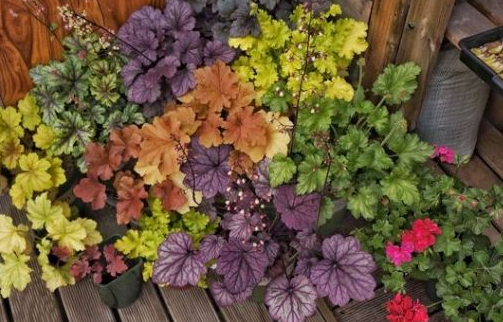
2. Fertilize in time
Coral bells should be fertilized in time during cultivation, as their demand for fertilizer is relatively high. Normally a slow-release fertilizer can be applied, and during their peak growing season some phosphorus and potassium fertilizer can also be applied appropriately, but after each fertilization they must be watered in time. Only in this way can their roots absorb and use the nutrients in the fertilizer in time.
3. Light and temperature
Coral bells like to grow in a warm environment, and they also love sunlight very much. During the growing period they should be grown in full sunlight, but note that in summer the temperature is too high and the sunlight is very intense, so at this time the plant must not be placed under direct sunlight, as this will scorch the plant. Therefore they should be shaded appropriately. In winter, because the temperature is too low, they should be moved indoors for care and placed in a spot that receives plenty of light.
The most suitable growing temperature for coral bells is between 20°C-28°C; within this temperature range they will grow very well, but they are also very cold-hardy. Even at minus 10 degrees in winter, they still grow tenaciously and will not die.
The above is an introduction to the question of how to grow coral bells. Now let us look at how coral bells are propagated!
How to Grow Coral Bells: Cultivation Methods and Precautions
Coral bells are a plant grown for the ornamental value of their leaves. They are relatively small in size, and their leaf colors are diverse, with red, yellow, green and purple being the most common. Many people now choose to grow coral bells, but most people are not very clear about how to grow them before they start. Let us take a look below!
How to grow coral bells
1. Best propagation time: as long as the high temperatures of summer noon are avoided, they can be propagated all year round.
2. Best growing soil: fertile, well-drained soil that is neutral to slightly acidic and rich in humus.
3. Growing humidity requirement: does not like dampness, prefers a semi-dry, semi-moist environment.
4. Best growing temperature: grows well above minus 15 degrees, but stops growing above 30 degrees.
5. Best growing light: coral bells are cold-hardy, sun-loving and shade-tolerant.
Cultivation methods for coral bells
1. Light and temperature. Coral bells are fairly cold-hardy, love sunlight and are shade-tolerant, making them very suitable for care in a cool, semi-shaded spot. In summer, avoid direct sunlight and shade them appropriately, and remember to keep them ventilated. In winter, coral bells can be placed in a sunny spot for care; coral bells are cold-hardy and can still grow at temperatures above -15°C.
2. Watering coral bells: in summer, water twice a week; in spring and autumn, water once a week; in winter, water once every half month, or even not at all. Watering should be decided according to the plant's needs. In addition, in summer you can water in the afternoon, and in winter when the weather is cold you can water a little less on a sunny morning. Do not spray water onto the crown.
3. Fertilizing. When growing coral bells, also pay attention to appropriate fertilization. In fact, coral bells grow even better in soil with a lower fertilizer content, but they can also tolerate soil with a higher fertilizer content. You can supplement a little more nitrogen fertilizer.
4. Propagation methods. Coral bells are mainly propagated by seed sowing and division, and can also be propagated by cuttings. For division, once the mother plant has grown enough to fill the pot, it can be divided. When dividing, pay attention to sterilization and disinfection. They are not strict about soil; if conditions allow, use slightly acidic soil that retains water and is airy. Mix some peat soil with some perlite at about a four-to-one ratio, apply fertilizer regularly, and avoid waterlogging.
Precautions for growing coral bells
1. Whether coral bells can be left outdoors in winter mainly depends on the temperature. Although coral bells are relatively cold-hardy and shade-tolerant plants, the low temperatures of winter can still harm them. In winter, you still need to decide whether to keep them indoors or leave them outdoors based on the climate environment and the growth condition of the coral bells.
2. When caring for coral bells, the soil must be chosen to be loose and airy. You can mix some river sand into the soil to increase airiness and drainage. For watering, follow the principle of watering only after the soil has dried out. In summer, especially, watering should be controlled so that waterlogging does not cause root rot.
3. Coral bells like light, and sufficient sunlight is beneficial to their growth. However, summer sunlight is too intense for coral bells, so to get them through summer, you need to avoid direct sunlight. You can place them on a shaded balcony for care, or in a cool place, such as an air-conditioned room, for care.
Pests and diseases of coral bells and their control
1. Pests and diseases are a fatal blow to any kind of plant. Once pests or diseases occur, they affect the plant's growth and can even kill it. Coral bells are a newly introduced plant, and pests and diseases are relatively rare; occasionally aphids, gray mold and root rot occur. Therefore, pest and disease control is mainly based on prevention.
2. During care, if you are worried about the threat of pests and diseases, you can frequently spray some insecticide or carbendazim for disinfection. The care environment needs to be semi-shaded and kept relatively cool, avoiding direct sunlight, which can reduce the chance of pests and diseases occurring.
The cultivation methods for coral bells can start with their growth habits. When growing them, special attention should be paid to their light and temperature, and shading should be done well during the high temperatures of summer. The fertilizer and water techniques for coral bells are also very important; appropriate watering and fertilizing are essential factors in ensuring their growth.
How to Grow Coral Bells: A Complete Guide to Coral Bell Varieties
How to Grow Coral Bells: A Complete Guide to Coral Bell Varieties
Coral bells (Heuchera micrantha), also known as coral bells, belong to the genus Heuchera in the family Saxifragaceae. They are perennial cold-hardy herbaceous flowers with shallow roots. The leaves are basal, broadly heart-shaped, 20-25cm long, deep purple, and evergreen in warm regions. The flowers are small, bell-shaped, 0.6-1.2cm in diameter, red, and bilaterally symmetrical.
They like semi-shade and tolerate full light; in gardens they are mostly used for understory flower borders, ground cover, courtyard greening and so on. The flowering period is from April to October. They are an ideal material for perennial flower borders. They are also a perennial herbaceous flower introduced from abroad in recent years.
Coral bells, this beautiful foliage plant, has many varieties. Based on leaf color alone, they can be divided into many color series. Which varieties of coral bells are popular?
Popular varieties of coral bells
Heuchera villosa
Heuchera villosa is a relatively popular cultivated variety of coral bells. The leaves of Heuchera villosa are covered with soft hairs, and the edges of the leaves are serrated.
The main varieties include the golden series 'Citronelle', 'Supreme Gold' (the underside of the leaf edge is light pink), and 'Electra'; the orange series 'Caramel'; and the green series 'Strawberry Swirl'.
Heuchera sanguinea
Heuchera sanguinea, also called coral bells, bears red flowers in a bell shape.
Popular varieties on the market include the green series 'Cascade', whose leaf undersides are purple; the green series 'Paris', whose leaf surfaces are variegated white; the green series 'Forest Green', whose veins are white-green between them; and the purple series and mixed-color variety 'Flower Carpet'.
Heuchera americana
Heuchera americana is a variety that entered the domestic market relatively early. Among them, 'Purple Palace' is its representative and was widely cultivated in the early days. This kind of coral bell was hybridized from Heuchera micrantha and Heuchera villosa.
Other varieties of coral bells
Caramel
Caramel is a kind of coral bell and belongs to the broadleaf type, with flower spikes in a conical shape.
Gardenia Yellow
Gardenia Yellow is also a kind of coral bell. Compared with other coral bells, Gardenia Yellow blooms later. Gardenia Yellow, in terms of leaf form and color changes, reminds people of maple leaves.
Peach Yellow
Peach Yellow shows a delicate silvery sheen on its leaves in spring, and the mature leaves turn purple with a slight rose-red tint.
Red Sandstone Red
The leaf color of Red Sandstone Red changes, going from peach red to bright copper yellow, and then to green with amber.
Noble Purple
Noble Purple produces pink-white flowers in summer, its leaf color remains a stable purple, and in winter the leaves turn silver.
Cultivation precautions
Coral bells are native to the United States, so they are widely used in American domestic landscape design. Coral bells are very easy to grow; whether the light conditions are full sun or partial shade, whether the growing soil is slightly moist or slightly dry, and whether the humidity is high or low, they can all grow well.
1. In winter, cultivate in a sunny spot; they are cold-hardy and can grow at temperatures above -15°C.
2. In summer, grow in a semi-shaded spot; avoid direct strong light to prevent sunburn.
3. Soil and fertilizer: plant in well-drained soil and add slow-release fertilizer. During the growing period, fertilize appropriately.
4. Watering: follow the principle of "water when dry, stop when wet." Water after the surface of the soil has dried. Because they do not like being too damp, watering can be appropriately controlled in summer.
Plant coral bells in a sloped spot. This is because they like well-drained substrates. Although they can tolerate short periods of high fertilizer content or high pH, coral bells grow more vigorously in a soilless substrate with good drainage and low fertilizer content. A continuous supply of 50 ppm nitrogen can ensure they grow robustly. The suitable pH for coral bells growth is 5.8 to 6.2, and the EC value is 2 to 3.5. Each watering of coral bells should be thorough, and the next watering should only be done after the substrate has completely dried out. Doing so can ensure normal plant growth, reduce the chance of the plant being infected by pathogens, and prevent Fusarium, Pythium, Botrytis and many others.