How to grow hollyhocks? Detailed guide to cultivation methods and precautions
Soil
Hollyhocks have a relatively strong tolerance to salt and alkali, so it is best to plant them in loose, fertile, sandy soil with good drainage.
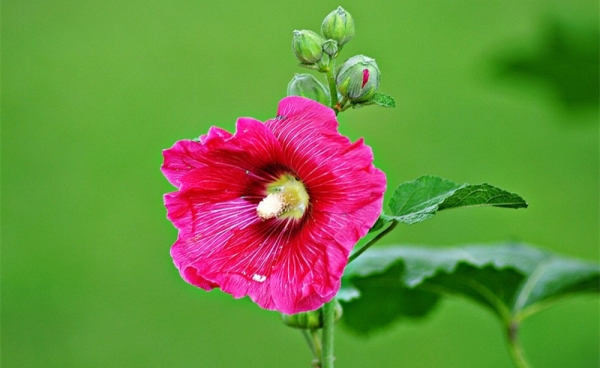
Watering
Hollyhocks have a relatively high demand for water during the flowering period, so we need to water appropriately to keep the soil moist and help prolong the flowering period.
Temperature
The suitable temperature for hollyhock growth is 25 to 30 degrees, and the suitable temperature during its flowering period is 26 to 28 degrees. If the temperature is too low, it will affect the flowering of hollyhocks and may even cause poor growth.
Fertilizing
During the seedling stage of hollyhocks, attention should be paid to fertilizing, weeding, and loosening the soil so that the plants grow strong. After flower buds form in the leaf axils, phosphorus and potassium fertilizer should be applied as a top dressing, and a few leaves at the base should be trimmed off.
When growing hollyhocks, what other precautions should we pay attention to?
Hollyhock cultivation methods
Hollyhock cultivation and management are relatively simple. When the seedlings grow 2 to 3 true leaves, they should be transplanted once, with increased spacing between plants and rows. After transplanting, water them in a timely manner. Before flowering, apply top dressing 1 to 2 times in combination with cultivating and weeding; phosphorus and potassium fertilizers are best for top dressing. After one transplanting, seedlings grown from seed can be planted out in November. During the seedling growth period, apply liquid fertilizer 2-3 times, mainly nitrogen fertilizer. At the same time, loosen the soil and weed frequently to help the plants grow strong.
After flower buds form in the leaf axils of hollyhocks, apply phosphorus and potassium fertilizer once as a top dressing. To prolong the flowering period, sufficient water should be maintained. After flowering, promptly cut off the aboveground parts, and new shoots can still sprout. When growing in pots, they should be potted in early spring, and only one main stem should be kept for flowering. Because hollyhock seeds are easy to scatter after ripening, they should be harvested in a timely manner. After 3-4 years of planting, the plants tend to age, so they should be renewed in a timely manner. In addition, hollyhocks easily crossbreed; to maintain variety purity, different varieties should be kept at a certain distance apart. Hollyhocks are susceptible to damage from leaf roller insects, aphids, red spiders, and others. Old plants and dry weather make them prone to rust disease, so timely control should be carried out.
Hollyhock cultivation methods
Hollyhock, also known as yizhanghong. A perennial herb in the Malvaceae family. Native to southwestern China.
1. Morphological characteristics: The plant is upright, reaching up to 2M tall, unbranched, with stems and leaves covered in hairs. The leaves are large, nearly round or heart-shaped palmately lobed leaves, often with 5〜7 shallow lobes, the leaf surface is rough and uneven, with petioles, and the raceme is solitary in the leaf axils, flower diameter7〜9 cm, flower colors include white, yellow, red, purple, dark purple, and bicolor. Flower forms include single, semi-double, and double varieties. The fruit is disc-shaped, and the seeds are kidney-shaped.
2. Growth habits: It prefers a warm, cool climate. The aboveground stems die when exposed to frost, and the tiller buds at the root crown can overwinter in the open ground. It likes sunlight and is slightly shade-tolerant. It is suitable for soil with deep, fertile layers and good drainage, and it has the ability to self-propagate.
Propagation methods: Seed propagation is commonly used. At 15 degrees, it germinates after 15〜20 days. Seedlings sown in autumn bloom the following year, while seedlings sown in spring often do not bloom in the same year and can only bloom the next year. Root crown tiller buds can also be used for division or cutting propagation. This method can maintain the excellent traits of the mother plant, such as double-flowered varieties and rare flower color varieties.
Cultivation and care: Hollyhocks grow robustly and require extensive management. They are often grown as wildflowers. Once planted, they can self-propagate and grow every year.
Pest and disease control: Hollyhocks rarely suffer from pests and diseases, and even if pests and diseases occur, they will not be endangered or die. The insect pests that need to be controlled include:
Cinnabar mite: Often occurs in mid-to-late May. When it occurs, many grayish-white small spots appear on the leaf surface, and the mites mostly damage the underside of leaves. During the occurrence period, spray for control with 40“ dicofol emulsifiable concentrate at 1 000〜1 500 times dilution, or 4 cm dimethoate emulsifiable concentrate at 1 500 times dilution.
Cotton leaf roller: Commonly known as leaf roller worm. The larvae roll the leaves into tubes and hide inside the tubes to eat the leaves. In severe cases, they can eat all the leaf parts, leaving only the thick, hard veins. The occurrence period is mostly in mid-June, late July, and late August. Control methods: 1. When few occur, manual capture can be used.
2. Spray 50 phoxim emulsifiable concentrate at 2 500 times dilution for control. In addition, aphids (cotton aphids) may sometimes occur, and generally their natural enemies can suppress severe damage.
Gardening uses: Hollyhock flowers are large, rich and bright in color, and have a long flowering period. They are an ideal material for backgrounds, screens, and decorative scenery around homes, and can also be used as fresh cut flowers for flower arrangements. In addition, the flowers, seedlings, roots, and seeds of hollyhocks can all be used as medicine. They are sweet and cold in nature, and have effects such as clearing heat and cooling blood, and promoting urination.