What should be noted when growing hollyhocks
When growing hollyhocks, to prevent the plants from staying short and lodging, we need to cut the roots around the plants in a cone shape with a spade around June, cutting the roots once every 2-3 weeks, then water immediately for care. When the fruit turns yellow and ripe, it should be harvested immediately to prevent the seeds from scattering. After the flowering period ends, the aboveground part of the plant can be cut off, and once new shoots sprout, a clumping plant can form.
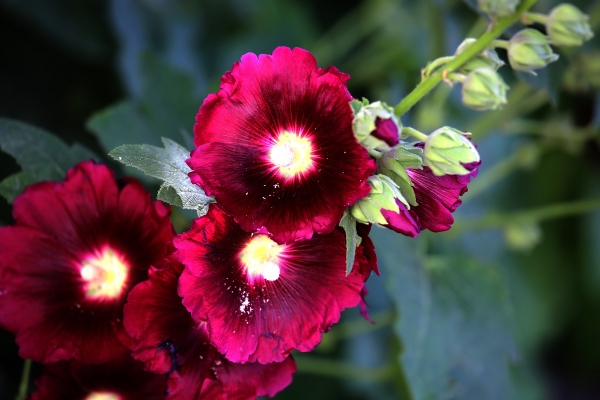
Have you all learned the growing methods for hollyhocks? Compared with other flowering plants, hollyhocks have strong vitality and are relatively easy to cultivate. If you are also interested, hurry and grow a pot at home!
How to grow hollyhocks, the growing methods and precautions for hollyhocks
Hollyhocks originated in the southwest region of our country and are now widely planted in many regions of our country. Hollyhocks have brilliant flower colors and taller plants, making them suitable for planting in courtyards. Hollyhocks can not only be cultivated as ornamental plants, but also have medicinal value. The whole plant is used as medicine and has the effects of clearing heat and detoxifying, relieving cough and promoting urination. So, how do you grow hollyhocks? Today the editor will tell you about the growing methods and precautions for hollyhocks.
How to grow hollyhocks, the growing methods for hollyhocks
1. Soil selection for hollyhocks: Hollyhocks have strong salt-alkali tolerance and can still grow in soil containing 0.6% salt. They grow well in loose, fertile, well-drained sandy soil rich in organic matter.
2. Key watering points for hollyhocks: Hollyhocks should be watered appropriately during the flowering period so that the flowering period is long and the flowers bloom well, continuing all the way to the top of the branches.
3. Hollyhocks need sufficient sunlight: Hollyhocks like sunlight and tolerate partial shade, but grow best under conditions of sufficient sunlight.
4. Hollyhocks have low temperature requirements for growth: Hollyhocks are cold-resistant and can safely overwinter outdoors in North China.
5. Key fertilizing points for hollyhocks: During the seedling growth period, hollyhocks should be given liquid fertilizer, with attention to weeding and loosening the soil, to promote robust plant growth. After buds form in the leaf axils, apply additional phosphorus and potassium fertilizer.
6. Pest control for hollyhocks: During the growth period, hollyhocks are harmed by red spider mites. When the infestation is severe, use 1.8% abamectin emulsifiable concentrate diluted 7000 to 9000 times and spray evenly for control; or use 15% pyridaben emulsifiable concentrate diluted 2500 to 3000 times, both of which have good control effects.
7. Pruning hollyhocks: In spring, the main stem of hollyhocks should be pinched to promote branching and dwarf the plant.
Hollyhock leaves are relatively large, the flowers are numerous, and the flowering period is relatively long. They are flowering plants quite suitable for planting in patches in home courtyards and other places, which will form a stretch of scenery and beautify the home environment.
The growing methods and precautions for hollyhocks
After the flower stems of hollyhocks emerge in spring, pinch them to promote branching and dwarf the plant. For tall varieties, set up supports to prevent lodging. During the growth period, appropriately apply additional phosphorus and potassium fertilizer and water appropriately, so that the flowers are large and brightly colored and the flowering period is prolonged. If you want hollyhocks to bloom a second time within a year, you can prune promptly after the first flush of flowers, keeping 15-20 cm of the lower part of the plant, and promptly apply additional fertilizer and water, so that they can bloom a second time in October. After winter begins, the stems and leaves wither and turn yellow, and you can cut at 10 cm above the ground, cutting off the parts above that.
How to grow hollyhocks, the growing methods and precautions for hollyhocks are briefly introduced here. When cultivating hollyhocks, note that hollyhocks have strong salt-alkali tolerance and can still grow in soil containing 0.6% salt, but they do not tolerate waterlogging, so avoid water accumulation in the soil. Hollyhocks like an environment with sufficient light, and soil rich in organic matter is even better.
The growing methods and precautions for hollyhocks
The growing methods for hollyhocks
Light
Hollyhocks prefer an environment with sufficient sunlight and tolerate partial shade.
During normal cultivation, hollyhocks should be placed in a spot with direct sunlight to receive sunlight.
Temperature
Hollyhocks are cold-resistant. After winter begins, the aboveground branches wither and die, but the underground perennial roots can overwinter naturally in the open ground and sprout new shoots the following year. They can safely overwinter outdoors in North China.
The growth temperature for hollyhocks is 25°C-30°C, and the most suitable temperature during the flowering period is 26°C-28°C. An average monthly temperature below 17°C affects flowering, and a nighttime temperature below 14°C leads to poor growth.
Watering
Pay attention to watering normally and keep the soil moist, but do not overwater, as hollyhocks are afraid of waterlogging.
Hollyhocks should be watered appropriately during the flowering period to prolong the flowering period and increase the number of flowers.
Soil
Hollyhocks have strong adaptability to soil and strong salt-alkali tolerance, and can still grow in soil containing 0.6% salt.
They grow best in loose, fertile, well-drained sandy soil rich in organic matter.
Fertilizing
Before planting hollyhocks, deeply turn the soil and add base fertilizer to the soil.
During the growth period, apply liquid fertilizer mainly based on nitrogen and potassium fertilizer once or twice. After the flower buds form, apply liquid fertilizer mainly based on phosphorus and potassium fertilizer once or twice more.
Precautions for growing hollyhocks
Prune promptly
After hollyhocks bloom, promptly cut off the aboveground part, and they can still sprout new shoots.
Provide partial shade in summer
In summer, because the light is strong, hollyhocks should try not to be exposed to direct sunlight, so as not to affect plant growth. They should be appropriately shaded to absorb scattered light.
Control plant height
To dwarf the plant, root cutting can be used to control height, that is, during the growth period, use a spade to vertically cut the root system at 10 cm to the left and right of the plant base, and 2-3 weeks after cutting, similarly cut the two places at the front and back.
The more times the roots are cut, the shorter the plant becomes, making it suitable for pot cultivation.