Common pests and diseases of obedient plant and their control methods
The downside of the obedient plant is that it is prone to rot disease, leaf spot disease and rust disease - you could say its strength lies in its stems and roots, and so does its weakness. Once any of the above problems is discovered, the plant should be promptly pulled up and burned to prevent contagion. Other minor problems can be handled with 65% zineb wettable powder.
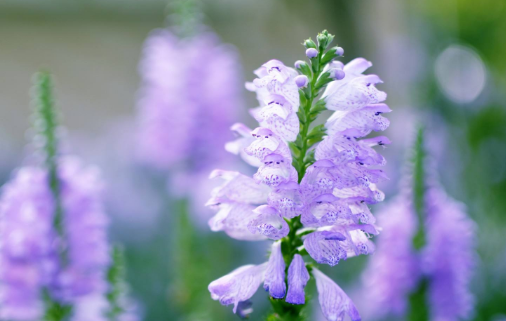
After reading this article, aren't you amazed by the flower language of the obedient plant? Did any of its flower meanings appeal to you? Why not go and grow a pot right now to admire yourself!
Obedient Plant Picture Gallery: Obedient Plant Flower Language and Symbolism
Doing as one pleases is the most ideal state that many people pursue in life. Being able to live as one pleases seems simple, but in fact it is extremely difficult - what life offers us is often more about restraints and confinement. There are actually very few people who truly live freely, yet there is a plant that people can call "free and easy" - just how unrestrained is it?
Obedient Plant Flower Language and Symbolism
Its flower language is "emotion moves with feeling, the heart moves with emotion." It presents a tall, elegant posture, robust by nature, yet it makes people feel like an elf - free and clever. When the wind blows, it sways wildly along with it, graceful and varied, making people feel free and unrestrained, as if it is dancing for itself.
So using "emotion moves with feeling, the heart moves with emotion" as its flower language is the most fitting choice.
Varieties of Obedient Plant
1. Snow Crown
Plant height is 75-80 cm, flower color is white.
2. Pink Rose
Plant height is 90-120 cm, flower color is rose red.
3. Summer Snow
Plant height is 80 cm, flower color is white.
4. Flower Ball
Plant height is 90 cm, flower color is pink. It has green and white variegated leaves.
The flowering period of the obedient plant
This plant blooms in summer. Its spike-like inflorescences gather into a panicle-like form, growing at the very top of the plant; the corolla is lip-shaped, and the flowers at the lower part open first, gradually opening up to the top, with the flowers very densely packed. If we push its flowers to one side, they will not return to their original position - this is also the origin of its name.
The flower colors come in many varieties - light purple, white, pink, and so on, and among the variant types there are also ones with markings. The overall impression it gives is fresh and elegant. It is very suitable for planting in courtyards or flower beds and other places, and planting in large patches is also good.
How to grow the obedient plant
1. Soil for the obedient plant
The obedient plant has low requirements for soil and prefers loose, fertile, well-drained sandy soil. For ground planting, deep soil layers are required; for pot planting, fertile, loose potting soil can be used.
2. Light for the obedient plant
The obedient plant likes a growing environment with sufficient light. During cultivation, sufficient light should be given, but during high summer temperatures, it should not be directly exposed to the sun - appropriate shading can be provided. Note that it should not be too shady, as this will cause the plant to grow leggy, with poor flowering or few flowers.
3. Temperature for the obedient plant
The obedient plant likes a warm environment. The suitable growing temperature is around 18-28°C, and it has strong cold resistance. During high summer temperatures, attention should be paid to cooling and maintaining moisture, spraying water on the plant 1-2 times a day. After the temperature drops in autumn, the flower pot should be placed at a south-facing, wind-sheltered window for care, keeping the soil moist. In winter, the obedient plant should be placed in a well-lit indoor spot for care. Especially in the northern regions of our country, attention should be paid to cold protection and warmth, and the indoor temperature must not be lower than 5°C.
4. Watering the obedient plant
The obedient plant likes a moist environment and is not tolerant of drought. Dry summer weather will lead to poor growth. During the growing period, the soil should be kept moist, with more watering to provide sufficient moisture, and the potting soil should not be allowed to become too dry.
5. Pest and disease prevention for the obedient plant
The obedient plant is prone to root and stem rot, leaf spot disease and rust disease. When root and stem rot occurs, it should be promptly pulled up and burned to prevent spread. Other diseases can be controlled with 65% zineb wettable powder.
6. Fertilizing the obedient plant
Use decomposed compost as base fertilizer. Apply nitrogen, phosphorus and potassium once a month, with a slightly higher proportion of phosphorus and potassium fertilizer to promote flowering. Be careful to control the amount of fertilizer to prevent the plant from growing leggy. When the inflorescences are emerging, apply 1-2 additional applications of phosphorus fertilizer or a specialized fertilizer.
Matching the name of the obedient plant is its flower language: "emotion moves with feeling, the heart moves with emotion." Perhaps the obedient plant always maintains an elegant, upright and free appearance, which makes people deeply envious, hoping they too could sway in the wind like the obedient plant - that is probably why it is called the obedient plant!
Flower pest and disease control methods
Flower pest and disease control methods
For the control of flower pests and diseases in protected cultivation, the principle of "prevention first, comprehensive control" should be implemented, with horticultural control as the foundation, strengthening manual control, giving full play to the controlling role of natural enemies, and combining with chemical control to carry out integrated management of pests and diseases.
There are three main approaches to prevention first: (1) Eliminate sources of pests and diseases or reduce the base population of pests and diseases. For example, plant quarantine is an effective measure adopted to prevent dangerous diseases and pests from spreading along with seeds and seedlings. Reducing the base population of pests and diseases refers to reducing the number of overwintering pathogens and pests; (2) Worsen the environmental conditions for the occurrence and damage of pests and diseases, that is, create or make full use of conditions unfavorable to pests and diseases, and change or eliminate conditions favorable to pests and diseases; (3) Take timely and effective measures to eliminate pests and diseases before they occur in large numbers and cause significant damage. For example, rationally using pesticides and adopting effective manual and physical measures.
Comprehensive control is based on agricultural technical control, adapting measures to local and timely conditions, rationally using chemical control, biological control, physical and mechanical control and other measures, giving full play to the positive role of various control methods, organically combining them and coordinating them with each other,
making up for each other's shortcomings, in order to achieve the goal of economically, simply, safely and effectively controlling and eliminating pests and diseases.
Take effective measures to protect flowers from pathogen and pest damage, control the number of pathogens and pests; improve environmental conditions to make them favorable for flower growth and development but unfavorable for the survival and infection of pathogens and pests, and improve the disease and pest resistance of flowers. The specific control methods are the following five:
I. Plant quarantine
The frequent exchange and transfer of flower species and varieties between countries or regions has allowed some pests and diseases to spread, causing great losses to flower production. The South American leafminer and the American leafminer, which are now widespread in our country, were introduced from abroad in 1994 due to lax quarantine, causing great losses to our country's flower and vegetable production. Therefore, blind introduction and transfer of seeds should be avoided, and quarantine regulations should be strictly enforced.
Plant quarantine includes three aspects: diseases, pests and weeds. It is a series of regulatory measures adopted by the state to protect agricultural production from the invasion of foreign dangerous diseases, pests and weeds. According to legal provisions, the types of plant products subject to quarantine and the list of prohibited diseases, pests and weeds that may not be brought in or taken out - if quarantine objects are found, they are not allowed to be imported or exported, or may only be exported or imported after disinfection treatment has eliminated the quarantine objects, in order to prevent spread and disaster. Plant quarantine is an important part of pest and disease control, especially in the contemporary era when transportation tools are highly developed and exchanges with foreign countries are continuously expanding, strengthening quarantine work is particularly important. At the same time, the transfer of seeds, seedlings and other cultivation materials between domestic regions must also implement quarantine, and quarantine objects are strictly prohibited from entering new areas.
II. Horticultural control methods
Agricultural technical control methods use a series of cultivation management technical measures in the flower cultivation process to purposefully change certain environmental conditions, making them unfavorable for the occurrence and development of pests and diseases but favorable for flower growth and development, thereby avoiding or reducing the occurrence of pests and diseases and achieving the goal of improving flower quality. Since most agricultural measures themselves are a means of achieving high flower yields, and do not require additional manpower and material resources for pest and disease control, they often achieve multiple benefits at once, meeting economic requirements, and at the same time agricultural control has no adverse side effects such as polluting the environment or killing natural enemies. The specific measures of agricultural technical control methods are:
1. Rational fertilization and scientific watering. Organic fertilizer applied should be fully decomposed. Before application, pathogens and
pests in it should be thoroughly killed, and pests should be prevented from laying eggs on the organic fertilizer after application. When applying inorganic fertilizer, the ratio of nitrogen, phosphorus and potassium should be reasonable - do not apply excessive nitrogen fertilizer, should appropriately increase phosphorus and potassium fertilizer, and advocate formula fertilization. The watering method should be appropriate - avoid spray-type watering, and it is best to use furrow irrigation or watering along the edge of the pot. Watering should be moderate. Choose to water in the morning on sunny days, and after watering, ventilation should be promptly provided to expel moisture.
2. Keep greenhouses and conservatories clean and hygienic
Promptly remove flower branches and leaves with pests and diseases, pull up diseased plants, clear away dead branches and fallen leaves, and thoroughly eradicate weeds inside and outside the conservatory to reduce sources of pests and diseases. Diseased residues should be buried deep or burned.
3. Improve environmental conditions
Ventilation should be provided frequently to reduce humidity, in order to reduce the occurrence of high-humidity diseases such as gray mold on flowers. Planting density and flower pot placement density should be appropriate to facilitate ventilation and light penetration between plants and reduce damage from mites and other pests. Control temperature well - do not let it fluctuate between hot and cold. In winter and spring, special attention should be paid to heat preservation, while in hot summer, shade nets should be used for covering. Adjust light intensity according to the needs of flower growth. Ventilation and cooling can control the development of many diseases; while high-temperature greenhouse sealing can control the occurrence of low-temperature diseases such as downy mildew.
4. Winter plowing and deep turning
Winter plowing and deep turning for open-field cultivated flowers has a significant effect on eliminating pests in the vast regions of our country, especially in cold regions. Winter plowing and deep turning can expose most of the
larvae, pupae, eggs and so on lurking in the soil to the surface to be frozen to death, or pecked by beneficial birds, and manual capture can also be carried out. Deep plowing can bury pathogens and crop residues in the shallow soil into deep soil layers, causing them to lose their vitality, and can also turn pathogens originally in deeper soil layers to the surface, increasing death due to the influence of other natural factors such as light, temperature and humidity.
5. Handle damaged plants
The residual plants after flowering and damaged plants of annual and biennial herbaceous flowers should be immediately pulled up and burned or buried deep in the soil; after perennial and woody flowers wither in late autumn or shed leaves, dead branches and fallen leaves should be promptly cleared and centrally destroyed. This measure can also reduce the number of some pathogens and pests.
6. Timely weeding
Overgrown weeds not only compete with flowers for nutrients and affect ventilation and light penetration, causing poor plant growth, but weeds are also breeding grounds for some pathogens and pests. Some viral diseases and pests often use weeds as hosts. Weeds are also overwintering sites for some pests and diseases. Therefore, timely clearing of weeds is of great significance in pest and disease control.
7. Timely pruning
In combination with flower and tree pruning, cut off diseased buds, diseased branches, diseased roots and so on to reduce the number of pathogens, and can also eliminate eggs, larvae and adults of pests that oversummer and overwinter on branches, reducing pest sources.
8. Adjust sowing time
The occurrence of many kinds of pests and diseases, due to the influence of temperature, humidity and other environmental conditions, has a certain disease onset period and pest occurrence period, and is most serious in a certain period. If sowing is advanced or delayed, the disease onset period and occurrence period can be avoided, reducing damage. For example, aster seedlings are most vulnerable to damage from the cucumber beetle - if sowing can be advanced, the degree of damage can be reduced. Adjusting the sowing or transplanting period has a certain control effect on pests that occur once a year, have a single food habit, and occur uniformly.
9. Rational crop rotation
As far as possible, avoid continuous cropping with mutually infecting flowers, so that pathogens and pests in the soil cannot get suitable hosts, thereby reducing the number of pathogens and pests.
10. Scientifically carry out the harvest and post-harvest management of bulbs and other organs. During the digging process, wounds should be minimized as much as possible. After digging out, promptly remove diseased
bulbs with pests. They can only be put into the cellar after being fully dried in the sun. Wounds caused during digging easily lead to the invasion of various molds. Too high temperature, too high humidity and poor ventilation at the storage site are important causes of rot disease in bulbs. Therefore, care should be taken during digging to minimize wounds. The storage cellar should be kept clean and hygienic. After being put into the cellar, the cellar temperature should be controlled at around 5°C, and the relative humidity should be controlled below 70%.
11. Pay attention to the rational arrangement of flower types
According to the characteristics of flower types and site conditions, arrange them reasonably so that the cultivated flowers are distributed in an orderly manner, with appropriate density, getting the space and sunlight they deserve, and in an environment with good air circulation, thus being favorable for flower growth and development and unfavorable for the occurrence of pathogens and pests.
12. Select healthy, pest-free propagation materials
Flower viral diseases occur commonly, and many propagation materials carry viruses. Therefore, virus-free tissue-cultured seedlings should be used in production. It is best to establish disease-free seed fields and collect seeds or obtain propagation materials from healthy mother plants.
13. Breed and cultivate pest- and disease-resistant varieties
Breeding pest- and disease-resistant flower varieties and cultivating flowers with strong disease resistance can protect flowers from pest and disease damage or reduce the degree of damage. This is one of the important methods for effectively controlling flower pests and diseases.
III. Biological control methods
Biological control is the use of natural enemies to control pests and diseases. Natural enemies are organisms that feed on pests or pathogens. Under natural conditions, natural enemies are universally present, controlling the damage of pests and diseases, especially pests. In flower care, the role of natural enemies should be consciously strengthened, such as leaving pruned pest-bearing branches for a few days before burning, to protect parasitic natural enemies inside the pests.
IV. Physical and mechanical control methods
1. Heat treatment of propagation materials
Soaking seeds or other propagation materials in water at a certain temperature can kill pathogens and pests on the surface and inside, but the temperature and treatment time must be well controlled. Too high a temperature and too long a treatment time will affect the vitality of seeds and other propagation materials.
2. Soil heat treatment
If conditions permit, soil can be treated with hot steam to kill pathogens, nematodes and pests in the soil. Soil heat treatment should be done before planting, and the heated soil should reach a certain depth, with the soil temperature at a depth of 20 cm reaching 75°C being appropriate.
3. Mechanical barriers
Covering with agricultural film can play a certain mechanical barrier role against the entry and spread of pathogens and pests, and can also inhibit the formation of gray mold and sclerotinia spores.
4. Trapping and killing insects and nematodes
Use the tropism of insects and nematodes to control pests and nematodes. For example, use yellow boards to trap and kill whitefly adults, use fly paper to trap and kill leafminer adults, and plant trap plants to trap nematodes, thereby reducing their damage to flowers.
V. Chemical control methods
Chemical control is pesticide control. It has the advantages of good control effect, quick results and simple usage. But at the same time it also pollutes the environment, causes pesticide damage, and after long-term use, pathogens and pests will develop resistance. Chemical control is an important component of comprehensive pest and disease control, but attention should be paid to the scientific use of pesticides.
1. Correctly select pesticide types
Understand the functions of pesticides and the targets to be protected, and apply the right pesticide according to the type of pest or disease. For example, the fungicide metalaxyl has a good control effect on downy mildew of various flowers, but cannot control powdery mildew. The insecticide pirimicarb has a good control effect on the vast majority of aphids, but is almost ineffective against cotton aphids.
2. Rationally select pesticide formulations
High humidity is favorable for the occurrence of gray mold, therefore, choosing quick-burning smoke agents or dust formulations has a better control effect on this disease. For controlling scale insects, soil-applied systemic granular formulations and watering with systemic pesticide solutions can be used, to achieve the purpose of applying pesticide underground to control pests above ground.
3. Timely application
It is necessary to fully understand the occurrence patterns of pests and diseases, find weak links, and apply pesticide in time. For example, before flower sowing or transplanting, pesticide can be applied to disinfect seedling rooms and conservatories, treat soil and dress seeds with pesticides, and use disinfectants such as formalin to disinfect agricultural operation tools and containers such as flower pots. Eliminating pests and diseases outside the flower garden and before damage is the best policy. For example, eliminating pathogens and pests on overwintering hosts, or eliminating them during the overwintering stage, are both proactive approaches. For diseases, the favorable timing for control is before pathogens are infected, or eliminating pathogens in the initial stage of occurrence before the next spore reproduction and spread. Applying pesticide too early, the pesticide power will decompose under sunlight and rain, failing to play its due role; applying pesticide too late, pathogens have already invaded, becoming "a belated action." For pest control, the resistance of different pests or the same pest at different developmental stages should be considered. For example, generally pest larvae are divided at the 3rd instar - before the 3rd instar, resistance is poor, and after the 3rd instar, resistance significantly increases, with newly hatched larvae having the lowest resistance. Generally speaking, the resistance of Lepidoptera insects to pesticides is egg > pupa > larva > adult, so the favorable period for controlling larvae is generally before the 3rd instar, and controlling adults is even more favorable. But controlling boring pests is different - generally it should be at the peak egg-laying period.
4. Alternation and mixed use of pesticides
Long-term single use of the same pesticide for pest and disease control in the same area may produce resistance within pathogen and pest populations. Therefore, it is advocated to rationally alternate or mix different types of pesticides to avoid the development of resistance.
5. Safe application, avoiding pesticide damage
Some flowers or certain growth stages may be sensitive to a certain pesticide or certain pesticides. In such cases, the pesticide should be used with caution. Even if not sensitive, the pesticide concentration and dosage should be strictly controlled - do not arbitrarily increase the concentration and dosage to prevent pesticide damage. If the pesticide used is a new pesticide, a test of pesticide concentration and dosage should first be done on a small area, and only after it is confirmed safe can it be used on a larger area. In addition, highly toxic pesticides should be used with caution, and high-residue pesticides that seriously pollute the environment and water sources should be restricted or prohibited.
(1) Inappropriate application dosage.
Too high a pesticide concentration often causes pesticide damage to flowers - this is the most easily occurring problem. To prevent pesticide damage, the concentration of the pesticide solution should be appropriate. Different pesticides used in different seasons for different pests and diseases and different types of flowers all use different concentrations, and must be prepared strictly according to the concentrations specified in relevant pesticide manuals.
(2) Different types and varieties of flowers, or flowers of the same variety at different developmental stages, react differently to pesticides.
For example, Bordeaux mixture and other copper-containing fungicides easily cause pesticide damage to peach, plum and so on; dimethoate emulsion easily causes pesticide damage to plum blossom, elm-leaved spirea, peach, ornamental peach, Chaenomeles speciosa, cherry blossom and so on; dichlorvos emulsion also easily causes pesticide damage to rhododendron, cherry blossom, plum blossom and so on. For the same flower, generally speaking, the seedling stage, tender shoots and tender leaves are prone to pesticide damage. The flowering period is even more sensitive to pesticides, therefore, spraying pesticide during flowering easily causes flower and fruit drop.
(3) Influence of environmental conditions.
Applying pesticide at high temperatures has a good effect, but too high a temperature easily causes pesticide damage. For example, lime sulfur mixture used at high summer temperatures (exceeding 30°C) very easily causes pesticide damage. The influence of humidity on some pesticides is also obvious - for example, arsenic agents and Bordeaux mixture easily cause pesticide damage under rainy and high-humidity conditions. Therefore, pesticide application should depend on the weather and be used flexibly.
① Toxicity to natural enemies. After many broad-spectrum pesticides are applied, they not only kill pests and pathogens but also kill natural enemies of pests, thereby causing pest resurgence. Solutions:
Use selective pesticides. For example, ovotran, dicofol and so on have no effect on general insect natural enemies (such as ladybugs, hoverflies, predatory mites, Trichogramma and so on), so using such acaricides to control mites is very safe for natural enemies. Trichlorfon has very low toxicity to ladybugs and their larvae and eggs, and is also relatively safe for parasitic wasps and braconid wasps. Also, botanical pesticides mostly have relatively low lethality to natural enemies. Applying tobacco water is relatively safe for ladybugs, mirid bugs, green lacewings, predatory mites, parasitic wasps and so on. Derris extract has relatively little impact on ladybug adults and parasitic natural enemies.
Choose an appropriate application period. For example, applying pesticide while parasitic wasps are still inside the host body will only kill the pests. Another example is before artificially releasing natural enemies, first apply pesticides with short residual effects, and after the pesticide toxicity disappears, then artificially release natural enemies.
② Toxicity to humans. Pesticides are mostly toxic to humans and livestock to a greater or lesser degree, therefore, attention must be paid to the safety of humans and livestock. Before application, on the one hand, it is necessary to learn and master the toxicity and usage precautions of various pesticides, and on the other hand, protective work should be done well. During application, the original pesticide or pesticide solution must not get on the skin - if it does, immediately wash it off with soapy water. When spraying, wear a mask, spray in the downwind direction, to prevent the pesticide solution from splashing on the face and inhaling toxic gas, and do not rub the eyes during operation. The tools used should be immediately washed after use and properly stored for future use. After each application, wash hands with soap as a precaution. If poisoning symptoms appear due to carelessness, immediately take detoxification measures, and if necessary, send to the hospital for treatment as soon as possible.