How to grow freesia? Detailed guide to cultivation methods and precautions
Soil
Freesia grows best in loose, sandy soil with strong water retention and good drainage. Before planting freesia, the soil should be drenched and disinfected with a solution of quintozene, methyl bromide and carbofuran mixed in proportion, then left for a week after disinfection before use.
Corm treatment
Before planting, it is not only the soil that needs disinfecting; the corms must be disinfected too. Soak the corms in a 800-fold dilution of thiophanate-methyl or carbendazim solution for 1~2 hours, then lift them out and leave them in a cool place to dry.
After drying, place the corms in a relatively warm environment to promote rhizome growth and break their dormancy. Once roots have grown, they can be transplanted.
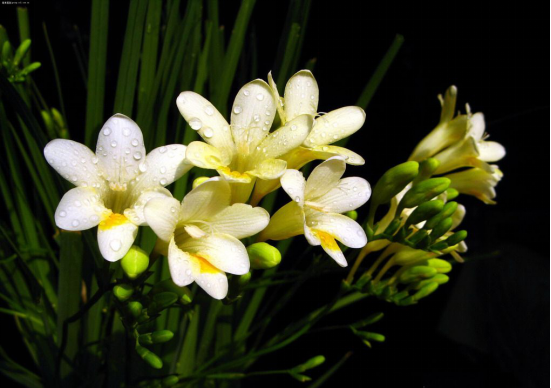
Fertilizer and water
After transplanting and until sprouting, keep the soil moist. After budding, adjust the amount of watering according to conditions, keep the soil as dry as possible and lower the air humidity.
From planting to flowering, the base fertilizer in the soil can basically meet the plant's growth needs, so there is no need to fertilize deliberately. But if the plant is weak and spindly, apply a top dressing once after several leaves have grown. Do not fertilize at budding, so as to avoid excessive leaf growth affecting flowering. At flowering, apply potassium dihydrogen phosphate fertilizer to promote blooming.
Temperature and light
Usually about one and a half months after planting, the inflorescence gradually differentiates. When the freesia has grown four leaves, maintain the temperature at about 13~14°C to promote leaf growth. During flower bud differentiation, keep the temperature at 10~25°C; after budding, raise the temperature appropriately, but be careful not to exceed 25°C. After flowering, the temperature can be lowered to 15°C to extend the flowering period.
When the freesia grows its first leaf, shade it appropriately to lower the soil temperature and promote root development. At flower bud differentiation, ensure 10 hours of sunlight, which is beneficial to flower bud differentiation. After flower bud differentiation, appropriately extend the light duration to promote inflorescence development and earlier flowering. Avoid direct sunlight during this period.
Netting
Freesia flower stems are soft and the inflorescence grows curved. When there are many flowers, the flower stems may droop and fall over, greatly ruining the appearance. So when the plant has grown three or four leaves, you can put up netting. Set the first layer of net at about twenty cm above the ground, and gradually add more layers of net as the plant grows. The mesh size depends on the situation; it should be neither too large nor too small.
The above is the introduction to freesia cultivation methods brought to you by the editor. Well, after reading it, have you learned how to grow freesia?
Freesia cultivation methods and precautions: daily growing knowledge
Freesia flowers resemble lilies and its leaves resemble those of orchids; the flower colors are elegant, delicate and refined, the fragrance is rich, and the flowering period is long, making it a favorite flower among gardening enthusiasts. Freesia is planted in autumn and blooms in winter; corms are planted in August-September and it can bloom in November-December. During the growing period it requires a temperature of 15-20°C and sufficient sunlight, keeping the soil moist and improving ventilation.
Freesia prefers a cool, moist environment with ample light. It has poor cold tolerance; the suitable growing temperature is 15~20°C, and the lowest overwintering temperature is 3~5°C. A temperature of 13.5~15°C can promote rooting and sprouting of the corms. It is best grown in loose, fertile sandy loam.Freesia cultivation methods (daily growing)
1. Soil: Freesia likes sandy loam rich in organic matter, with strong water retention and good drainage, pH 6~7.2; acidic soil is more suitable for planting.
2. Watering: After planting and until sprouting, the soil must be kept moist. After budding, gradually reduce the amount of watering appropriately, keeping the soil surface as dry as possible, so as to lower air humidity and prevent disease.
3. Light: Although freesia loves light, it should also avoid strong light. Under conditions of excessive light and relatively high temperature, shade it with a 70% light-transmittance shade net.
4. Temperature: Temperature management is very important for cut freesia production. It has poor cold tolerance; the suitable growing temperature is 15~20°C, and the lowest overwintering temperature is 3~5°C. Regarding temperature, note that above 25°C ventilation is needed, and below 10°C cover for insulation or heating must be added.
5. Fertilizing: The organic fertilizer and compound fertilizer applied before planting can basically meet growth needs, but if the plant grows weakly, apply one more top dressing of ammonium nitrate, urea and potassium sulfate at the 2~4 leaf stage. At early flowering, use 0.2% potassium dihydrogen phosphate as a foliar feed, but it is best to avoid top dressing before and after budding. Apply organic liquid fertilizer once every two weeks, and a moderate amount of compound chemical fertilizer may also be applied.
6. Pests and diseases: Freesia is prone to mosaic disease, corm rot and so on. During planting, thoroughly disinfect the soil and corms, and completely replace the potting soil every year. Also pay attention to controlling aphids; in the early stage of aphid infestation, spray 40% omethoate 1500-fold solution or 90% trichlorfon solution for control.
Freesia cultivation precautions1. When freesia is grown indoors, the plant often becomes spindly and leggy. When the flower stalk is drawn, a stick should be used to support the flower stem to prevent the stalk from bending and affecting its ornamental value.
Control method: To prevent it from becoming leggy and to promote "dwarfing", treat the corms with "paclobutrazol" before planting, which gives excellent results. Before potting freesia in autumn, soak the stored corms in an 80ppm (80×10-6) "paclobutrazol" solution for 15 hours to 20 hours, take them out, rinse with clean water, then pot them and carry out normal watering and other management. Freesia treated this way emerges evenly, has dark green leaves, increased leaf width and reduced length, and a richer fragrance after flowering. Freesia flower stems are rather soft and the inflorescence grows bent; when there are many flowers the stems easily droop and fall over. At the 3~4 leaf stage, you can begin setting up supports and netting, setting the first layer of net about 25cm above the ground, and then setting 2~3 more layers of net as the plant grows. Generally the net mesh is 10cm×10cm or 10cm×15cm squares.
2. Diseases: Freesia is prone to mosaic disease, corm rot and so on.
Control method: During planting, thoroughly disinfect the soil and corms, and completely replace the potting soil every year. Also pay attention to controlling aphids; in the early stage of aphid infestation, spray 40% omethoate 1500-fold solution or 90% trichlorfon solution for control.
Freesia cultivation pointsIn early August, grade the freesia corms by size and plant them separately in pots. Generally, corms with a diameter of more than 1 cm can bloom the following year after planting; those with a diameter of less than 1 cm will not bloom the following year and should be planted separately to grow corms. Use a growing medium of 7 parts fine sandy soil, 3-4 pieces of horse hoof slices or 4-5 granules of compound fertilizer, then add growing medium to 3/5 of the pot depth, plant the selected corms into the pot, and cover with 1-1.5 cm of soil. After planting, water with a fine-spouted watering can, and they will sprout and grow in about 10 days. Generally 5-7 corms of uniform size can be planted per pot to ensure neat flowering the following year.
Freesia growing tips1. Propagation method: Corms are usually sown in September; generally tissue-culture plantlets or seeds are used for sowing, and small corms can be grown into high-quality seed corms after 1~2 years of cultivation.
2. Seed selection: For cultivation, choose large corms with a diameter of more than 1cm. To reduce virus infection, virus-free tissue-culture corms must be used, or new corms grown from seeds or daughter corms.
3. Planting and potting: Before potting freesia, soak the stored corms in an 80ppm "paclobutrazol" solution for 15 hours to 20 hours, take them out and rinse with clean water. When planting, usually cover with 2~3cm of soil; never make it too thick. After planting, the soil surface is often covered with a thin layer of peat soil or pine needles, straw, sawdust, etc., to keep the soil moist.
How to grow freesia, freesia cultivation methods
Freesia is a perennial bulbous herbaceous flower of the genus Freesia in the iris family. It is a flower with relatively strict environmental requirements. During its growth, all kinds of unexpected problems always appear. So flower growers who plant freesia often find it very troubling. So how do you grow freesia? Today the Hot Agricultural Supplies Network gives everyone a detailed introduction to freesia cultivation methods.
Freesia cultivation methods
Freesia prefers a cool, moist environment with ample light. It has poor cold tolerance; the suitable growing temperature is 15~20°C, and the lowest overwintering temperature is 3~5°C. A temperature of 13.5~15°C can promote rooting and sprouting of the corms. It is best grown in loose, fertile sandy loam.
For home growing, an artificial growing medium made of 2/3 peat soil plus 1/3 fine sand is usually used for planting. Flower bud differentiation requires a low temperature of 8~13°C; during flower bud development the suitable temperature is 13~18°C. Below 18°C will delay the flowering period and shorten the flower stem. Higher temperatures can promote earlier flowering, but the plant grows weakly. Short-day conditions favor flower bud differentiation in freesia, and after flower bud differentiation, long days can bring flowering forward.
During the growing period it requires ample fertilizer and water; apply organic liquid fertilizer once every two weeks, and a moderate amount of compound chemical fertilizer may also be applied. The potting soil should be kept alternately dry and moist; it must not become waterlogged or too dry. Corms are usually sown in September, flower buds begin to differentiate around early November, and differentiation is complete in late November. After May of the following year, the leaves gradually wither and the corms enter their natural dormancy period.
When freesia is grown indoors, the plant often becomes spindly and leggy. When the flower stalk is drawn, a stick should be used to support the flower stem to prevent the stalk from bending and affecting its ornamental value. To prevent it from becoming leggy and to promote "dwarfing", treat the corms with "paclobutrazol" before planting, which gives excellent results.
The method is: before potting freesia in autumn, soak the stored corms in an 80ppm "paclobutrazol" solution for 15 hours to 20 hours, take them out, rinse with clean water, then pot them and carry out normal watering and other management. Freesia treated this way emerges evenly, has dark green leaves, increased leaf width and reduced length, and a richer fragrance after flowering.
The above is the detailed information introduced in this article about how to grow freesia and freesia cultivation methods. Thank you all for reading and your support. If you want to learn more technical information about flower cultivation, you can follow the Hot Agricultural Supplies Network more and learn more detailed agricultural technical information.