How to Propagate Muehlenbeckia complexa (Maidenhair Vine)? Detailed Propagation Methods
1. Propagation by cuttings
Muehlenbeckia complexa is best propagated by cuttings in spring and summer; spring and autumn are warmer and more suitable for plant growth. Take the pruned branches and use them as cuttings, and in this way you can grow a lush Muehlenbeckia complexa. But during the cutting process, you must pay close attention to the timing, and try to avoid the hot summer and the cold winter. After cutting, simply give the plant plenty of sunlight and water, and it will easily take root and sprout, multiplying in large numbers.
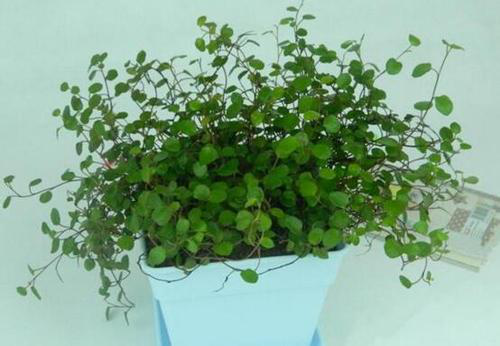
2. Propagation by division
This method of propagation by division is mainly used to divide mature Muehlenbeckia complexa. Once the Muehlenbeckia complexa plant has become very lush, you can begin propagation by division. The main steps of propagation by division are to dig the leafy Muehlenbeckia complexa out of the soil, rinse the roots clean with water, then place it in a moist, damp spot and wait for the roots to soften, after which you can separate the leaf clusters with scissors and divide them into several portions, so that each can be grown separately into a new plant.
Have you all learned how to propagate Muehlenbeckia complexa? Here the editor would like to remind everyone of a few points to note during the growing process!
How to Grow Muehlenbeckia complexa and Its Benefits
Muehlenbeckia complexa is native to New Zealand, is robust in habit, and likes a warm, humid environment; it can grow normally in both full sun and partial shade. Because it can beautify the home and purify the air, it is much loved by people today and is a common green plant in homes. Of course, growing Muehlenbeckia complexa at home also requires attention to method. So what exactly are the ways to grow Muehlenbeckia complexa? What are the benefits of Muehlenbeckia complexa? Let's take a look together with the editor.
How to grow Muehlenbeckia complexa:
Speaking of how to grow Muehlenbeckia complexa, generally any plant needs light, temperature, water and so on during the growing process. Of course, when growing houseplants you also need to pay attention to pruning. Let's look at the details below:
1. Light and temperature:
Muehlenbeckia complexa likes a partially shaded environment and needs plenty of sunlight during growth, but note that if the light is too strong or insufficient, the leaves easily become pale and yellow. In summer, when the sunlight is intense, pay attention to shading to avoid scorching the plant; in winter, be sure to maintain light to avoid the leaf color fading due to insufficient light.
Muehlenbeckia complexa likes a warm, humid climate and is not cold-tolerant. The suitable growing temperature is 20 to 24°C. If the temperature is too high, the leaves easily turn yellow and dry, so in summer pay attention to cooling and ventilation. In winter, when the temperature is low, maintain a certain overwintering temperature and do not let it go below 5°C.
2. Water and fertilizer management:
Muehlenbeckia complexa can grow vigorously in spring and autumn, so watering should be sufficient, and the potting soil should be kept moist at all times, but not waterlogged. In summer, when temperatures are high, spray frequently to increase humidity; in autumn, gradually reduce the amount of watering. During the peak growing season, Muehlenbeckia complexa can be given a dilute liquid fertilizer once every half month; in winter, topdressing should be stopped.
3. Pruning and repotting:
Muehlenbeckia complexa grows very quickly, and over time the plant can soon grow lush. To maintain a good shape, it should be reshaped regularly, cutting off branches that affect the plant's form to keep it looking attractive. Pruning can also stimulate many new branches to sprout, making the plant fuller.
Because Muehlenbeckia complexa grows quickly and easily fills its pot, it should be repotted once every two years. The best time to repot is spring, and the potting soil should be a sandy soil rich in humus, loose and fertile, with good drainage and aeration.
4. Pest and disease control:
Common problems of Muehlenbeckia complexa include scale insect damage and root rot.
5. Propagation methods of Muehlenbeckia complexa:
Muehlenbeckia complexa can be propagated by division combined with repotting; generally one plant can be divided into two to several clumps. You can also cut off branches for cuttings, or use the small plantlets on the runners for propagation; Muehlenbeckia complexa can also be grown from seed, but this is generally seldom used.
The above is a brief introduction to how to grow Muehlenbeckia complexa. It is believed that after the above introduction, everyone will have a further understanding and knowledge of growing this plant. Of course, like other indoor plants, Muehlenbeckia complexa also has certain benefits. So what exactly are the benefits of Muehlenbeckia complexa? Let's take a look at the introduction below:
Benefits of Muehlenbeckia complexa:
1. Muehlenbeckia complexa is ornamental:
Muehlenbeckia complexa is a beautiful ornamental plant. Its leaves are very small and heart-shaped or round, very cute; it can be enjoyed for its foliage, and its plant form is also elegant, so it can be enjoyed for its shape. Its plant grows in clusters and can produce many slender stems, which are long and very thin, giving a feeling like strands of hair. Because it grows in a creeping manner, these stems can be said to grow freely, with a shape all their own. If it grows in a hanging form, it is perfect for use as a hanging basket; hanging basket plants have a special charm. In addition, Muehlenbeckia complexa blooms small white flowers in summer or when temperatures are high in other seasons, with the flowers concentrated at the ends of the drooping branches, the stamens yellow, and the small tender leaves inside sometimes purple, which is also a fine ornamental sight.
2. Muehlenbeckia complexa can be used as a potted plant:
Muehlenbeckia complexa has a full plant form and dancing foliage and branches, with high ornamental value. It has a creeping habit and is relatively small, making it suitable as a small potted plant placed indoors; looking at the small pot, it can add a touch of green to the room and keep it from being monotonous. Muehlenbeckia complexa can also be grown as a hanging basket, because when its stems grow too long they may grow hanging down, trailing strand by strand, which makes it very suitable for a hanging basket. Hang the basket up, or place it on a high stand or the top of a cabinet, and the stems and leaves hang down naturally, covering the entire pot like a green ball, very beautiful.
3. Muehlenbeckia complexa can purify:
Many plants have a purifying effect, and Muehlenbeckia complexa is the same. Muehlenbeckia complexa can carry out photosynthesis under weak light and release oxygen, and it can absorb more than 80% of harmful gases indoors; its ability to absorb formaldehyde is extremely strong. Muehlenbeckia complexa plays an important role in purifying indoor air.
How to take cuttings of Muehlenbeckia complexa, cutting method and steps
Muehlenbeckia complexa can be propagated by cuttings, and it can be planted all year round; apart from winter, it can be propagated in the other seasons. So how do you take cuttings of Muehlenbeckia complexa? Below is a summary of the cutting methods and steps for Muehlenbeckia complexa.
How to take cuttings of Muehlenbeckia complexa. 1. Cutting timeAs for the cutting time for Muehlenbeckia complexa, it is recommended that gardeners choose spring, summer or autumn for better results, and it is not recommended to take cuttings in winter, because the winter temperature is too low and the cuttings are easily frostbitten, especially for gardeners in the north; taking cuttings of Muehlenbeckia complexa in winter is not recommended.
2. Selection of cuttingsThe cuttings of Muehlenbeckia complexa require plump and healthy branches, about 5—10cm in length. When cutting the slips, choose young branches, preferably branches with a terminal bud, then remove part of the leaves at the lower end; keep relatively few leaves on the cutting.
Soil selection for repottingGardeners can choose a round flowerpot with a diameter of about 7.5cm for cutting, and the cutting soil is generally a breathable mixed soil.
3. Cutting methodAfter the cuttings of Muehlenbeckia complexa have been prepared, gardeners can carry out the cuttings. Generally, multiple branches can be inserted into one flowerpot; gardeners simply insert the prepared cuttings into the soil, and insert the remaining branches in order from the center outward.
Generally, taking cuttings of Muehlenbeckia complexa in spring and summer can promote faster rooting; usually after about 2 to 3 weeks, roots will grow. However, Muehlenbeckia complexa grows relatively slowly, so when taking cuttings, choose a small flowerpot and fill the entire pot with cuttings.
4. Later careGenerally, once the cuttings of Muehlenbeckia complexa begin to grow, gardeners can apply some fertilizer to promote growth.