How to Propagate Rangoon Creeper? Detailed Guide to Common Propagation Methods
The main methods of propagating Rangoon creeper are seed propagation, clump division propagation and layering propagation.
1. Seed propagation
Select ripe, plump fruits as seeds (Rangoon creeper seeds that have been heated on a kang cannot be used as seeds), sow in spring in the 2nd-3rd lunar month or in autumn in the 8th-9th lunar month; autumn sowing is better. Before sowing, break the tip of the seed shell, but do not damage the kernel; soak in warm water (40°C-50°C) for 1-1.5 days to help germination. When sowing, choose sandy soil, place the seeds with the broken opening facing up and sow them into the soil, with a row spacing of 20 cm and a plant spacing of about 10 cm. Then cover with river sand and rice husk. After sowing, keep the soil moist; after about 1 month, they will germinate and emerge. Generally, when the seedlings are 10-15 cm tall, they can be transplanted; they should be moved with soil so they are easier to establish. This method produces more plants, but takes longer; it takes about 4 years after sowing to bloom and bear fruit.
2. Clump division propagation
In late winter and early spring, select a robust mother plant, and divide and transplant the suckers together with their roots; they will bear fruit after about 3 years.
3. Layering propagation
It is best to do this in spring or autumn of the lunar calendar. Cut off a tender vine tip of Rangoon creeper that has borne fruit, 1.70-200 cm long, coil it into a small circle, and bury it in the soil, leaving 67 cm of the planted part above ground, or bury 2/3 horizontally in the soil and let 1/3 emerge from the soil surface, but do not bury it upside down. This method grows faster and will bear fruit in 2-3 years.
For the above three propagation methods, if planting in a block, the plant spacing and row spacing are generally about 3.3 m, the hole depth is 34 cm, and the width is 100 cm (the holes for sowing are smaller and shallower). The soil at the bottom of the hole should be mixed fine, and 50 kg of barnyard manure or local manure should be used as base fertilizer, fully mixed with the soil; after planting, cover with soil and press gently.
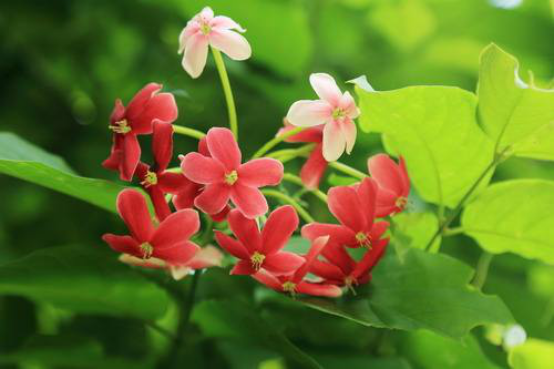
The planting and care methods for Rangoon creeper are introduced here. Hurry up and take action; to create a distinctive balcony, start by growing Rangoon creeper!
Propagation Methods of Rangoon Creeper
Cutting Propagation of Rangoon Creeper
Rangoon creeper can be propagated by cuttings, and cuttings root easily, so cutting propagation is the most commonly used propagation method for Rangoon creeper. Rangoon creeper can be propagated by stem cuttings or root cuttings.
For stem cuttings, this can be done in spring or autumn. Cut 1-2-year-old robust branches of Rangoon creeper as cuttings, about 20 cm long, and insert the cuttings obliquely into a sand bed; they can be transplanted the following year.
For root cuttings, do this from December each year to January of the following year. Dig out the lateral roots of Rangoon creeper that are relatively far from the main root, cut them into 20 cm-long cuttings with a thickness of about 1 cm, insert them into a seedling bed, and transplant after one year.
Layering Propagation of Rangoon Creeper
In early spring, select robust long branches of Rangoon creeper, bend them and bury them in the soil, and wait for them to root; after rooting, remove them for transplanting. Rangoon creeper layering can be transplanted and established in mid-to-late February or during the rainy season; after planting, water thoroughly.
Sowing Propagation of Rangoon Creeper
For sowing propagation of Rangoon creeper, both spring sowing and autumn sowing are possible, with autumn sowing being better. Seeds can be sown as soon as they are collected, or they can be stored and sown in spring of the following year.
Sowing propagation of Rangoon creeper requires a very long growth cycle. When sowing, place the tip of the Rangoon creeper seed
facing down, insert it obliquely into the soil, cover with soil, and keep the soil moist; it will germinate in about one month. When the Rangoon creeper seedlings grow to about 10 cm, they can be transplanted with soil.
Division Propagation of Rangoon Creeper
In addition to cuttings, sowing and layering, Rangoon creeper can also be propagated by division. In winter and spring, divide the plant at the roots and transplant; it will generally bear fruit in about 3 to 5 years.
Propagation Methods of Rangoon Creeper and Its Benefits
Rangoon creeper is a relatively well-known plant. Its flowers are small; when they first open they are white and later turn red, which is very beautiful, so people who like it grow it at home and in other places. Below, let us look at the propagation methods and benefits of Rangoon creeper.
Propagation Methods of Rangoon Creeper
There are quite a few propagation methods for Rangoon creeper; sowing, cuttings, division or air layering can all be used, and both spring and autumn are suitable sowing periods. The cutting method roots easily and is the most commonly used propagation method.
1. Cutting propagation
There are stem cutting and root cutting methods. For stem cuttings, in February-March or September-October, cut 1-2-year-old robust branches as cuttings, 20-25 cm long, and insert them obliquely into a seedling bed; transplant the following year. For root cuttings, from December to January-February of the following year, cut and dig out the lateral roots beyond 30 cm from the main root, choose those with a diameter of more than 1 cm and cut them into cuttings about 20 cm long, insert them into a seedling bed, and transplant after 1 year.
2. Layering propagation
In February-March, select robust long branches, bend and bury them in the soil, or use serpentine layering; after rooting, cut them off for transplanting. For seedlings propagated by the above methods, establish them in mid-to-late February or during the rainy season. Row spacing and plant spacing are 3.3 m x 2.3 m; apply barnyard manure in the holes, mix evenly with the soil, plant 1 seedling per hole, and water after planting to settle the roots.
Benefits of Rangoon Creeper
1. The dried mature fruit of Rangoon creeper is used as medicine. It is sweet in taste, warm in nature, non-toxic, and enters the spleen and stomach meridians. It is mainly produced in Fujian, Hunan, Yunnan, Guangdong, Guangxi, Jiangxi, Guizhou and other places. In traditional Chinese medicine it is classified as an anthelmintic and spleen-strengthening medicine. Its Chinese medicinal name is Shijunzi, first recorded in the Kaibao Bencao; it can kill parasites and reduce accumulation, strengthen the spleen, and has effects such as expelling parasites and resisting skin fungi. It mainly treats abdominal pain due to worm accumulation, abdominal distension, diarrhea and dysentery, infantile malnutrition, and retention of milk and food. In modern clinical use, it is applied to expel roundworms, pinworms and tapeworms, and externally for various skin fungal infections, Trichomonas vaginalis, and so on.
2. The leaves of Rangoon creeper are used as medicine. They are pungent in taste, neutral in nature, and enter the spleen and stomach meridians. In traditional Chinese medicine they are classified as an anthelmintic medicine. The Chinese medicinal name is Shijunzi leaf; it has effects such as killing parasites and detoxifying, regulating qi and strengthening the spleen. It mainly treats infantile furunculosis, childhood malnutrition, abdominal distension and fullness, and sores, boils and ulcers.
3. The roots of Rangoon creeper are used as medicine. They are pungent and bitter in taste, neutral in nature, and enter the spleen and lung meridians. In traditional Chinese medicine they are classified as a spleen-strengthening medicine and a lung-diffusing medicine. The Chinese medicinal name is Shijunzi root; it has effects such as redirecting rebellious qi and relieving cough, killing parasites and strengthening the spleen. It mainly treats cough, dysentery, worm accumulation, and so on.