How to care for Cissus sicyoides in winter? A detailed guide to winter cultivation methods
1. Provide a suitable environment
Cissus sicyoides loves sunlight, is drought-tolerant and heat-tolerant, and is extremely easy to cultivate. Its growth is relatively slow, and the suitable temperature is about 22-30°C. In winter, when the average temperature falls below 10°C, cold protection must be implemented to help the aerial roots grow. Water once every two or three days, apply a light fertilizer once every two or three months, and simply keep it well ventilated.
2. Master propagation techniques
Cissus sicyoides can be propagated by stem cuttings or air layering. Seedlings can be raised in all three seasons of spring, summer and autumn, and its vitality is extremely strong, so prune it promptly according to its growth rate. You can choose to set up a wide trellis on a terrace, allowing the branches to climb freely over its surface. When first cultivating it, there is no need to fertilize; just pay attention to watering frequency, because Cissus sicyoides is very good at using moisture in the air to grow quickly.
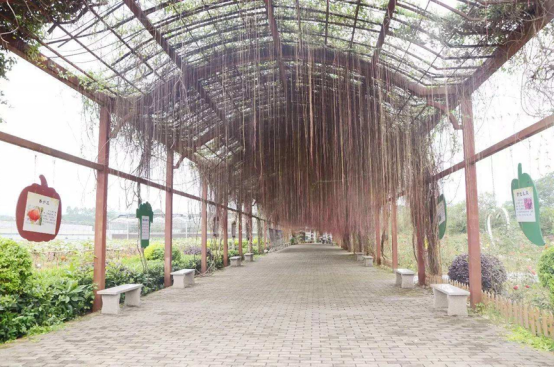
If you need to plant it over a large area, for the sake of appearance you can plant a little at each trellis, spaced 5-10 m apart, and regularly remove some pest-damaged branches and overly long branches. Within a year, you will see Cissus sicyoides grow a large mass of branches and leaves, magnificent in momentum, like a "curtain of dreams."
3. Treat pest infestations with the right remedy
Generally speaking, Cissus sicyoides has few diseases, but making preparations early can reduce unnecessary losses. The pests it is prone to catching mainly include leaf beetles, tussock moths and the like. After pruning branches and leaves in winter, spray thoroughly with an appropriate amount of 1% equal-amount Bordeaux mixture, or it can be replaced with carbendazim 800 times solution. Leaf drop in winter is a normal phenomenon, so there is no need to worry too much.
Can Cissus sicyoides be grown in a pot?
The aerial roots of Cissus sicyoides are very beautiful, and many people want to grow it on their own balcony, so is pot cultivation possible? The answer is yes. In fact, as long as you choose a smaller plant and a suitable clay pot, you can easily cultivate it! Pot cultivation is very flexible and movable. To avoid poor nutrition caused by a pot that is too small, you can appropriately increase the frequency of fertilizing. In addition, take the pot out to receive sunlight more often, so that it can grow better!
The above content is packed with practical tips. Did you learn anything, friends? I hope it can help those who want to carefully grow Cissus sicyoides well!
What is Cissus sicyoides? An introduction to pruning and cultivation methods for Cissus sicyoides
I always hope that one day my home can have a courtyard, with a not-too-long corridor in it, climbing plants like waterfalls planted on both sides of the corridor, and at the end of the corridor a comfortable sofa and a leisurely coffee table. There are many climbing plants, but Cissus sicyoides is the most wonderful and peculiar among them. What is Cissus sicyoides? How is Cissus sicyoides cultivated? Today the editor will introduce this distinctive Cissus sicyoides to everyone.
What is Cissus sicyoides
A perennial evergreen climbing herbaceous vine, entirely hairless, with slender branches and tendrils; leaves alternate, long heart-shaped, with serrated leaf margins, 5-10 cm, with long petioles. Its distinguishing feature is that mature plants can grow reddish-brown, metallic-lustered, unbranched, slender aerial roots from the stem nodes, reaching up to 3 m in length, with hundreds or thousands hanging down beneath the trellis in an extremely elegant and uniquely styled manner. When the aerial roots extend to the ground (soil), they will penetrate into the soil to absorb nutrients, making the leaves greener, the flowers more beautiful, and the whole plant even more vigorous. It blooms in summer and autumn, with cymes, small 4-petaled flowers about 1.5 cm, pale greenish-white. It bears fruit in July-August; the fruit is nearly spherical, about 1 cm in diameter, green when young and purplish-black when mature, containing 1 seed. Cissus sicyoides has extremely strong vitality and is a very easy-to-cultivate garden plant.
Pruning and planting methods for Cissus sicyoides
The propagation of Cissus sicyoides mainly uses water culture and cuttings, but I mainly use water culture. The method is simple and the survival rate is high, and it can be done in spring, summer and autumn. The method is: while pruning, cut the removed branches and vines into 10 cm stem sections, then insert them directly into a mineral water bottle filled with water. Generally, they will root in about 15 days. Once the seedling roots have reached a certain number, they can be planted into a permanent pot. Seedlings can be raised in all three seasons of spring, summer and autumn. The aerial roots of Cissus sicyoides are used to propagate life. For cultivation, loam soil with strong water retention is best, and drainage and sunlight need to be good. Its spreading ability is extremely strong, so the trellis set up needs to be wide; guide the growth direction of the branches at any time so that the vines spread evenly over the trellis surface. As long as Cissus sicyoides is planted in the soil and a trellis or net frame is set up above for the vines to climb on, it will grow naturally. There is no need to fertilize, and after it has been planted for a period of time there is no need to water it anymore; it will absorb moisture from the air on its own, and it can even find a way to take root when it grows onto concrete ground. However, every so often it needs to be pruned and tidied once, and in this way a large mass of fibrous roots can grow within a year.
The above is a brief introduction to Cissus sicyoides and related content on pruning and cultivation methods. After reading the editor's introduction, many people should suddenly recall the image of Cissus sicyoides! In some scenic areas, designers like to first build a pavilion or a corridor, then spread Cissus sicyoides over it, making it look like a natural screen. Many people like to take photos in such places. Have you ever taken a photo with Cissus sicyoides too?
Cultivation methods and precautions for Cissus sicyoides
Chinese scientific name: JinpingtengLatin scientific name: Cissus sicyoides L.Also known as: Mandirong, Zhulianteng, Yilianyoumeng, FugulianKingdom: PlantaeDivision: AngiospermsClass: DicotyledonsSubclass: RosidaeFamily: VitaceaeGenus: CissusSpecies: Cissus sicyoidesNative to tropical America1. Morphological characteristics
A perennial evergreen climbing herbaceous vine, entirely hairless, with slender branches and tendrils; leaves alternate, long heart-shaped, with serrated leaf margins, 5-10 cm, with long petioles. Its distinguishing feature is that mature plants can grow reddish-brown, metallic-lustered, unbranched, slender aerial roots from the stem nodes, reaching up to 3 m in length, with hundreds or thousands hanging down beneath the trellis in an extremely elegant and uniquely styled manner. When the aerial roots extend to the ground (soil), they will penetrate into the soil to absorb nutrients, making the leaves greener, the flowers more beautiful, and the whole plant even more vigorous. It blooms in summer and autumn, with cymes, small 4-petaled flowers about 1.5 cm, pale greenish-white. It bears fruit in July-August; the fruit is nearly spherical, about 1 cm in diameter, green when young and purplish-black when mature, containing 1 seed. Cissus sicyoides has extremely strong vitality and is a very easy-to-cultivate garden plant.2. Growth habits
Drainage and sunlight must be good. Its spreading ability is extremely strong, so the trellis set up must be extensive; guide the growth direction of the branches at any time. Soil: choose a cultivation medium with good water retention that does not become waterlogged, which is ideal. Sunlight: about 80-100% (full sun). Temperature: the suitable growth temperature is about 22-30°C. In winter it will shed leaves, grow slowly, and not grow aerial roots; when the temperature is below 10°C, cold protection must be implemented. In summer it grows quickly, so prune it in good time to facilitate ventilation. Watering: in summer, water once every 1-2 days; in winter, once every 2-3 days. Fertilizing: apply a light fertilizer once every 2-3 months. The situation with pests and diseases is not serious, but it is necessary to maintain ventilation regularly.3. Propagation and cultivation
Stem cuttings or air layering. Seedlings can be raised in all three seasons of spring, summer and autumn. The aerial roots of Cissus sicyoides are used to propagate life. For cultivation, loam soil with strong water retention is best, and drainage and sunlight need to be good. Its spreading ability is extremely strong, so the trellis set up needs to be wide; guide the growth direction of the branches at any time so that the vines spread evenly over the trellis surface. As long as Cissus sicyoides is planted in the soil and a trellis or net frame is set up above for the vines to climb on, it will grow naturally. There is no need to fertilize, and after it has been planted for a period of time there is no need to water it anymore; it will absorb moisture from the air on its own, and it can even find a way to take root when it grows onto concrete ground. However, every so often it needs to be pruned and tidied once, and in this way a large mass of fibrous roots can grow within a year.4. Landscape uses
Suitable for green corridors, green walls or shade sheds. Cissus sicyoides blooms from summer to autumn, with pale greenish-white flowers, and bears fruit in July-August. Its most special feature is that Cissus sicyoides can grow slender reddish-brown aerial roots from the stem nodes, hanging beneath the trellis with a unique style.Cissus sicyoides is very suitable as a green corridor, green wall or shade shed. The newly grown aerial roots of Cissus sicyoides are red, and after a period of time turn yellow-green, so the upper and lower colors of the entire string of aerial roots differ, adding even more charm. Cissus sicyoides is the best heat-insulating curtain. It is said that at the Neiwan Scenic Area in Hsinchu, Taiwan, China, many shops use Cissus sicyoides for landscaping; the slender long strips, like a curtain, have become a scenery there.