How to Grow Bleeding Heart Vine? Detailed Guide to Cultivation Methods and Precautions
Bleeding heart vine generally lives in a semi-shaded environment and likes warm, humid conditions, but is not cold-tolerant. Its optimum growing temperature is 18-24°C, so in winter the temperature must be maintained, and it is best moved indoors or into a greenhouse.
1. Watering
During the growing period of bleeding heart vine, keep it frequently moist, but do not overwater; simply keep the potting soil moist. In high temperatures, water thoroughly to help bleeding heart vine replenish moisture, and provide shade. In winter, reduce watering to let bleeding heart vine enter dormancy and overwinter safely.
2. Sunlight
In summer when temperatures are high, place bleeding heart vine where it is not exposed to direct sunlight; in winter, move it to a sunny indoor spot. During the flowering period of bleeding heart vine, provide sufficient light to promote the development of its flower buds. Insufficient light will have an adverse effect on how well bleeding heart vine blooms.
3. Fertilizing
When cultivating bleeding heart vine, do not fertilize excessively; applying diluted nutrient solution once a month is enough. When bleeding heart vine is in its flowering season, for one continuous month apply additional feedings of fully rotted, thin cake fertilizer water at intervals of 7-10 days. If bleeding heart vine's leaves turn yellow, apply small amounts of 0.2% ferrous sulfate water several times.
4. Pests and Diseases
The main pests of bleeding heart vine include scale insects and whiteflies, which can be sprayed with a 1000-fold to 1500-fold dilution of 40% omethoate. However, when mosaic disease occurs, promptly remove diseased leaves, improve ventilation, and keep the leaves dry.
How to Grow Bleeding Heart Vine
Flower Bonsai Network Flower Care Column: How to Grow Bleeding Heart Vine will introduce to you the cultivation methods of bleeding heart vine and the prevention and control of its pests and diseases
Bleeding heart vine is also known as Qilin Tuzhu, Zhenzhu Baocao, Zhenzhu Baolian, Chou Mudan Teng, and Baihua Sheshecao
Verbenaceae
[Ornamental Value of Bleeding Heart Vine]
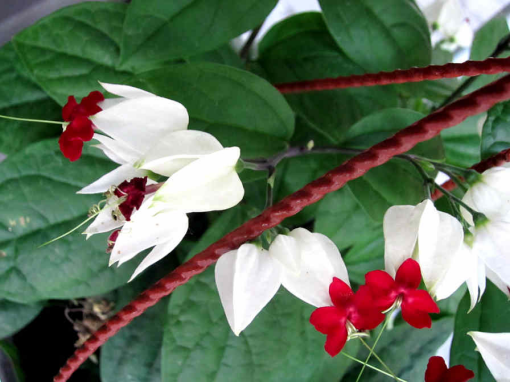
Woody climbing shrub, plant slender, leaves stalked, long ovate with three main veins, from May to August cymes emerge from the leaf axils, flowers have deep red corollas extending from white calyces, like a swimming dragon spitting pearls, very beautiful, suitable for potted plants and flower beds.
[Habits of Bleeding Heart Vine]
Likes warm and humid environments, not cold-tolerant, often epiphytic on tree trunks or moist rocks.
[Key Cultivation Points for Bleeding Heart Vine]
(1) Propagate by division or cuttings. For cuttings, in March to April or August to September, take vigorous one-year-old branches, cut them into 10 cm lengths, leave 2-3 buds on each cutting, insert half into the soil, keep the seedbed moist, shade during the day, roots form in about 1 month, then transplant into small pots with a 15 cm diameter for growing on.
(2) For planting, pots with a 30 cm diameter are suitable; use garden soil as the potting soil, enlarge the drainage hole at the bottom of the pot, and line it with a layer of tile pieces.
(3) During the growing period, it should receive plenty of sunlight; in hot summer, water once in the morning, and apply once a month a 3:7 diluted rotted urine fertilizer.
(4) In summer and autumn, the branches and vines should be properly pruned; after pruning, place in a sunny spot to promote the sprouting and growth of new branches.
(5) Plants more than two years old should have their soil replaced with new soil in February to March.
(6) After October, it should be moved into a greenhouse for protection against the cold.
Is Bleeding Heart Vine Easy to Grow? How to Grow Bleeding Heart Vine
Bleeding heart vine is a climbing shrub of the genus Clerodendrum in the Verbenaceae family and is a beautiful ornamental plant. Generally, when potted, due to the limitation of pruning, the plant stays quite short. It is often used for greenhouse cultivation and viewing, can be used on flower stands, and is also used as a potted plant to accent windowsills and small summer courtyards, as well as for parks or tourist sites to build flower baskets, arches, pavilions, and so on. Now let us take a look at the cultivation methods and precautions for bleeding heart vine!
Growth Habits of Bleeding Heart Vine
Bleeding heart vine likes a warm, humid, and sunny semi-shaded environment, and is not cold-tolerant. In winter, the temperature should not be lower than 8°C; below 5°C, the stems and leaves are prone to frost damage, with mild cases causing leaf drop and severe cases causing the tender stems to wither. During the vegetative growth period, the temperature can be relatively high; at high temperatures above 30°C, as long as water is supplied adequately, it can still grow normally. However, the temperature during reproductive growth, that is, the flowering period, should be relatively low, around 17°C.
Propagation Methods for Bleeding Heart Vine
1. Cuttings: Bleeding heart vine cuttings are generally taken from May to June each year. You can choose the tender top shoots of vigorous, disease-free branches, or cut the lower old branches into 8-10 cm stem sections as cuttings. The cutting bed can use substrates such as peat, perlite, leaf mold, river sand, and vermiculite. The optimum cutting temperature is 21°C, and a cutting bed temperature of 26°C is very favorable for rooting; roots form 3 weeks after insertion. If the base of the cuttings is treated with a 0.5-0.8% indolebutyric acid solution for 1-2 seconds, rooting will be faster and more abundant.
2. Sowing: The seeds of bleeding heart vine have a short lifespan and should be sown immediately after collection. Sowing can be done from March to April each year by scattering seeds in a shallow pot, keeping the temperature at 24°C; seedlings emerge in 10 days. When the seedlings are 10 cm tall, repot and transplant them, and they can bloom in the second year. However, the sowing method is not easy to succeed with, so cutting propagation is recommended.
Cultivation Methods for Bleeding Heart Vine
1. Soil: For growing bleeding heart vine, use fertile, loose, and well-drained sandy loam; for potting, use a mixed soil of culture soil or peat soil and coarse sand. A commonly used soil formula is 4 parts leaf mold, 4 parts garden soil, and 2 parts sandy soil.
2. Watering: Bleeding heart vine is quite sensitive to moisture and needs sufficient water during the growing period. During the stem and leaf growth period, keep the soil moist, but watering must not be excessive; too much water causes it to grow only vines without flowering, and even yellowing and falling leaves, root rot, and death. If the branches wither, stop watering and let it recover and sprout new leaves. In the hot summer season, water thoroughly and provide appropriate shade. In winter, reduce watering to let it go dormant so it can overwinter safely.
3. Light: Bleeding heart vine needs sufficient light in winter; when the weather is too hot in summer, it should be shaded, otherwise the leaves turn yellow. When light is insufficient, it causes vine-like growth and no flowering. Flower bud differentiation is not affected by photoperiod, but stronger light promotes flower bud differentiation and development. It should not be placed in darkness for too long; at temperatures above 21°C, exceeding 24 hours will cause flower drop.
4. Fertilizing: Bleeding heart vine should not be fertilized excessively. Fertilize once every half month, and during the flowering season apply 1-2 additional applications of phosphorus and potassium fertilizer, "Huiyou" 20-8-20 four-season high potassium nitrate fertilizer, or apply fully rotted thin cake fertilizer water once every 7-10 days; 3-4 consecutive applications are enough. In winter, reduce watering and stop fertilizing. If yellowing is observed during the cultivation of bleeding heart vine, it can be applied together with topdressing using 0.2% ferrous sulfate water, which will gradually turn the leaves from yellow back to green.
5. Pruning: For bleeding heart vine, after potted cutting seedlings or sowing seedlings grow to 15 cm, cut the branch 10 cm from the pot rim to promote the sprouting of sturdy new branches. During the growing period, strictly control the height of the branches, and pay attention to pinching and topping so the branches are neat and flowering will be dense in the future. Half a month after pinching, apply daminozide or chlormequat to control plant height, achieving a short plant, lush leaves, and many flowers.
6. Repotting: Potted bleeding heart vine commonly uses a 12-15 cm pot, and 3 plants can be planted per pot. Generally, repot once every 1-2 years, either in early spring or after the flowers fade. When repotting, first cover the drainage hole with broken tile pieces, then add a small amount of bone meal as base fertilizer, then fill with new culture soil, plant the plant well, and leave 2-3 cm of rim space for fertilizing and watering. After repotting, water thoroughly and place in a shaded spot to recover; after recovery, move to a sunny place for care.
Precautions for Growing Bleeding Heart Vine
1. During cultivation, bleeding heart vine can develop leaf spot disease. At first there are just small brown spots; if not treated in time, large black patches will appear, and the leaves will wither and die. So once illness is found, immediately spray the leaves with an 800-fold dilution of chlorothalonil, once every 7-8 days, for 2-3 consecutive times, and it can basically recover.
2. The main pests of bleeding heart vine include scale insects and whiteflies, which can be sprayed with a 1000-fold to 1500-fold dilution of 40% omethoate. For leaves that cannot spread normally and become chlorotic and yellow due to alkaline soil, irrigate with a 0.2% ferrous sulfate solution. For mosaic disease and fungal diseases, promptly remove fallen diseased leaves, improve ventilation, and keep the leaves dry to control the condition.