What are the cultivation methods and precautions for Delphinium grandiflorum
Fertilizing
Delphinium grandiflorum requires different types of fertilizer at different stages. For example, before planting, organic fertilizer should be applied along with an appropriate amount of compound fertilizer as a base fertilizer; during the vegetative growth stage, nitrogen fertilizer needs to be added, as the Delphinium grandiflorum plant grows rapidly at this time, and timely nutrient supplementation can make the leaves large and deep green; during the flowering stage, timely supplementation of phosphorus and potassium fertilizer can make the plant produce more flowers and bloom for a longer time. This enhances the ornamental value of Delphinium grandiflorum.
Watering
Delphinium grandiflorum is a very cold-hardy plant, but it fears waterlogging, so water it when the soil is dry. Once you water, water thoroughly in one go, but be careful not to let water accumulate in the pot, as this may very likely cause the plant's roots to rot. During the plant's flowering period, the amount of water should be increased to keep the soil moist, so the plant blooms for a longer time and produces more flowers, but do not water the plant at midday when the temperature is too high, as this is very unfavorable to the plant's growth.
Management
Delphinium grandiflorum does not like hot weather, so do not place it under direct sunlight, especially in summer, when it should be given moderate shade, such as building a small shelter for the plant or planting it under tall trees. During the growing process, the plant should be frequently loosened around the soil and weeds removed. This allows Delphinium grandiflorum to grow more healthily and gives it higher ornamental value.
The above is an introduction to how to grow foliage Delphinium grandiflorum. Below, let us learn about what to pay attention to when cultivating Delphinium grandiflorum.
Delphinium grandiflorum Delphinium grandiflorum Delphinium grandiflorum illustrated guide: how to grow Delphinium grandiflorum / how to propagate Delphinium grandiflorum
Delphinium grandiflorum profileDelphinium grandiflorum Delphinium grandiflorum
Cultivation methods and precautions for Delphinium grandiflorum Introduction to Delphinium grandiflorum
Delphinium grandiflorum is a perennial herbaceous plant of the genus Delphinium in the buttercup family (Ranunculaceae). Because its flower shape is distinctive and closely resembles little swallows, it is also known as larkspur and dove flower, with a flower diameter of about 4 cm. Its form is elegant and endearing. It is a drought-tolerant plant and a light-loving plant. It is a sun-loving plant, tolerates partial shade, is very robust, drought-tolerant, cold-tolerant, and prefers a cool climate. It grows on hillsides, grasslands, and fixed sand dunes, and dislikes heat. It is native to southern Europe, and in China it is distributed in Yunnan, Shanxi, Hebei, Ningxia, Sichuan, and other places.
Delphinium grandiflorum is 35-65 cm tall, with sparsely branched stems and palmately parted leaves. The raceme bears 3-15 flowers, and the axis and pedicels have recurved fine pubescence; the flowers are bilaterally symmetrical; the bracteoles are linear or subulate; the sepals are 5, petal-like, blue or purplish-blue, 1.5-1.8 cm long, the upper one with a spur and often slightly concave at the tip; the petals are 2, smaller, with a spur, the spur projecting into the sepal spur; the staminodes are 2, the stamens petaloid, the petal lobes broadly obovate, slightly concave, with yellow bearded hairs; the stamens are numerous; the carpels are 3, free.
The follicles are 3, clustered together. The flowering period is August to September. It is suitable for arranging flower beds and flower borders, and can also be used as a cut flower. The whole plant and seeds can be used as medicine to treat toothache.
Morphological characteristics of Delphinium grandiflorum
Delphinium grandiflorum is a perennial herb, 35-65 cm tall. The whole plant is covered with soft hairs. The stems are sparsely branched. The leaves are alternate, palmately parted, the basal leaves and lower stem leaves with long petioles; the leaf blade is round-reniform, three-parted, 2.2-6 cm long, 4-8 cm wide, the lobes finely divided, the small lobes linear, 0.6-2.5 mm wide.
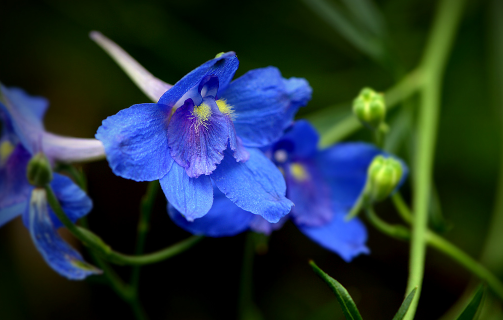
The raceme of Delphinium grandiflorum bears 3-15 flowers, and the axis and pedicels have recurved fine pubescence; the flowers are bilaterally symmetrical; the bracteoles are linear or subulate; the sepals are 5, petal-like, blue or purplish-blue, 1.5-1.8 cm long, the upper one with a spur and often slightly concave at the tip; the petals are 2, smaller, with a spur, the spur projecting into the sepal spur; the staminodes are 2, the petal lobes broadly obovate, slightly concave, with yellow bearded hairs; the stamens are numerous; the carpels are 3, free. At full bloom, it looks even more like a flock of little blue birds descending from the sky, very moving.
The follicles are 3, clustered together. The flowering period is August to September. The fruiting period is September to October.
This genus is very close to Aconitum, and the distinguishing features are: the upper sepal has a spur, the petals have no claw, and on each side outside the stamens there is 1 clawed petal-like staminode (often with a tuft of bearded hairs in the center of the petal lobe). The flowers of many species in this genus are blue or purple and often have long spurs, resembling flying birds, very beautiful.
In China, only Delphinium grandiflorum is cultivated as an ornamental. The genus Consolida is very close to this genus, but its 2 petals are connate, it has no staminodes, and it has only 1 carpel (this genus has 3-5), so it differs from this genus. There are about 40 species, native to southern Europe and western Asia. The larkspur cultivated for ornament in China is native to southern Europe and southwestern Asia.
Many people treat larkspur as another name for Delphinium grandiflorum, because both are called larkspur in English. In fact, the two are different plants, even belonging to different genera.
Ecological habits of Delphinium grandiflorum
Delphinium grandiflorum grows on hillsides, grasslands, and fixed sand dunes. It prefers a cool, ventilated, dry environment with ample sunlight and well-drained sandy loam. It is a drought-tolerant plant and a light-loving plant. It is a sun-loving plant, tolerates partial shade, is very robust, drought-tolerant, cold-tolerant, and prefers a cool climate, and dislikes heat.
Delphinium grandiflorum grows in areas at altitudes of 500 m to 2,800 m, mostly on mountain grassy slopes and hilly sandy land.
It is native to southern Europe. In China it is distributed in Yunnan, Shanxi, Hebei, Ningxia, Sichuan, Gansu, Heilongjiang, Jilin, Liaoning, **, Tibet, and other places, and is cultivated in every province. It grows on hillsides, grasslands, and fixed sand dunes. It prefers a cool, ventilated, dry environment with ample sunlight and well-drained sandy loam.
Cultivation techniques of Delphinium grandiflorum Main characteristics of cut flowers
Delphinium grandiflorum is highly sensitive to ethylene. When exposed to an ethylene concentration of 3 microliters/liter for 24 hours, the cut flowers are damaged. Silver thiosulfate (STS) treatment and 1-methylcyclopropene (1-MCP) treatment (see appendix for details) can reduce the harm of exogenous ethylene and increase postharvest longevity.
Harvest and cutting developmental stage
Harvest and cut when most of the flowers on the flower stem have opened.
Vase life
With proper treatment, the vase life of Delphinium grandiflorum cut flowers can reach 14 days.
Storage and transport techniques
(1) After receiving the cut flowers, they should be recut and hydrated in warm clean water at pH 3.5-4.0. If the cut flowers have not previously been treated with silver thiosulfate (STS), silver thiosulfate (STS) should be added to the hydration solution.
(2) Use a preservative solution to wet-store the cut flowers, with a storage temperature of 2-5°C.
(3) The cut flower display area should not be too cold or too hot, and should avoid wind and ripe fruit.
Breeding
Some European countries began horticultural cultivation as early as the 17th century. To date, thousands of ornamental cultivars have been bred worldwide, and they are widely used in courtyard landscaping, potted ornament, and cut flower production.
Medicinal material collection
The fruiting period is inconsistent, and after ripening they naturally split open, so they should be harvested in time. Generally, in June, the already ripe seeds are harvested first 1-2 times, and in July the best ones are selected and all harvested, sun-dried, and threshed. The whole plant is rinsed, cut into sections, and sun-dried.
Propagation methods of Delphinium grandiflorum
Delphinium grandiflorum is commonly propagated by division, cuttings, and sowing.
Division
It can be done in spring and autumn. In spring, when new shoots grow to 15-18 cm, take cuttings, and transplant after rooting; alternatively, after flowering, take new shoots from the base for cuttings.
Cuttings
Propagation is carried out in spring. When new shoots grow to more than 15 cm, cut off cuttings and insert them into sandy soil.
Sowing
Mostly carried out in March-April or September, with an optimum germination temperature of about 15°C. Autumn sowing is in late August to early September. First sow in an open-field seedbed, and before winter begins move to a cold frame or cold room to overwinter, then plant out when spring is warm. In the south, direct sowing in the open field in early spring, with thinning to maintain a plant spacing of 25-50 cm. In the north, seedlings are generally raised first, planted out in mid-April, transplanted when there are 2-4 true leaves, and planted out when there are 4-7 true leaves. Pay attention to drainage on rainy days. Apply sufficient base fertilizer before planting, and topdress mainly with nitrogen fertilizer. Old plants have weakened growth vigor and need to be transplanted once every 2-3 years. The plants are tall and prone to lodging or bending, so they need support and fixing.
Disease control of Delphinium grandiflorum
Common diseases of Delphinium grandiflorum include black spot and root crown soft rot.
Distribution area of Delphinium grandiflorum
Delphinium grandiflorum is native to southern Europe. In China it is distributed in Yunnan, Shanxi, Hebei, Ningxia, Sichuan, Gansu, Heilongjiang, Jilin, Liaoning, **, Tibet, and other places, and is cultivated in every province.
Delphinium grandiflorum is distributed in Russia, Mongolia, and in mainland China in Liaoning, Sichuan, Shanxi, Hebei, Jilin, Heilongjiang, Inner Mongolia, Yunnan, and other places.
Medicinal or dietary therapeutic value of Delphinium grandiflorum
The medical information and health dietary therapy information on Hugarden Network is for reference only and cannot be used as a basis for diagnosis or medical treatment. Any health problem should be consulted with professional medical staff, and the treatment of any disease should follow a doctor's advice.
Ultimate flower-protecting mission: love yourself, start from reality, and strictly follow a doctor's advice. For illness, do not be careless, do not delay, do not give up hope, face it bravely, use love to warm the silent world, and use your heart to care for the flower field within.
Medicinal value
The whole plant and seeds can be used as medicine to treat toothache. The juice soaked from stems and leaves can kill insects.
(The fruiting period is inconsistent, and after ripening they naturally split open, so they should be harvested in time. Generally, in June, the already ripe seeds are harvested first 1-2 times, and in July the best ones are selected and all harvested, sun-dried, and threshed. The whole plant is rinsed, cut into sections, and sun-dried.)
Functions and indications
① "Handbook of Commonly Used Chinese Herbal Medicines in Northeast China": "Purging fire and relieving pain, killing insects."
② "Handbook of Chinese Herbal Medicine Treatment on the Plateau": "Antibacterial and dehumidifying, killing insects and treating ringworm."
③ Treating wind-heat toothache: larkspur 5 fen to 1 qian. Decoct in water and gargle, do not swallow. ("Handbook of Commonly Used Chinese Herbal Medicines in Northeast China")
④ Treating scabies and ringworm: larkspur combined with Sophora flavescens, grind into powder and apply. ("Handbook of Chinese Herbal Medicine Treatment on the Plateau")
⑤ Treating head lice: fresh whole plant of Delphinium grandiflorum, crush, soak in water and wash the head. ("Jilin Chinese Herbal Medicines")
Medicinal material identification
The root is long cylindrical, 2-7 cm long, 1-3 mm in diameter; the surface is dark brown, with obvious transverse wrinkles; the broken surface is yellow. The stem surface is brownish-yellow, ridged, and the cross-section is hollow. The leaves are shrunken, yellow-green, and after moistening and flattening are reniform-pentagonal, 0.8-1.4 cm long, 0.7-2.3 cm wide, 3-parted, the central whole lobe broadly rhombic, the lateral whole lobes nearly fan-shaped, once or twice finely divided, the small lobes narrowly ovate; the petiole is long. The flowers are solitary at the branch tips, the bracteoles leaf-like or elliptic; the pedicels are covered with short soft hairs; the sepals are 5, blue-purple, broadly elliptic, the spur cylindrical-subulate, about as long as the sepals; the staminodes are 2, petal-like, dark brown, 2-cleft, covered with yellow bearded hairs; the ovary is hairy. The follicles are about 1.8 cm long. The seeds are obconical-tetrahedral. The odor is slight, and the taste is bitter.
Chemical composition
The aerial parts contain the alkaloid methyllycaconitine, and the roots contain diterpenoid alkaloids: lycoctonine and methyllycaconitine. The roots are toxic. The LD50 of the total alkaloids of the root injected intravenously into mice is 4.90 mg/kg, with the main symptoms being weakness of the limbs, difficulty breathing, convulsions, and death after sudden jumping. The whole plant can be used as a farm insecticide to kill flies and their larvae.
Selected prescriptions
① Treating wind-heat toothache: larkspur 5 fen to 1 qian. Decoct in water and gargle, do not swallow. ("Handbook of Commonly Used Chinese Herbal Medicines in Northeast China")
② Treating scabies and ringworm: larkspur combined with Sophora flavescens, grind into powder and apply. ("Handbook of Chinese Herbal Medicine Treatment on the Plateau")
③ Treating head lice: fresh whole plant of Delphinium grandiflorum, crush, soak in water and wash the head. ("Jilin Chinese Herbal Medicines")
Harvest period
There are many kinds of Chinese medicinal materials, and the medicinal parts differ, so their optimal harvest times are also different. The so-called optimal harvest period is defined with respect to the quality of the Chinese medicinal material. The quality of Chinese medicinal materials depends on the content of active ingredients and is closely related to the place of origin, variety, cultivation techniques, and the number of years, season, time, and method of harvest. To ensure the quality and yield of Chinese medicinal materials, most should be harvested in time after maturity. The maturity of Chinese medicinal materials means that the medicinal part has reached the medicinal standard and meets the provisions and requirements of the national pharmacopoeia. Medicinal material quality includes internal quality and external appearance traits, so the optimal harvest period for Chinese medicinal materials should be when the content of active ingredients is highest and the external traits such as shape, color, texture, and size are optimal, so as to obtain high-quality medicinal materials and achieve better benefits.
Now, based on the experience of predecessors, combined with the factors affecting the traits and quality of medicinal materials and the patterns of nutrient storage and loss during the growth and development of medicinal plants, and according to the different medicinal parts of Chinese medicinal materials, the optimal harvest periods of Chinese medicinal materials are briefly described as follows.
I. Varieties of Chinese medicinal materials used as medicine from roots and rhizomes
For this type of Chinese medicinal material, those with firm roots and rhizomes, straight root strips, few branches, and sufficient powderyness are generally of better quality. The harvest season is mostly in autumn, winter, or early spring, during the dormant period after growth has stopped and flowers and leaves have withered, or before germination in early spring. For most varieties, harvesting before germination in spring is the most suitable period, because in early spring the medicinal plant is preparing to sprout, and the large amount of nutrients stored in the root and rhizome parts has not yet decomposed or has just begun to decompose, so the content of active ingredients is highest, the nutrients are most abundant, and the quality is best. But there are also exceptions, such as Astragalus membranaceus, Aconitum kusnezoffii, Coptis chinensis, and Codonopsis pilosula, which are harvested in autumn, while Pseudostellaria heterophylla, Pinellia ternata, and Aconitum carmichaelii are dug and harvested in summer for high active ingredient content and good quality. The most suitable harvest periods for some varieties are described below (see attached table) for reference.
II. Varieties of Chinese medicinal materials used as medicine from flowers
Flower-type Chinese medicinal materials are mostly harvested when the flower buds are still closed, giving better quality. If the flowers have already fully opened, the petals are likely to scatter, break, lose color, and lose fragrance, seriously affecting quality. For example, honeysuckle should be harvested in summer and autumn when the bud tip is enlarged and turns from green to yellow; clove in autumn when the flower buds turn from green to red; Magnolia biondii in late winter and early spring when the flowers have not opened; rose in late spring and early summer when the flowers are about to open; and Sophora japonica flower buds in summer when the buds form. Harvesting at these times is most suitable, with high active ingredient content and good quality. However, some flower-type Chinese medicinal material varieties need to be harvested when the flowers are open, such as Chinese rose in spring and summer when the flowers are slightly open, Rhododendron molle in April-May when the flowers bloom, Datura metel in spring and summer and when the flowers first open, chrysanthemum in autumn and winter when the flowers are fully open, and safflower in summer when the flowers turn from yellow to red. These are the most suitable harvest periods.
III. Varieties of Chinese medicinal materials used as medicine from fruits and seeds
Fruit-type Chinese medicinal materials are better harvested when naturally mature or nearly mature; seed-type Chinese medicinal materials are better harvested when the seeds are fully developed and mature, the grains are plump, and the active ingredient content is high. Such as hemp seed, Aristolochia debilis, Kochia scoparia fruit, Celosia argentea seed, Schisandra chinensis, Vaccaria hispanica, nutmeg, radish seed, raspberry, Chaenomeles speciosa, hawthorn, Trichosanthes kirilowii, bitter apricot seed, bunge cherry seed, black plum, Cherokee rose fruit, Astragalus complanatus, cassia seed, Psoralea corylifolia, fenugreek, bitter orange, Evodia rutaecarpa, croton, wild jujube seed, boat sterculia seed, Hydnocarpus anthelminticus, Rangoon creeper fruit, chebulic myrobalan, fennel, Cnidium monnieri, Cornus officinalis, Forsythia suspensa, Ligustrum lucidum, nux vomica, dodder seed, Pharbitis nil seed, henbane seed, goji berry, burdock seed, coix seed, Amomum villosum, Amomum tsaoko, Alpinia oxyphylla, and so on. For varieties with inconsistent maturity, they should be harvested as they ripen, in batches. Such as garden balsam seed and Euphorbia lathyris, etc.
IV. Varieties of Chinese medicinal materials used as medicine from leaves
Leaf-type Chinese medicinal material varieties should be harvested when the plant is growing most vigorously and the flowers have not opened or are in full bloom. At this time the plant has fully grown, photosynthesis is vigorous, and the active ingredient content is highest. Such as Isatis indigotica leaf, perilla leaf, senna leaf, Clerodendrum trichotomum leaf, mugwort leaf, and so on.
V. Varieties of Chinese medicinal materials used as medicine from the whole plant
Chinese medicinal materials used as medicine from the whole plant should be harvested when the plant is growing most vigorously and about to bloom. Such as mint, Andrographis paniculata, Lycopodium clavatum, Houttuynia cordata, Epimedium, Agrimonia pilosa, Phryma leptostachya, Verbena officinalis, Agastache rugosa, Lycopus lucidus, Scutellaria barbata, Oldenlandia diffusa, Senecio scandens, Eupatorium fortunei, dandelion, Artemisia capillaris, Lophatherum gracile, Dendrobium, and so on.
Identification of raw medicinal materials
The root is long cylindrical, 2-7 cm long, 1-3 mm in diameter; the surface is dark brown, with obvious transverse wrinkles; the broken surface is yellow. The stem surface is brownish-yellow, ridged, and the cross-section is hollow. The leaves are shrunken, yellow-green, and after moistening and flattening are reniform-pentagonal, 0.8-1.4 cm long, 0.7-2.3 cm wide, 3-parted, the central whole lobe broadly rhombic, the lateral whole lobes nearly fan-shaped, once or twice finely divided, the small lobes narrowly ovate; the petiole is long. The flowers are solitary at the branch tips, the bracteoles leaf-like or elliptic; the pedicels are covered with short soft hairs; the sepals are 5, blue-purple, broadly elliptic, the spur cylindrical-subulate, about as long as the sepals; the staminodes are 2, petal-like, dark brown, 2-cleft, covered with yellow bearded hairs; the ovary is hairy. The follicles are about 1.8 cm long. The seeds are obconical-tetrahedral. The odor is slight, and the taste is bitter.
Uses and purposes of Delphinium grandiflorum Landscape uses
The flower shape of Delphinium grandiflorum is distinctive, and the colors are elegant. It can be planted in groups, planted in flower beds and flower borders, and can also be used as a cut flower.
Garden uses of Delphinium grandiflorum
Delphinium grandiflorum is a flower bed flower, flower border flower, rock garden flower ornamental type, for naturalistic planting, flower borders, flower beds, and rock gardens.
The flower shape of Delphinium grandiflorum is distinctive, and the colors are elegant. It can be planted in groups, planted in flower beds and flower borders, and can also be used as a cut flower.
Flower language of Delphinium grandiflorum
Delphinium grandiflorum flower language: tranquility, lightness, justice, freedom
Blue Delphinium grandiflorum flower language: depression
Purple Delphinium grandiflorum flower language: admiration and gentleness
Pink Delphinium grandiflorum flower language: poetic
White Delphinium grandiflorum flower language: elegant
Delphinium grandiflorum pictures
Pedilanthus bracteatus illustrated guide: how to grow Pedilanthus bracteatus / how to propagate Pedilanthus bracteatus Genus Pedilanthus
Chinese scientific name: Pedilanthus bracteatusLatin name: Pedilanthus bracteatus
Family and genus: Genus Pedilanthus
Introduction: Pedilanthus bracteatus, habitat: Mexico / Colombia / South American coast. Shape: plant height about 0.4-3 m. The minimum suitable survival temperature is about 12°C, a semi-deciduous shrub.
Family name: Euphorbiaceae Genus name: Pedilanthus Latin name: Pedilanthus bracteatus Chinese name: Pedilanthus bracteatus Synonym: pedilanthus pavonis Habitat: Mexico / Colombia / South American coast Shape: plant height about 0.4-3 m Similar species: Flowers: Habits: minimum suitable survival temperature about 12°C, semi-deciduous shrub.