What are the key points to note when growing Dipladenia?
1. Dipladenia needs plenty of light; insufficient light will affect its blooming and is also bad for its growth.
2. When fertilizing, control the dosage of nitrogen fertilizer; excess nutrients will make the Dipladenia plant grow too vigorously, which is bad for blooming.
3. Although Dipladenia has strong stress resistance and generally does not suffer from pests or diseases, you should still take preventive measures, ventilate and drain frequently, and keep the leaves dry.
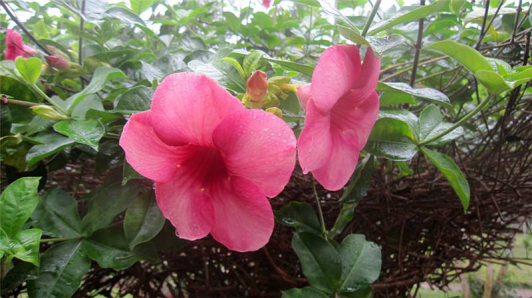
Dipladenia is not only fragrant and pleasant but can also decorate and beautify our courtyard; it is a flower with a very wide range of uses. The above is the content on how to grow Dipladenia, and the tips on points to note when cultivating Dipladenia that I have added, hoping to help everyone. If you like it, save it to Four Seasons Plants website!
How to grow Dipladenia and points to note
How to grow Dipladenia
Light requirements: Dipladenia likes a warm, humid environment with plenty of sunlight. Sufficient light is needed to ensure normal growth of Dipladenia; partial sun to full sun is fine. Of course, Dipladenia can also be kept in a slightly shaded spot.
Water and fertilizer management: During the care of Dipladenia, water and fertilizer management must be done well. When watering, control the watering; do not let it become waterlogged or too dry, which would cause poor plant growth. Good water and fertilizer management can form a well-developed root system, and only then will Dipladenia grow vigorously. During the growing season, apply a compound fertilizer 3-5 times as a top dressing.
Temperature requirements: The optimal temperature for Dipladenia growth is between 20-30°C, and it is best not to exceed 35°C. In winter, when the temperature is too low, it is prone to frost damage, so in winter pay attention to maintaining the temperature, preferably not below 10°C.
Soil selection: Dipladenia has low soil requirements and strong adaptability, but sandy loam rich in humus and with good drainage is best.
Propagation methods: Dipladenia is generally propagated by cuttings, and tissue culture can also be used for rapid propagation.
Pruning: Dipladenia is generally pruned at two times. Pruning after the flowering period and pruning in spring. Pruning after the flowering period can shape Dipladenia and make it more attractive. Pruning old plants in spring can promote the sprouting of new branches.
Points to note when growing Dipladenia
Light must be sufficient; insufficient light will lead to reduced blooming in Dipladenia.
When fertilizing, control the amount of nitrogen fertilizer applied, so that the Dipladenia plant does not grow too vigorously due to excessive nutrients and thereby affect blooming, reducing the number of flowers.
Although Dipladenia has strong stress resistance and is less susceptible to diseases, you should still take preventive measures.
Is Dipladenia poisonous? How to grow Dipladenia
Below, the Flowers and Bonsai website introduces the knowledge of how to grow Dipladenia, and also introduces whether Dipladenia is poisonous and the value of Dipladenia.
Dipladenia (scientific name: Dipladenia sanderi) is a new type of climbing plant, also known as red crepe jasmine, double gland vine, double happiness vine, wisteria vine, and red cicada flower. It is native to tropical America and is a perennial evergreen plant of the Apocynaceae family. The twining stems of Dipladenia are soft and flexible, spiraling upward along a support, and the pink trumpet-like flowers are large and upright, with flower stems reaching 6-8 cm.
Dipladenia likes a warm and humid environment, but its branching is not good. During the flowering period, Dipladenia often shows a grand display of more flowers than leaves. When a breeze comes, waves of refreshing fragrance make people feel relaxed and happy, hence the elegant name "Dipladenia" (fragrance-floating vine).
Dipladenia is a plant of the Apocynaceae family, and many people know that plants in the Apocynaceae family are poisonous. So, is Dipladenia poisonous? Where can it be kept?
Is Dipladenia poisonous?
Many plants in the Apocynaceae family are poisonous, but whether Dipladenia is poisonous currently has no clear conclusion. Dipladenia has a rich fragrance, and some people worry whether this scent can cause poisoning. However, so far, there appear to be no cases of poisoning from growing Dipladenia. Everyone likes this fragrance very much, and few people feel unwell because of it, so although the fragrance of Dipladenia is rich, everyone can still grow it with peace of mind.
Where is Dipladenia suitable for growing
Dipladenia can be grown indoors or outdoors. When grown indoors, it can be made into a potted plant, placed on a balcony or elsewhere, or grown as a hanging plant. When grown outdoors, Dipladenia can be used for fences, trellises, or as a small courtyard landscaping plant. When cultivating outdoors, be careful not to grow it in low-lying places, so that soil waterlogging does not cause poor plant growth.
Points to note when growing Dipladenia
When growing Dipladenia indoors, be careful to provide sufficient light. If the light is insufficient, or the growing environment is too shaded, it will lead to reduced blooming in Dipladenia.
Growing Dipladenia indoors can purify the air, and this beautiful flower also gives off a rich fragrance, making the indoor environment purer.
In addition, when growing Dipladenia, as long as you pay more attention, you can reduce the possibility of poisoning. You should know that Dipladenia may also have effects you never expected!
How to grow Dipladenia and points to note
Dipladenia is also known as red crepe jasmine, double gland vine, double happiness vine, wisteria vine, and red cicada flower. The reason it is named "fragrance-floating" is that Dipladenia gives off waves of fragrance when it blooms, fresh and pleasant. So, what exactly are the methods for growing Dipladenia, and what points should be noted?
How to grow Dipladenia
Light requirements: Dipladenia likes a warm, humid environment with plenty of sunlight. Sufficient light is needed to ensure normal growth of Dipladenia; partial sun to full sun is fine. Of course, Dipladenia can also be kept in a slightly shaded spot.
Water and fertilizer management: During the care of Dipladenia, water and fertilizer management must be done well. When watering, control the watering; do not let it become waterlogged or too dry, which would cause poor plant growth. Good water and fertilizer management can form a well-developed root system, and only then will Dipladenia grow vigorously. During the growing season, apply a compound fertilizer 3-5 times as a top dressing.
Temperature requirements: The optimal temperature for Dipladenia growth is between 20-30°C, and it is best not to exceed 35°C. In winter, when the temperature is too low, it is prone to frost damage, so in winter pay attention to maintaining the temperature, preferably not below 10°C.
Soil selection: Dipladenia has low soil requirements and strong adaptability, but sandy loam rich in humus and with good drainage is best.
Propagation methods: Dipladenia is generally propagated by cuttings, and tissue culture can also be used for rapid propagation.
Pruning: Dipladenia is generally pruned at two times. Pruning after the flowering period and pruning in spring. Pruning after the flowering period can shape Dipladenia and make it more attractive. Pruning old plants in spring can promote the sprouting of new branches.
Points to note when growing Dipladenia
Light must be sufficient; insufficient light will lead to reduced blooming in Dipladenia.
When fertilizing, control the amount of nitrogen fertilizer applied, so that the Dipladenia plant does not grow too vigorously due to excessive nutrients and thereby affect blooming, reducing the number of flowers.
Although Dipladenia has strong stress resistance and is less susceptible to diseases, you should still take preventive measures.
When does Dipladenia bloom?
Dipladenia is grown mainly for its flowers. Once the beautiful flowers open, they are enough to catch people's eyes. Are you eager to know about Dipladenia flowers? Let us look at when Dipladenia blooms.
The flowering period of Dipladenia
The flowering period of Dipladenia is actually quite long, mainly concentrated in summer and autumn. Dipladenia blooms from April and the flowers fall in October, lasting nearly half a year. It can be said to be very long-lasting.
The flower shape and color of Dipladenia
The flowers of Dipladenia look somewhat like small trumpets. The flowers are very large and upright when open, and the flower stems can reach 6-8 cm. The flowers of Dipladenia are mainly axillary, with a funnel-shaped corolla and 5 petals. The petals overlap one by one in a well-arranged pattern, and the flower shape is very elegant.
The flower colors of Dipladenia are mainly in the red range, including red, peach red, golden red, pink, and other colors, rich in variation, and sometimes there are also some other colors. They look brilliant and colorful, pleasing to the eye.
The flower language of Dipladenia
The flower language of Dipladenia is love and virtue. Such a beautiful flower is full of rich fragrance, just like love and virtue, both beautiful and unforgettable.
Points to note when Dipladenia blooms
The flowering period of Dipladenia is mainly summer and autumn, but if cared for properly it can also bloom in other seasons.
After a long flowering period, Dipladenia has entered autumn. Blooming consumes a large amount of nutrients, and after the flowers fall, a large number of old branches, dead branches, and spent flowers remain. Therefore, pruning can be done after the flowering period. Pruning at this time is mainly for shaping, to make the whole Dipladenia plant look more attractive.
Reduced blooming may be due to insufficient light or excessive fertilization. In daily care, pay attention to increasing light time and fertilizing reasonably to avoid excessive nutrients and excessive growth of the plant.
The value of Dipladenia
Dipladenia has large flowers and brilliant colors and a beautiful plant shape, and is known as the queen of tropical climbing plants. Is such a beautiful plant only for viewing, or does Dipladenia have some other uses?
The ornamental value of Dipladenia
Being viewed by people is an important function of Dipladenia. Its flowers are beautiful and often bloom very profusely, showing a grand display of more flowers than leaves. Dipladenia has very high ornamental value.
Dipladenia can be cultivated outdoors. When cultivated outdoors, it can be used for hedges, trellises, rooftops, and small courtyard landscaping, and can play a role in beautifying the environment and providing viewing, adding a touch of brightness and novelty. But note that when cultivating outdoors, pay attention to the planting site and do not choose low-lying areas, to avoid waterlogging.
Dipladenia can also be used as an indoor potted plant. Dipladenia actually does not have strong vining growth and is quite suitable as a small potted plant, placed on a balcony, windowsill, corridor, steps, and other places to decorate the home. Dipladenia can also be made into a ball shape or a hanging basket and hung up, which is also very unique and can fill the home with exotic charm.
When placed indoors, Dipladenia can not only beautify the indoor environment but also fill the room with fragrance.
The purifying value of Dipladenia
Dipladenia can purify the air, and this point is also very important. Placing Dipladenia indoors can absorb harmful substances such as benzene and formaldehyde in the air, as well as some dust in the air, making people's indoor environment purer. Outdoor Dipladenia has a certain adsorption effect on sulfur dioxide and other toxic components in the air, with a relatively obvious effect on purifying the environment.
Other values of Dipladenia
Dipladenia can be used to extract essential oil. When Dipladenia blooms, its fragrance spreads everywhere and is very rich. Its flowers contain a large amount of natural volatile oil, from which natural essential oil can be extracted. The essential oil from the flowers has many benefits for people. It can refresh the mind and regulate mood.