How to propagate Dipladenia? An introduction to several common methods
The most suitable growing temperature for Dipladenia is 20-31°C, with spring being the most suitable; it should not be cultivated below 10°C to avoid cold damage. Dipladenia has strong adaptability to soil and especially loves sandy soil rich in humus. It is generally propagated by sowing or cuttings, selecting semi-lignified branches, with one internode used as a cutting. Its cuttings take a long time to root, so place them in a sunny spot as much as possible, and a moderate amount of rooting powder can also be used to speed up rooting.
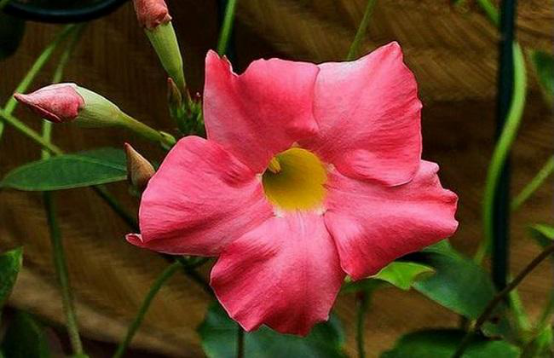
Now that you know all this, would you like to grow a beautiful Dipladenia yourself? Placed at home, it not only gives off waves of delicate fragrance but also has great ornamental value. Remember not to miss its flowering season!
An introduction to the propagation methods of Dipladenia
Dipladenia has large, brightly colored flowers and a very beautiful plant shape, so it has the fine name "Queen of Tropical Vines." Because Dipladenia is not very vining in habit, it can also be grown indoors. Some flower enthusiasts plant a few Dipladenia on a balcony or in a courtyard, adding a touch of exotic flavor to the setting.
Dipladenia
Dipladenia is generally propagated by cuttings, which can be done in spring, summer, and autumn, and tissue culture methods can also be used for rapid propagation. Dipladenia likes a warm, humid, and sunny environment, and can also be placed in a slightly shaded spot, but insufficient light reduces flowering. The suitable growing temperature is 20-30°C. It has strong adaptability to soil, but sandy loam rich in humus and with good drainage is best.
For outdoor cultivation, it should not be planted in overly low-lying sites, to avoid poor growth caused by oxygen deficiency from water accumulation. For indoor potted plants, in the north, leaf mold soil plus a small amount of coarse sand can be used; in the south, pond mud, peat soil, and river sand can be mixed in a 5:3:2 ratio. During the growing period, a moderate amount of compound fertilizer can be applied 3-5 times, but the amount of nitrogen fertilizer should be controlled to avoid excessive vegetative growth that affects reproductive growth and reduces flowering. During care, watering should be appropriately controlled to develop a well-developed root system.
Pruning can be done after the flowering period. If the plant is one or two years old, light pruning can be done, mainly for shaping. For old perennial plants, heavy pruning can be done in spring to encourage the growth of strong new branches.
Dipladenia Dipladenia sanderi Dipladenia illustrated guide: how to grow Dipladenia / how to propagate Dipladenia
Dipladenia profileDipladenia Dipladenia sanderi
How to grow Dipladenia and points to note: an introduction to Dipladenia
Dipladenia (scientific name: Dipladenia sanderi) is a new type of vine, also known as red wrinkled vine, double gland vine, double happiness vine, wen vine, and red cicada flower. It is native to tropical America and is a perennial evergreen plant in the Apocynaceae family. The twining stems of Dipladenia are soft and flexible, spiraling upward along a support. Its pink, trumpet-like flowers are large and upright, and the flower stem can reach 6-8 cm. Dipladenia blooms continuously from early spring to late autumn, with flower colors including pink, peach red, bright red, and more, and they are rich in variation. It has the fine name "Queen of Tropical Vines." Dipladenia likes a warm and humid environment, but its branching is not good. During the flowering period, Dipladenia often shows a grand display of more flowers than leaves. When a breeze comes, waves of refreshing fragrance fill the air, hence the elegant name "Dipladenia."
The morphological characteristics of Dipladenia
Dipladenia is a perennial evergreen vine in the Apocynaceae family. The leaves are opposite, entire, long ovate, with acute tips, leathery, with wrinkled leaf surfaces, and the leaf color is deep green and glossy. The flowers are axillary, with funnel-shaped corollas, and the flowers are red, peach red, pink, and other colors. The flowering period is mainly summer and autumn, and with proper care it can also bloom in other seasons.
The ecological habits of Dipladenia
Dipladenia likes a warm, humid, and sunny environment, and can also be placed in a slightly shaded spot, but insufficient light reduces flowering. The suitable growing temperature is 20-30°C. It has strong adaptability to soil, but sandy loam rich in humus and with good drainage is best.
The garden uses of Dipladenia
Dipladenia has large, brightly colored flowers and a beautiful plant shape, and is known as the queen of tropical vines.
For outdoor cultivation, it can be used to beautify hedges, trellises, rooftops, and small courtyards. Because its vining habit is not strong, it is also suitable for indoor potting, and can be placed on a balcony as a spherical or hanging basket display. Growing a few Dipladenia fills the courtyard and balcony with an exotic atmosphere.
The cultivation techniques of Dipladenia
Dipladenia is generally propagated by cuttings, which can be done in spring, summer, and autumn, and tissue culture methods can also be used for rapid propagation.
Dipladenia likes a warm, humid, and sunny environment, and can also be placed in a slightly shaded spot, but insufficient light reduces flowering. The suitable growing temperature is 20-30°C. It has strong adaptability to soil, but sandy loam rich in humus and with good drainage is best.
For outdoor cultivation, it should not be planted in overly low-lying sites, to avoid poor growth caused by oxygen deficiency from water accumulation. For indoor potted plants, in the north, leaf mold soil plus a small amount of coarse sand can be used; in the south, pond mud, peat soil, and river sand can be mixed in a 5:3:2 ratio. During the growing period, a moderate amount of compound fertilizer can be applied 3-5 times, but the amount of nitrogen fertilizer should be controlled to avoid excessive vegetative growth that affects reproductive growth and reduces flowering. During care, watering should be appropriately controlled to develop a well-developed root system.
Pruning can be done after the flowering period. If the plant is one or two years old, light pruning can be done, mainly for shaping. For old perennial plants, heavy pruning can be done in spring to encourage the growth of strong new branches.
Disease control of Dipladenia
Dipladenia has strong stress resistance and is rarely infected by diseases, so during the growing period, spraying a fungicide once a month is enough to prevent diseases.
Dipladenia pictures