How to grow Asparagus cochinchinensis? Cultivation methods and precautions
Soil
Asparagus cochinchinensis has relatively high requirements for soil, so choose fertile, loose, and breathable soil. This kind of soil can be mixed yourself: mix leaf mold, garden soil, and river sand in a 2:1:1 ratio to get the required soil. You can also buy special soil for Asparagus cochinchinensis at a flower shop.
Watering
In summer, watering Asparagus cochinchinensis 2-3 times a week is enough. If the air is relatively dry, use a spray bottle to spray water around the plant to maintain the air humidity around it. In autumn, it only needs spraying 2-3 times a day; in summer, water once a day. Be careful to water thoroughly in one go. Also, Asparagus cochinchinensis is rather afraid of waterlogging, so when watering, be careful not to let too much water accumulate in the flower pot; otherwise, the plant's root system may very likely rot. This is very unfavorable to the plant's growth.
Fertilizing
May to September is the plant's vigorous growth period. At this time, give the plant sufficient nutrients. Generally, apply once every 15-20 days with decomposed cake fertilizer water. If indoor light is insufficient, in spring and autumn the plant can be placed outdoors for care; if the winter temperature is too low, place the plant indoors for care, and put it in a position indoors where it can receive scattered light.
The above is an introduction to the question of how to grow Asparagus cochinchinensis. Now let's take a look at its propagation methods.
How to grow Asparagus cochinchinensis?
Plant name: Asparagus cochinchinensis
Other names: Sanbaibang (Hunan), Sidong (Hainan), Laohuweibagen (Hubei)
Scientific name: Asparagus cochinchinensis
Family and genus: Asparagaceae, Asparagus
Distribution area: East China, Central South, Southwest, as well as Hebei, Shanxi, Shaanxi, Gansu, Taiwan, and other places.
Asparagus cochinchinensis is cold in nature, sweet in taste, and slightly bitter. It has the effects of nourishing yin and clearing heat, moistening the lungs, and nourishing the kidneys. It is used to treat yin deficiency fever, cough with blood, lung abscess, sore and swollen throat, thirst, constipation, and other conditions.
The tuberous roots of Asparagus cochinchinensis nourish yin and clear heat, moisten dryness, and promote fluid production. Main indications include pulmonary tuberculosis, bronchitis, diphtheria, whooping cough, dry mouth and throat, thirst due to febrile disease, diabetes, and dry bound stool; for external use, it treats sores, swellings, and snake bites. It grows in shady and moist mountain forest edges, hillside grass, or shrubs in hilly areas; it is distributed in South China, Southwest China, Central China, as well as Henan, Shandong, and other provinces.
Plant characteristics
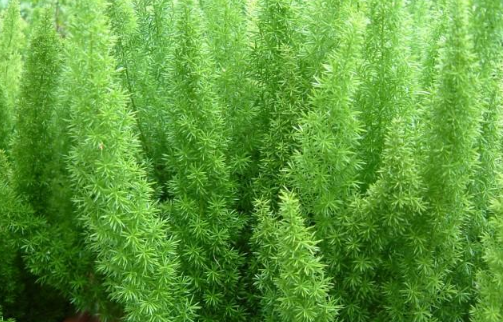
It is a perennial evergreen, semi-vining herb. The stem base is woody, with many branches, clustered and drooping, 80-120 cm long. The leaves are clustered, flat, and resemble pine needles, green and glossy. The flowers are mostly white, with a flowering period from June to August. The fruit is green, turning red when mature, spherical, and the seeds are black.
The tuberous roots are fleshy, clustered, long elliptical or spindle-shaped, 4-10 cm long, grayish yellow.
The stem is slender, up to 2 m long, with longitudinal groove lines.
Cladodes 2-3 in a bundle, borne in leaf axils, linear, flat, 1-2.5(-3) cm long, about 1 mm wide, slightly curved, with a sharp apex.
The leaves are reduced to scales; the scale-like leaves on the main stem often become downward-curving short spines.
Flowers 1-3 in clusters in leaf axils, yellowish white or white, drooping; perianth 6, arranged in 2 whorls, long ovate or ovate-elliptic, about 2 mm long; stamens 6, anthers T-shaped; pistil 1, ovary 3-locular, stigma 3-forked.
Berry spherical, about 6 mm in diameter, red when ripe.
Flowering period: May.
Growth characteristics: It likes warmth, humidity, and semi-shade, is tolerant of drought and barren soil, and is not cold-tolerant. In winter, the temperature must be kept above 6°C.
Cultivation techniques
Site selection and land preparation
In places below 1000 m elevation, it is best to choose sparse mixed forest or broad-leaved forest for planting; if the forest is dense, thin it out. It can also be planted in farmland between crops such as corn and broad beans, or in places between two mountains where sunlight does not last long. Select soil according to its biological characteristics, deep plow 30 cm, remove miscellaneous tree branches, etc., and apply 2500-3500 kg of decomposed barnyard manure, 100 kg of cake fertilizer, and 50 kg of superphosphate per mu. After leveling and harrowing finely, make high beds 150 cm wide and 20 cm high.
Propagation methods
There are two types: seed propagation and division propagation. At present, division propagation is mostly used.
Seed propagation
Every year from September to October, harvest when the fruit turns from green to red. After stacking and fermenting, select large and plump seeds as seeds. The sowing period is divided into spring sowing and autumn sowing. Autumn sowing is from early September to early October; autumn sowing has a high germination rate, occupies land for a long time, and requires labor for management; spring sowing is in late March, occupies land for a short time, and is convenient to manage.
Sowing method: Open horizontal furrows in the bed at a row spacing of 20-24 cm; furrow depth 5-7 cm, sowing width 6 cm, seed spacing 2-3 cm. Use 10-12 kg of seeds per mu. Raising seedlings on 1000 sq m can plant 10000 sq m. After sowing, cover with compost or plant ash, then cover with fine soil level with the bed surface, and then cover with rice straw to retain moisture. At a temperature of 17-20°C and with sufficient humidity, seedlings emerge 18-20 days after sowing. Remove the covering grass after germination. When the seedlings begin to emerge, shade them with a shed, or use crops such as corn between the beds for shade, and keep the soil moist regularly. When the seedlings are about 3 cm tall, weed and fertilize. In autumn, combine loosening the soil with fertilizing; the fertilizer is mainly human and livestock manure. Apply 1000-1500 kg per mu each time.
Seedlings after one year can be planted out. Generally in October or before budding in late spring, when the seedlings are 10-12 cm tall, transplant them with soil. When lifting the seedlings, grade them by size and plant them separately. Open holes at a row spacing of 50 cm and a plant spacing of 24 cm. First plant 2 rows of Asparagus cochinchinensis, reserve an intercropping row spacing of 50 cm, then plant another 2 rows of Asparagus cochinchinensis. When planting, spread the tuberous roots evenly in all directions, and cover with fine soil and press firmly. In the reserved rows, corn or broad beans can be intercropped every year.
2. Division propagation
When digging up Asparagus cochinchinensis, select robust mother plants with large root heads and thick strong buds, divide each plant into at least 3 clusters, each cluster with 2-5 buds and with more than 3 small tuberous roots. The cut should be small, and apply lime to prevent infection. After spreading out to dry for 1 day, they can be planted. The method is the same as transplanting after seedling raising.
Field management
1. Cultivation and weeding: During the growth period, weed and loosen the soil 4-5 times. Each time, do not loosen the soil too deeply to avoid damaging the tuberous roots.
2. Trellising
When the stems and vines grow to about 50 cm, set up supports or pillars to let the vines twine and grow, so as to facilitate stem and leaf growth and field management.
3. Topdressing
Every year before thawing and budding, apply 2500-3000 kg of barnyard manure per mu, use a four-tooth tool to scratch the soil so that the manure and soil mix evenly. In late June or early July, apply 1 topdressing of diluted manure water or apply 10 kg of compound fertilizer per mu in furrows, then cover with soil and water.
Pest and disease control
The main pest is red spider mites, which damage the leaves from May to June.
Control methods:
① In winter, pay attention to cleaning the garden, and bury deeply or burn fallen dead branches and leaves;
② Spray 0.2-0.3 Baume degree lime-sulfur mixture or spray with 25% chlordimeform water agent diluted 500-1000 times, once a week, for 2-3 consecutive times.
How to grow Asparagus cochinchinensis: how to cultivate Asparagus cochinchinensis
Asparagus cochinchinensis is a plant with a low, cute plant shape, and the whole plant is a treasure. It can be used for ornament, air purification, food, and medicine. When grown at home, Asparagus cochinchinensis is generally cultivated in pots. It has relatively strong vitality; even in the wild, it can survive without anyone caring for it, so growing it at home is relatively easy, and you only need to pay attention to some details.Asparagus cochinchinensis is also known as Taindongcao. Both names sound very beautiful, as if suddenly seeing a touch of fresh green full of spring in a snowy winter. The cultivation method of Asparagus cochinchinensis is not difficult. Let's learn about it together below.I. The functional value of Asparagus cochinchinensis
1. Ornamental value: The clear green stems and branches of Asparagus cochinchinensis trail and hang, never withering throughout the year, long and slender, elegant and graceful. It is not only a good potted foliage flower for decorating indoors in all four seasons; if its green stems and branches are cut to make bouquets and flower baskets, they are even more gorgeous.
2. Medicinal value: The main medicinal properties of Asparagus cochinchinensis are nourishing yin and clearing heat, moistening dryness and promoting fluid production. It is mainly used to treat pulmonary tuberculosis, cough, hernia, consumptive body pain, mouth sores, bronchitis, and other diseases. However, it is said that Asparagus cochinchinensis should not be eaten with carp, as it will cause adverse reactions and is bad for the body.II. Morphological characteristics of Asparagus cochinchinensis
Climbing plant. The roots become spindle-shaped and swollen in the middle or near the end; the swollen part is 3-5 cm long and 1-2 cm thick. The stem is smooth, often curved or twisted, up to 1-2 m long, and the branches have ridges or narrow wings. Cladodes usually in clusters of 3, flat or slightly sharply triangular due to the keeled midrib, slightly sickle-shaped, 0.5-8 cm long, about 1-2 mm wide; the scale-like leaf bases on the stem extend into hard spines 2.5-3.5 mm long, and the spines on branches are shorter or inconspicuous. Flowers usually 2 per axil, pale green; pedicels 2-6 mm long; the joint is generally located in the middle, sometimes its position varies; male flowers: perianth 2.5-3 mm long; filaments not adnate to the perianth segments; female flowers similar in size to male flowers. Berry 6-7 mm in diameter, red when ripe, with 1 seed. Flowering period May-June, fruiting period August-October.
III. Ecological habits of Asparagus cochinchinensis
Asparagus cochinchinensis likes fertile sandy soil and is suitable for a humid climate and environment, but it is afraid of waterlogging and scorching sun. It likes a warm and humid climate, is not tolerant of severe cold, and avoids drought and standing water. It is advisable to choose deep, fertile, humus-rich, well-drained loam or sandy loam for cultivation; it should not be planted in clay soil, barren soil, or places with poor drainage.IV. Propagation methods of Asparagus cochinchinensis
Asparagus cochinchinensis can be propagated by seeds and by division.
Seed seedling transplant propagation method: Collect the fruits when they turn yellow and mature, remove the flesh, and choose plump, large seeds to sow in March-April. Pay attention to maintaining a certain row spacing, and fertilize and weed regularly, so as to ensure growth nutrients for Asparagus cochinchinensis. Water once every two or three days; Asparagus cochinchinensis is afraid of waterlogging. It does not need frequent watering; just keep the surrounding humidity.
Division propagation: Autumn insertion in August-September has a relatively high germination rate and the plants grow robustly. Apply decomposed fertilizer or nitrogen fertilizer once every ten to twenty days, keep sunlight abundant, and maintain the temperature above 5°C. In some places, Asparagus cochinchinensis is made into potted plants and used as an ornamental fruit and foliage plant to decorate the home, which is very charming. But Asparagus cochinchinensis grows relatively fast and needs frequent repotting.V. Key points for cultivating Asparagus cochinchinensis
1. Sufficient sunlight and good ventilation. The cultivation soil should be loose, fertile, and well-drained. In northern regions, it is mostly potted. After being brought out in early spring, it can be placed under the eaves of a corridor or on a balcony. Because early summer in the north often has dry, hot, and exposed weather, it should be slightly shaded around noon, and water should be sprinkled on the nearby ground to increase air humidity. After the beginning of spring, Asparagus cochinchinensis enters a fast growth season. The amount of watering can be gradually increased, and diluted liquid fertilizer can be applied as topdressing. To promote lush branches and leaves, more nitrogen fertilizer can be applied.
2. The root system of Asparagus cochinchinensis grows rapidly, so it must be repotted every early spring, and part of the fleshy old roots must be cut off so that it can grow luxuriantly. Otherwise, the root system will be crowded in the pot, nutrients will be in short supply, and stems and leaves will often turn yellow and wither. If Asparagus cochinchinensis is placed in a dark indoor place for a long time, the stems and leaves are also prone to yellowing and withering due to insufficient light. Therefore, every once in a while, the flower pot should be moved outdoors to a place with sufficient sunlight, and fertilizer and water management should be strengthened to help it recover after transplanting for a period of time, and then it can be placed indoors again for decoration. In cold northern regions, move it indoors before Frost's Descent in late October to overwinter, and place it in front of a south-facing curtain with sufficient sunlight, stop fertilizing, and control watering. If watered too much in winter and indoor light is insufficient, the stems and leaves often turn yellow. If the room temperature is not lower than 5°C, it can overwinter safely.Here we should also tell everyone that Asparagus cochinchinensis relatively rarely suffers from pests and diseases. Its pest and disease-prone period is from May to June each year, and generally it is enough to pay more attention at this time. However, for home potted Asparagus cochinchinensis, the probability of pests and diseases is even lower, so as long as daily care is done well, it is fine.
Common flowers and plants are pushed daily on an ongoing basis. If you want to know how to grow and care for a certain flower or plant, please send the standard name of the flower or green plant to get the relevant growing and care information. Most of the growing and care methods are compiled from the internet. If there is anything inappropriate, corrections and criticism of the content are welcome. We look forward to your participation!