How to propagate Coral Vine? Introduction to common propagation methods
According to research, Coral Vine mainly has two propagation methods, seed propagation and cutting propagation. Let me introduce them to you one by one below:
Seed propagation
Spring and summer are the best periods for sowing Coral Vine, because the weather during this time is relatively warm and the temperature is not too high, and the optimal germination temperature for Coral Vine is about 24°C. Before sowing, the seeds should be soaked in water for four to six hours so that the seeds absorb sufficient moisture.
After that, bury the seeds shallowly about 1 cm below the soil surface. Remember to water the seeds moderately and keep the soil moist at all times. The soil should be well-drained, fertile, humus-rich acidic soil. After about one month, the Coral Vine seeds we sowed will be able to take root and sprout.
Cutting propagation
Coral Vine cutting propagation is best carried out in spring. First, we should cut good-quality branches from the whole plant, each segment about two spans long, remove the lower leaves from the branches, and leave only a few leaves at the upper part.
After that, we can insert the branches into a flowerpot already covered with a mixed soil of peat soil and coarse sand, water thoroughly, cover the flowerpot with a plastic bag, and place it in a semi-shaded environment. After about half a month, the inserted Coral Vine branches can take root and sprout, and after new leaves grow, they can continue to be transplanted.
After propagating Coral Vine well, the next step is to keep your Coral Vine alive and healthy yourself, but some situations always arise during the process of growing Coral Vine, such as yellowing leaves. Below, the editor will teach everyone the countermeasures for yellowing Coral Vine leaves.
The flower language of Coral Vine and the propagation methods of Coral Vine
Coral Vine is an annual or perennial herbaceous plant, also known as Phoenix Jewel, and can grow as a climber up to 10 m tall. It is cultivated in many provinces with relatively warm climates and is an excellent vertical greening plant. Today I will tell you about the flower language of Coral Vine and knowledge about Coral Vine propagation methods.
The flower language of Coral Vine
The flower language of Coral Vine is: the chain of love.
In a myth, there was a beautiful goddess who attracted the pursuit of many gods, but no one could move her heart. The mother of the mountain god wanted wholeheartedly to win the beauty for her son. One day, this mother went into the mountains and gathered many vines and grasses, weaving them into vine clothing and a necklace, and asked the mountain god to wear them and go to the goddess's dwelling.
When the goddess opened the door, the sunlight happened to shine on the vine clothing and the vine-made necklace. In an instant, thousands of pink, brilliant, coral-shaped small flowers bloomed, along with heart-shaped small leaves representing countless true hearts. The goddess could not help but blurt out: "What beautiful Coral Vine!" So the mountain god put the vine necklace around the goddess's fair neck and won the goddess's heart.
Propagation methods of Coral Vine
Propagation can use sowing or cutting methods, but sowing is mainly used, with spring to summer as the suitable period, and the suitable germination temperature is about 22~28 degrees. Before sowing, first soak the seeds in water for 4~6 hours to make them fully absorb water, then bury them shallowly in the soil about 1 cm, maintain humidity, and after about 30 days they can take root. Because it does not tolerate transplanting, direct sowing or pot sowing is best. Spring is the suitable period for Coral Vine cuttings. Cut fully developed branches, each segment about 15~20 cm. Remove the lower leaves, leaving only 2-3 leaves at the upper part, insert them into a culture soil mixed with equal amounts of peat soil and coarse sand, water thoroughly, then cover the flowerpot with a plastic bag, place it in semi-shade, and they can take root in 15-20 days. After new leaves grow, they can be transplanted, but the rooting rate and growth are not as ideal as sowing.
The best cultivation soil is fertile loam or humus loam, with good drainage and sunlight; insufficient sunlight results in sparse flowering and pale color. After the stems and vines of young plants extend, supports need to be set up for climbing. If there are many branches, select and keep 2~3 as main branches, cut off the others, and after they climb onto the trellis, pinch them to promote more branching. During the growth period from spring to summer, water supply must be sufficient. Fertilization can use various organic fertilizers or the three elements, applied in small amounts once every 1~2 months. In the north, leaf fall occurs in winter, so this is a good time to prune and shape the plant and shorten the branches; for aged plants, use heavy pruning. It likes high temperatures, and the suitable growth temperature is about 22~30 degrees.
Coral Flower likes moisture, so during the growth period it should be watered fully, often keeping the potting soil moist, and in the high-temperature summer season, water should be sprayed on the leaves. During the dormant period, water less, as long as the potting soil does not dry out. In summer, potted plants maintained outdoors are best placed under tree shade, but there must be at least 3-4 hours of direct sunlight every day. If the growing environment is too shady and humid, it is easy to cause the plant to grow leggy, with sparse flowering, and pale and small flowers. During the growth period, more fertilizer is needed, and 25% decomposed cake fertilizer should be applied once every 7-10 days. When the flowers bud, more phosphorus and potassium fertilizer should be applied. This can make the stems firm. The flower color will also be more vivid. If you want Coral Flower to grow into a shrub-like form, then in the early growth stage it must be pinched multiple times to promote more branching, thereby making the plant shape fuller.
Coral Vine Antigonon leptopus Hook. & Arn. Coral Vine illustrated guide: how to grow Coral Vine / how to propagate Coral Vine
Coral Vine profileCoral Vine Antigonon leptopus Hook. & Arn.
Coral Vine cultivation methods and precautions, and an introduction to Coral Vine
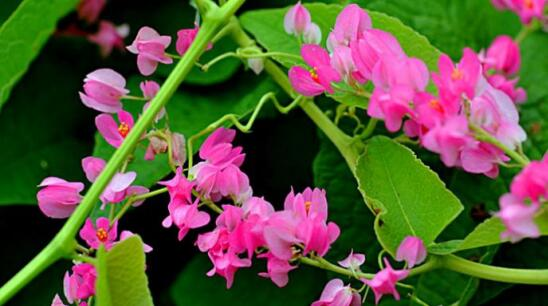
Coral Vine, also known as Phoenix Crown and Phoenix Jewel, etc., is an evergreen woody vine in the Polygonaceae family, Antigonon genus. The stem can reach 15 m long. The leaves are ovate or ovate-triangular, with a heart-shaped base, hairy margins, acuminate apex, and obvious veins. The inflorescence is 4-20 cm long, and the flowers are pink (there are also white-flowered and red-flowered horticultural varieties), composed of five petal-like bracts. The flowering period is March to December, and the Coral Vine in Xishuangbanna Tropical Botanical Garden is now in full bloom. The fruit is an achene. It likes full sun and fertile slightly acidic soil. Propagation can use sowing or cutting methods, and its roots are thick and its stems and vines have strong climbing ability, reaching more than 10 m. The flowers are mostly densely clustered in strings, in racemes. The flowering period is March-December, and the fruit is conical. It is native to Central America. It is now cultivated in Taiwan, China, Hainan, Guangzhou, and other places. Coral Vine is dazzling and spectacular, a good plant for gardens and vertical greening, and also one of the ornamental flowers, known as the "queen of vines."
Morphological characteristics of Coral Vine
The stem of Coral Vine can reach 15 m long. The leaves are ovate or ovate-triangular, with a heart-shaped base, hairy margins, acuminate apex, and obvious veins.
The inflorescence is 4-20 cm long, and the flowers are pink (there are also white-flowered and red-flowered horticultural varieties), composed of five petal-like bracts. The flowering period is March to December, and the Coral Vine in Xishuangbanna Tropical Botanical Garden is now in full bloom.
The fruit is an achene. It likes full sun and fertile slightly acidic soil. Propagation can use sowing or cutting methods, and its roots are thick and its stems and vines have strong climbing ability, reaching more than 10 m.
The flowers are mostly densely clustered in strings, in racemes. The flowering period is March-December, and the fruit is conical. It is native to Central America.
The stems of Coral Vine usually have swollen nodes. The leaves are simple, alternate, with stipular sheaths. Flowers are bisexual, rarely unisexual, actinomorphic; the inflorescence is composed of several small cymes arranged in racemes, spikes, or panicles, and flowers are sometimes solitary; tepals 3-6; stamens 6-9, rarely 16, with a disc; pistil 1, ovary superior, 1-loculed. Achenes ovate, 3-angled or flattened, usually enclosed in the persistent perianth; embryo curved or straight, with abundant endosperm. About 40 genera and 800 species, mainly distributed in the northern temperate zone, with a few in the tropics. China has 11 genera and more than 200 species. Persicaria is distributed throughout the country; Rheum is distributed in the mountainous areas of Northwest, Southwest, and North China; Calligonum and Atraphaxis are distributed in the desert and semi-desert areas of the northwest; Koenigia is distributed in the high mountain areas of the northwest and the Qinghai-Tibet Plateau; Pteroxygonum and Parapteropyrum are endemic genera of China.
The underground roots of Coral Vine are tuberous, and the stem tips are tendril-like. Simple leaves are alternate, ovate-cordate, with acute leaf tips, heart-shaped bases, and entire but slightly wavy margins. The leaves are papery and have leaf sheaths. The panicle is opposite the leaves, and the flower is composed of five petal-like bracts. The fruit is brown, three-rhombic, hidden in the persistent calyx. The inflorescence is racemose, terminal or axillary, and the inflorescence axis extends and becomes a tendril. The flowers are pale red or white, 7-10 mm long, and the three outer tepals are larger. Flowering period: April-August. The fruit is brown, three-rhombic, hidden in the persistent calyx.
Flowers climbing, slightly woody; perennial vine emerging from thick tubers, up to 10 m tall, with tendrils. Leaves opposite, ovate to oblong-ovate, 6-14 cm long, acuminate at the apex, deeply cordate at the base, with obvious reticulate veins, nearly glabrous on both sides. Racemes terminal or in the axils of upper leaves, flowers numerous, pale red, sometimes white, 8-10 mm long, clustered, tepals persistent. Achene conical, upper part 3-angled, about 10 mm long, flowering period March-December. There are double-flowered horticultural varieties.
Type: Flowers climbing, slightly woody, perennial vine
Stem: Emerging from thick tubers, up to 10 m tall, with tendrils
Leaves: Opposite, ovate to oblong-ovate, 6-14 cm long, acuminate at the apex, deeply cordate at the base, with obvious reticulate veins, nearly glabrous on both sides.
Flowers: Racemes, terminal or axillary, mostly pale red, sometimes white, 8-10 mm long, with branched tendrils at the tip of the flower axis; perianth 5-lobed, persistent, the inner 2 lobes smaller, stamens 8, ovary triangular; there are also double-flowered horticultural varieties. Clustered, up to 30 cm long.
Flowering period: March-December, can bloom in summer, autumn, and winter.
Fruit: Achene, conical, upper part 3-angled, about 10 mm long, with multiple veins.
Ecological habits of Coral Vine
Coral Vine likes sunny, moist, fertile acidic soil. After spring warms, it sprouts and grows leaves; when the winter temperature is below 10°C, the leaf color will turn dark green and sometimes slightly wither. In tropical or southern subtropical cool seasons, it grows luxuriantly. Open-field cultivation of Coral Vine is mainly in South China, and a fertile soil location should be chosen. Because the branches and vines are relatively long, planting should not be too dense. It is generally used as hedge vertical greening, with a plant spacing of 4 m as suitable. In other areas, it is mostly grown in pots and requires a high-temperature greenhouse to overwinter. There are few pests and diseases.
Coral Vine grows luxuriantly in tropical or southern subtropical cool seasons. After spring warms, it sprouts and grows leaves; when the winter temperature is below 10°C, the leaf color will turn dark green and sometimes slightly wither. There are few pests and diseases.
Coral Vine likes high temperatures, and the suitable growth temperature is about 22~30 degrees. It likes moisture and grows better in an environment with bright light. It likes fertilizer, is slightly cold-tolerant, and in winter can generally overwinter safely at above 5°C. It likes to grow in well-drained loam rich in humus.
Cultivation techniques of Coral Vine: Cultivation
· The best cultivation soil for Coral Vine is fertile loam or humus loam, with good drainage and sunlight; insufficient sunlight results in sparse flowering and pale color. It likes high temperatures, and the suitable growth temperature is about 22~30 degrees.
· After the stems and vines of young plants extend, supports need to be set up for climbing. If there are many branches, select and keep 2~3 as main branches, cut off the others, and after they climb onto the trellis, pinch them to promote more branching.
· During the growth period from spring to summer, water supply must be sufficient. Fertilization can use various organic fertilizers or the three elements, applied in small amounts once every 1~2 months.
· In the north, leaf fall occurs in winter, so this is a good time to prune and shape the plant and shorten the branches; for aged plants, use heavy pruning.
· Open-field cultivation is mainly in South China. Because the branches and vines are relatively long, open-field planting should not be too dense. It is generally used as hedge vertical greening, with a plant spacing of 4 m as suitable. Potted plants require a high-temperature greenhouse to overwinter.
Maintenance
· Coral Vine likes moisture, so during the growth period it should be watered fully, often keeping the potting soil moist, and in the high-temperature summer season, water should be sprayed on the leaves.
· During the dormant period, water less, as long as the potting soil does not dry out.
· In summer, potted plants maintained outdoors are best placed under tree shade, but there must be at least 3-4 hours of direct sunlight every day. If the growing environment is too shady and humid, it is easy to cause the plant to grow leggy, with sparse flowering, and pale and small flowers.
· During the growth period, more fertilizer is needed, and 25% decomposed cake fertilizer should be applied once every 7-10 days. When the flowers bud, more phosphorus and potassium fertilizer should be applied. This can make the stems firm and the flower color more vivid.
· If you want Coral Flower to grow into a shrub-like form, in the early growth stage it must be pinched multiple times to promote more branching, thereby making the plant shape fuller.
Cultivation methods of Coral Vine
Coral Vine likes a warm and humid environment and has low cold tolerance. Seedlings are averse to frost. If mature plants encounter long-term low temperatures of 5-6 degrees Celsius, young branches and leaves will suffer cold damage. It likes light and does not tolerate shade. It likes deep, fertile, moist soil, and both sandy soil and clay soil are suitable. It is relatively tolerant of waterlogging, but not of drought.
Cultivation
For ground planting of Coral Vine, large holes should be dug and sufficient farmyard manure applied as base fertilizer. After that, loosen the soil and apply fertilizer once every winter and spring, or spray dilute nitrogen fertilizer water on the leaves. The cultivation site needs to be kept moist regularly. For potted plants, pond mud or forest topsoil should be used, and attention should be paid to setting up stakes and posts. The supports can be thick iron wires, coiled into various forms such as spherical or animal shapes. Pay attention to timely pruning of excess branches; it can bloom all year round and is extremely beautiful.
Propagation methods of Coral Vine
Coral Vine can use sowing or cutting methods, but sowing is mainly used. Because it does not tolerate transplanting, direct sowing or pot sowing is best.
· Spring to summer is the suitable period, and the suitable germination temperature is about 22~28 degrees. Before sowing, first soak the seeds in water for 4~6 hours to make them fully absorb water, then bury them shallowly in the soil about 1 cm, maintain humidity, and after about 30 days they can take root.
· Spring is the suitable period for cuttings. Generally in spring or autumn, cut new branches or stem segments that have not yet formed buds as cuttings, 5-8 cm long. Remove the lower leaves, leaving only 2-3 leaves at the upper part, insert them into a culture soil mixed with equal amounts of peat soil and coarse sand, water thoroughly, then cover the flowerpot with a plastic bag, place it in semi-shade, and they can take root in 15-20 days. After new leaves grow, they can be transplanted, but the rooting rate and growth are not as ideal as sowing.
Pest and disease control of Coral Vine
Coral Vine grows luxuriantly in tropical or southern subtropical cool seasons. After spring warms, it sprouts and grows leaves; when the winter temperature is below 10°C, the leaf color will turn dark green and sometimes slightly wither. There are few pests and diseases.
Distribution area of Coral Vine
Coral Vine is native to Mexico and is commonly cultivated in Taiwan, China, Hainan, Guangzhou, and Xiamen, and is also distributed in tropical or southern subtropical regions.
Uses and purposes of Coral Vine: Ornamental value
Coral Vine has delicate flower shapes, a very long flowering period, bright colors, and branches full of flowers. It is exceptionally beautiful. Coral Vine has abundant flowers and a slight fragrance, and is a rare famous flower in summer.
Coral Vine is called the queen of vines. It can be planted in flowerbeds and is also a good material for potted arrangements on both sides of windows in hotels and assembly halls. It is suitable for flower stands and green shade trellises, can be used as a trellis plant, and is a good material for vertical greening. There are double-flowered horticultural varieties. [2] It can also be used as cut flowers for flower arrangements and flower baskets. The tubers are edible.
Landscape uses of Coral Vine
Coral Vine has luxuriant branches and leaves, a very long flowering period, and blooms almost all year round. Its green vines are like a canopy, and its red flowers are magnificent, making the scenery especially beautiful. It is an important shade plant. It is suitable for planting in front of courtyard gates, on trellises, on flower walls, and at open-air tea seats. Because of its good covering effect, planting it in patches on slopes in parks and large amusement parks also forms a scenery of its own.
Cultural background of Coral Vine: Plant culture
According to legend, in a Western myth, there was a beautiful goddess who attracted the pursuit of many gods, but no one could move her heart.
The mother of the mountain god wanted wholeheartedly to win the beauty for her son. One day, this mother went into the mountains and gathered many vines and grasses, weaving them into vine clothing and a necklace, and asked the mountain god to wear them and go to the goddess's dwelling. When the goddess opened the door, the sunlight happened to shine on the vine clothing and the vine-made necklace. In an instant, thousands of pink, brilliant, coral-shaped small flowers bloomed, along with heart-shaped small leaves representing countless true hearts. The goddess could not help but blurt out: "What beautiful Coral Vine!" So the mountain god put the vine necklace around the goddess's fair neck and from then on won the goddess's heart.
Therefore, Coral Vine is also called the "Lover's Chain" (Lover`s Chain)
Greening material
Coral Vine has a very long flowering period and branches full of flowers, and is exceptionally beautiful. It is called the queen of vines. If it climbs on a tree, the whole tree becomes pink, making it hard to tell whether the tree or the vine is blooming. In gardens, it can be used for greening pavilions, trellises, and fences, and can also be planted on slopes as ground cover. It is also a good material for courtyard vertical greening.
Plant invasion
Coral Vine is native to Central America and has now become widely distributed in tropical and subtropical regions. It can be propagated by cuttings or sowing. Because it has numerous seeds, it is very easily spread by water flow or animal feeding, and in some countries and regions it has become an invasive plant (mainly in Hawaii and other Pacific islands).
The flower language of Coral Vine
The flower language of Coral Vine: the chain of love.
Coral Vine is called "Love's Chain," which is also the origin of its flower language "the chain of love."
Coral Vine pictures