A Detailed Guide to Sundew Care Methods and Precautions
Soil and Temperature
To grow sundews, you can use peat soil and sphagnum moss, or a soil mix of peat soil, river sand, and perlite. It can be said that the soil requirements are not very high. The suitable temperature for sundew growth is generally 15°C-25°C; environments that are too cold or too hot are both unsuitable. In winter when the weather is cold, it is best to do a good job of keeping them warm, keeping the minimum temperature above 0°C, and moving them indoors when necessary; when summer temperatures are too high, sundews will enter dormancy.
Light
Sundews love sunlight. If you want your sundew to have vivid colors, note that during care you need to maintain a relatively long period of light every day. You can place it on a balcony or windowsill in a spot with plenty of sunlight. If your home does not have enough direct light, providing bright indirect light is also fine. Pay special attention that when the summer sun is too strong, you need to provide shade to avoid scorching the sundew.
Watering
Sundews are moisture-tolerant and are usually not very strict about air humidity levels, though excessively high humidity in summer can cause stems and leaves to rot. Water to keep the soil moist; for watering, soft water is best, and generally the "tray watering" method is used to supply water.
Learn these propagation methods and turn your one sundew into two! Friends who have sundews, go and give it a try!
Sundew Cultivation Methods
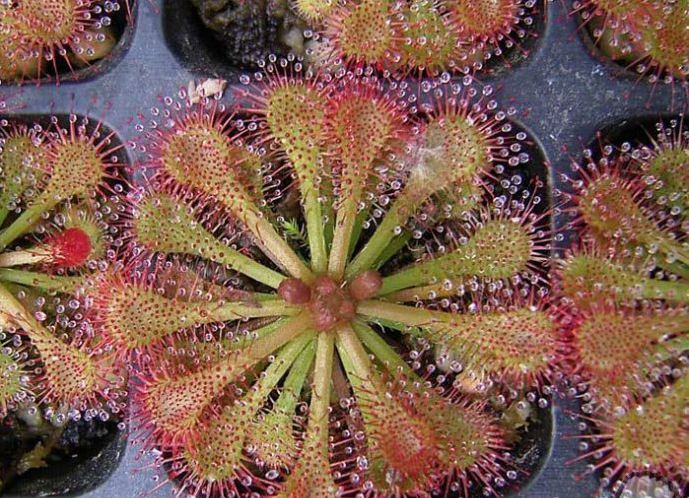
Sundews are a major group among carnivorous plants, also known as sundew, summer vanish, white flower leaf, and so on. Their leaves are densely covered with crystal-clear "dewdrops" that are dazzling to the eye, and they are deeply loved by people. However, to their prey, these dazzling lights are "fatal," because sundews hunt precisely through these "dewdrops." Below, let us take a look at sundew cultivation methods together!
Growing Medium
1. Except for tuberous sundews, other types of sundews do not have high requirements for the growing medium. You can use pure sphagnum moss, or mix two parts sphagnum moss or peat with one part perlite, then add one part akadama, bark, vermiculite, or other media. To prevent green algae from growing on the surface of the medium, you can spread a thin layer of non-decaying granules such as akadama on the surface, avoiding contact between the lower medium and light.
2. Tuberous sundews have different requirements for the growing medium mix and need sandy soil with good drainage. You can mix peat and perlite at a 1:2 ratio, or mix peat, perlite, and river sand at a 1:1:1 ratio. Also try to use a large pot with a diameter and depth of more than 15 cm.
Humidity Management
1. Sundews do not have high humidity requirements; it needs to be controlled at 40-90%. In winter when it is dry, general indoor humidity can meet the requirements. In summer when it is hot, humidity should not remain above 90% for several consecutive days, otherwise it may cause stems and leaves to rot. If this situation occurs, ventilation should be strengthened immediately. In cooler seasons, humidity as high as 95% generally will not cause problems.
2. Sundews that have just been repotted or newly planted after being mailed are relatively fragile and usually have no mucilage, so humidity needs to be increased. The simplest way is to use a glass tank or cover them with a transparent bag for enclosed cultivation, but remember that during enclosed cultivation they must not receive direct sunlight, otherwise a sudden rise in temperature will suffocate the plant to death. They should be placed in a bright, cool place. After 1 week, gradually increase ventilation until they adapt to an environment without enclosed cultivation, then gradually increase light.
Light Management
1. The vast majority of sundews are fairly sun-loving and tolerant of strong sunlight. Try to provide more than 4 hours of direct light every day; they are suitable for placement on a balcony or windowsill with good light. If all-day direct light can be provided, they will display very vivid colors and the mucilage will become stickier. If there is no good light environment, all-day bright indirect light should also be provided. Generally, sundews other than North Australian sundews can also grow normally, but the plants will appear emerald green, and their growth vigor and disease resistance will be relatively poor.
2. North Australian sundews are the type of carnivorous plant most tolerant of strong sunlight and also have the highest light requirements. It is best to provide an all-day direct sunlight environment. Less than 4 hours of direct light may lead to poor growth, and if they receive no direct light for a long time, they will die. If there is no good light environment, using a plant grow light for supplemental lighting is a good choice.
3. Drosera prolifera and Drosera binata are two special sundews that grow in woodland with weaker light. They are not tolerant of prolonged direct light and high temperatures, and only need bright indirect light.
4. Some sundews that are relatively afraid of heat or have summer dormancy habits should also be placed in a slightly shadier, cooler place in summer, avoiding direct light from 11 a.m. to 3 p.m. as much as possible. You can also use 30-80% shade netting for shading. Common ones include Drosera binata, Drosera filiformis, Cape sundew, Drosera regia, Drosera adelae, and so on.
Watering Control
1. Sundews are usually fairly moisture-tolerant. You can use the "tray watering" method to supply water, that is, place the flowerpot in a water tray, glass tank, or other container with water so that the water seeps into the entire pot on its own. You only need to keep about 1 cm of water in the tray to keep the medium moist.
2. Sundews have relatively high water quality requirements. When watering, use soft water with low levels of minerals such as calcium and magnesium. Hard water will slow sundew growth, and especially under hot temperatures may cause its stems and leaves to rot, and it will quickly die. If this situation has already occurred, you can replace the medium with clean medium to rescue it, and use soft water such as rainwater, bottled water, purified water, air conditioner condensate, or water from a reverse osmosis purification machine.
Temperature Control
1. Miniature sundews: Miniature sundews do not have high temperature requirements. Their survival temperature is mostly between 0-37°C, with the optimal temperature between 5-30°C. After the temperature drops below 15°C in late autumn, many "winter buds" will begin to grow at the growth point in the center of the plant. These winter buds will mature after one month and will sprout like seeds to grow into new plants.
2. Temperate sundews: Temperate sundews are all fairly tolerant of low temperatures. Below 10-15°C, their insect-catching leaves will slowly wither, and they will grow some very small dormant leaves without mucilage. In winter they can generally survive low temperatures of 0°C, and after warming in spring they will grow very vigorously. In summer, temperate sundews are generally fairly heat-tolerant, and most can safely survive high temperatures of 37°C, but when temperatures exceed their optimal growing temperature (about 30°C), they should be placed in a slightly shadier, cooler place.
3. Tuberous sundews: Tuberous sundews are a type of carnivorous plant that is especially difficult to grow, and few people cultivate them. For tuberous sundews, when the summer temperature is above 25°C, the stems and leaves above ground will wither. At this time, the soil should be kept very dry, and you must not water thoroughly; if it is too wet, the tubers will easily rot, but it must not dry out completely either. You need to keep the soil slightly moist and place it in a dark place.
4. North Australian sundews: North Australian sundews are a type of carnivorous plant that likes heat and fears cold. Their survival temperature is between 12-42°C, with the optimal temperature between 25-35°C. There is basically no need to worry about getting through summer. In autumn, when the temperature remains below 25°C for a long time, growth will become slow, and temperature should be raised by strengthening light and other methods. In winter, below 10°C, they easily die, so at this time it is best to have heating equipment to raise the temperature.
5. Tropical, subtropical, and other unclassified sundews: Tropical, subtropical, and other unclassified sundews mainly grow in South America and Africa, mostly in tropical and subtropical regions. Their habits do not have very distinctive features, and the temperatures they prefer also differ. As long as the temperature is suitable, they can grow all year round.
Pest and Disease Control
1. Pest and disease control: In spring and summer each year, the new sprouts of sundews may be attacked by aphids, causing deformed or withered leaf growth. When pests such as caterpillars and cutworms have no food to eat, they may all gnaw on sundew leaves. When you find traces of gnawing on the leaves, you should promptly look around the plant to see whether such pests are present, capture and kill them, or use a broad-spectrum (general-purpose) insecticide to kill them. When using it, simply spray the leaves damp; be sure not to spray heavily.
2. Fungal infection: Sundews becoming infected by fungi is a problem that easily occurs in summer, usually when conditions are enclosed, poorly ventilated, and somewhat high in temperature. Sundews should be provided with a well-ventilated environment, and during enclosed cultivation, ventilation should also be carried out regularly. When fungi are likely to occur, a broad-spectrum fungicide can be sprayed once every 1-2 weeks for prevention. If fungi have already begun to grow on the medium or plants, ventilation must be strengthened immediately, the diseased parts removed, and some fungicides with better therapeutic effects should be used. You need to ask clearly at the time of purchase and treat the specific problem.
How Are Sundews? Sundew Cultivation Methods
Sundew leaves are densely covered with crystal-clear "dewdrops," dazzling to the eye and deeply loved by people. So, how do you grow sundews? Many people say sundews are not easy to grow, but in fact growing sundews is relatively easy, and with a little care they can grow very well. Today, let us teach everyone how to grow sundew, so come and learn the cultivation methods of sundew together.
How to Grow Sundews
Soil: Except for tuberous sundews, other types of sundews do not have high soil requirements. You can use pure sphagnum moss, or mix two parts sphagnum moss and peat with one part perlite, and you can also add one part akadama, bark, vermiculite, or other media. Tuberous sundews can use granular soil; if using the tray immersion method for cultivation, you can mix 1 part peat with 1 part perlite or river sand.
Light: Sundews like ample sunlight and tolerate strong sunlight. They are suitable for placement on a balcony or windowsill with good light. If all-day direct light can be provided, they will display very vivid colors and the mucilage will become stickier. If there is no good light environment, all-day bright indirect light should also be provided.
Humidity: Sundews do not have high humidity requirements; it needs to be controlled at 40%-90%. Higher humidity can make the "dewdrops" on the glandular hairs larger and more ornamental. During the plum rain season, when air humidity is relatively high, attention should be paid to strengthening ventilation, otherwise it may cause sundew stems and leaves to rot.
Watering: Sundews are usually fairly moisture-tolerant. You can use the tray immersion method to supply water, that is, place the flowerpot in a water tray, glass tank, or other container with water so that the water seeps into the entire pot on its own. You only need to keep about 1 cm of water in the tray to keep the medium moist. Sundews have relatively high water quality requirements. When watering, use soft water with low levels of minerals such as calcium and magnesium.
Fertilizing: During the sundew growing season, use a general compound fertilizer diluted five thousand times and spray it on the leaves, 1-2 times per month. When fertilizing, it is better to apply thin fertilizer frequently; do not use too high a concentration, to avoid the serious consequences of fertilizer burn or even fertilizer death. If you have no experience, do not fertilize at will. It is not recommended to provide nutrients by feeding food, to avoid affecting the ornamental value.
Pests and Diseases: In spring and summer each year, the new sprouts of sundews may be attacked by aphids, causing deformed or withered leaf growth. Pests such as caterpillars and cutworms may all gnaw on sundew leaves. When you find traces of gnawing on the leaves, you should promptly capture and kill them, or use a broad-spectrum (general-purpose) insecticide to kill them. When using it, simply spray the leaves damp; be sure not to spray heavily.
Sundew Varieties
Drosera nidiformis
Drosera nidiformis originates from remote mountainous areas of South Africa, where the climate is stable all year round and summer does not exceed 33°C. In cultivation, Drosera nidiformis and Cape sundew are the first choices of flower enthusiasts for upright sundews, but Drosera nidiformis is more delicate and also more afraid of heat, so it is suitable for cultivation in an airy medium.
Cape Sundew
This is the most famous sundew. Its tall and imposing appearance is deeply ingrained in people's minds, and its leaves curl in a very exaggerated way. In its place of origin, South Africa, it is a lowland sundew and has multiple forms. In cultivation it is somewhat afraid of heat; grow it in summer with ventilation and shade, and in autumn it will be very beautiful.
Drosera filiformis
Drosera filiformis can be broadly divided into red filiformis, green filiformis, and common filiformis, among which red filiformis is the most famous variety. In cultivation it is slightly afraid of heat; in summer just avoid midday sun with shading. It can be considered an entry-level variety among temperate sundews and is worth collecting.
Other sundew varieties include Drosera bellii, Drosera binata, Drosera affinis, Drosera hartmeyerorum, Drosera aliciae, Drosera paleacea, Drosera regia, Drosera burmannii, and so on.
The above are the sundew cultivation methods we have explained for everyone. Has everyone learned them? For more home decoration knowledge, please pay attention.