What are the precautions for growing pitcher plants?
Pitcher plants are tropical plants that like high temperatures, but they are not cold-tolerant, so they must spend the winter indoors. And although they are tropical plants and can grow in sunlight, they are afraid of strong light. In summer, pay attention to sun protection; the usual practice is to set up a shade net. But do not move the pitcher plant directly to a shady place just to avoid direct strong light. If the pitcher plant receives too little light, the plant will grow slowly!
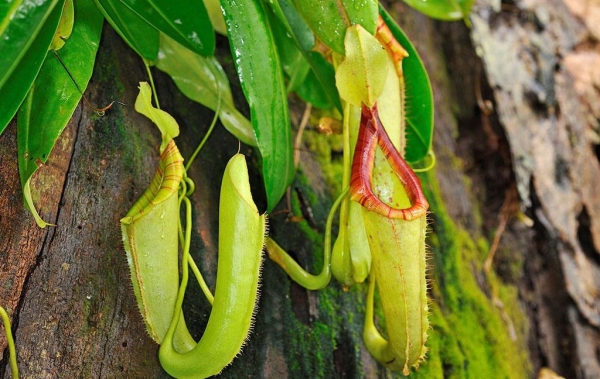
The above is an introduction to the benefits of pitcher plants. After reading it, do you feel tempted to grow one at home too? Although pitcher plants have many benefits, you should also note that their sap is toxic, so never touch or eat it directly when growing them!
Pitcher Plant Growing Methods and Precautions for Growing Pitcher Plants
Pitcher plant is a general term for all species in the genus Nepenthes. Pitcher plants have raceme inflorescences and bear small green or purple flowers; the pitcher-like body at the tip of the leaf is a tool for catching insects. Nowadays every home grows some flowers and plants. Would a pitcher plant be one of your choices? So, what should we pay attention to when growing them? Let's take a look together below.
Pitcher Plant Growing Methods
Pitcher plants can be cultivated in a greenhouse. Lowland pitcher plants that are relatively easy to grow include Nepenthes indica, Nepenthes kampotiana, and Nepenthes mirabilis; highland pitcher plants include Nepenthes bicalcarata, Nepenthes alata, and Nepenthes veitchii. Pitcher plants have diverse requirements for their growing environment and conditions. Because hybrids have stronger adaptability, it is difficult to summarize in just a few sentences the living habits of all pure species and hybrids. When planting, you can improve the environment according to the needs of the pitcher plant. Improve the growing environment where conditions are unsuitable for pitcher plant growth. The basic requirements for pitcher plant growth are: light, water, humidity, temperature, nutrients, and growing medium.
The pitcher of a pitcher plant is a modified leaf, so like the leaves of other plants, it will also age and die. Generally speaking, under suitable conditions each pitcher can survive for several months. When it has withered, you can cut it off to make the whole plant look more attractive, but this is purely for appearance and has nothing to do with the health of the plant. Pitcher plants have no dormancy period.
The suitable growing temperature for pitcher plants is 25-30°C; from March to September it is 21-30°C, and from September to March of the following year it is 18-24°C. In winter the temperature should not be lower than 16°C; below 15°C the plant stops growing, and below 10°C the leaf edges suffer frost damage.
Pitcher plants are relatively sensitive to water. Pitcher plants can grow and develop normally only under high humidity conditions. During the growing season they need frequent misting, 4-5 times a day. If the temperature changes greatly or it is too dry, it will affect the formation of the leaf pitchers. Pitcher plants are epiphytic plants, often growing under large trees or on the north side of rocks; natural conditions are semi-shaded. Under direct strong light in summer, shading is necessary, otherwise the leaves are easily scorched, directly affecting the development of the leaf pitchers. But under long-term shady conditions, the leaf pitchers form slowly and are small, and the colors on the pitcher surface are dull. The soil should preferably be loose, fertile, and airy leaf mold or peat soil. For potted plants, a mixed medium of peat soil, sphagnum moss, charcoal, and fir bark shavings is commonly used.
Light.
Light is one of the most important factors in producing huge and vividly colored insect-catching pitchers. Providing sufficient air humidity, moderate soil moisture, and ample light can make the leaves appear red like red wine. The plant can be acclimated to accept some direct sunlight, preferably morning sunlight. On the contrary, full sun will make the plant's color dull and hinder the plant's growth. The signs of strong light scorching appear very quickly; at first only the old pitchers are scorched or dehydrated, and eventually the whole plant is damaged. When the plant produces new pitchers, it shows that the plant has adapted to the new environment. Generally speaking, the more ample the light, the larger and more vividly colored the pitchers the plant will produce. While providing ample light, it is also necessary to always maintain relatively high air humidity, especially in windy and dry, hot weather. Therefore, bright indirect light is more suitable for pitcher plants. When using a shade net, a shading rate of 50-80% is more suitable. If growing them in a plastic greenhouse, it is best to use a transparent polyethylene greenhouse film. In addition, the length of daylight also affects how much light energy the plant absorbs. Most pitcher plants can tolerate a low-light environment, but their growth rate will be limited because of this, and the amount of watering also needs to be reduced. When a pitcher plant receives enough light, it will show this in the size and color of its pitchers. If a pitcher plant is troubled by insufficient light, then if conditions permit, you can provide it with a few hours of artificial supplemental light, which is beneficial.
Water.
Pitcher plants do not have high requirements for the moisture content of the growing medium; pitcher plants generally do not like growing media that are overly wet and not breathable. Unlike other carnivorous plants that only need the soil kept moist during the growing season, when growing pitcher plants, the soil needs to be kept moist at all times. The medium should preferably be loose and not squeeze out water. Therefore, watering is more suitable for pitcher plants. However, the immersion method can still be used to supply water, but the air permeability of the growing medium needs to be improved and the proportion of large-particle growing medium increased, so as to avoid the growing medium becoming too wet.
Although all carnivorous plants need soft water with relatively few minerals to grow, pitcher plants have relatively looser requirements for water quality, but this does not mean pitcher plants do not need high-quality water. Because pitcher plants have a very long cultivation period, one potential problem with using the immersion method is the accumulation of salts. Many yellow-white scales will appear on the surface of the growing medium; this is formed by salts in the water precipitating out, and it has an adverse effect on the growth of pitcher plants. You can remove the surface layer of growing medium and lay down a new layer of growing medium to improve the situation.
Humidity.
The level of air humidity is the key to whether pitcher plants can normally produce pitchers.
Under natural conditions, pitcher plants usually grow in relatively humid areas, with humidity of at least 60%. Therefore, in cultivation, many people always encounter the problem that pitcher plants cannot grow new pitchers; often the pitcher has not yet grown large before it withers as if scorched. The main reason pitcher plants do not grow pitchers is that the environment is too dry. But this does not mean the water given is insufficient; rather, the air humidity is too low. To increase air humidity, you can cover the entire pitcher plant with a transparent plastic bag, and in this way you can easily obtain a high-humidity environment. Placing the pitcher plant in an aquarium, or putting it in a corner, will increase humidity as long as ventilation is reduced. However, pitcher plants also have the ability to adapt to the environment. Once new insect-catching pitchers have grown, you can try gradually lowering the air humidity to let the pitcher plant adapt to a relatively dry environment.
Temperature.
Pitcher plants are distributed across a very wide range of elevations, from flat ground to high mountains above 3,000 m in elevation. In horticulture, they are divided into two major categories according to their elevation distribution: highland species and lowland species. Pitcher plants growing in high mountains above 1,200 m in elevation are highland species, and their cultivation temperature is 21°C during the day and 10°C at night; pitcher plants growing on flat ground or in areas below 1,200 m in elevation are lowland species, and their cultivation temperature is 29°C during the day and 21°C at night. The temperature difference between day and night is very helpful for the growth of pitcher plants, while seasonal changes are not important. Lowland pitcher plants grow in low-latitude areas, where seasonal changes are not obvious and temperatures do not differ much throughout the year. However, highland pitcher plants grow in high mountains, and their characteristic is a large day-night temperature difference, which can reach more than 10°C.
Precautions for Growing Pitcher Plants
1. Pitcher plant flowers do not have much ornamental value; the flowers are small and plain, and only a few varieties have relatively vivid flowers. In addition, pitcher plant flowers also give off a not very pleasant smell, so try not to grow them indoors; a courtyard or balcony is the best choice.
2. Pitcher plants are vine plants and must have something to cling to in order to stand, so a support frame needs to be set up for the pitcher plant. To set up the support, a larger flowerpot is needed; on the other hand, a larger flowerpot can hold more growing medium, making the flowerpot stable and heavy, able to support a large pitcher plant without being blown over by the wind.
After reading the above introduction to pitcher plant growing methods and precautions, do you have a better understanding of pitcher plant growing methods? If you want to know more about pitcher plants, please continue to follow us.
Growing Conditions for Pitcher Plants: Precautions for Growing Pitcher Plants
What kind of plant is a pitcher plant? It is very common, and you will recognize it when you see it. Below, let's learn about the growing conditions for pitcher plants and precautions for growing pitcher plants.
Pitcher plant growing methods and precautions:
1. Temperature: Pitcher plants like high-temperature environments and grow vigorously at 20-30°C. In winter, when the temperature is relatively low, pitcher plants almost stop growing. To prevent pitcher plants from freezing to death, you also need to warm them. Ensure the indoor temperature is not lower than 10°C.
2. Humidity: The level of air humidity is the key to whether pitcher plants can normally produce pitchers. To increase air humidity, you can cover the entire pitcher plant with a transparent plastic bag, and you can easily obtain a high-humidity environment. In addition, placing the pitcher plant in an aquarium, or putting it in a corner to reduce ventilation, will increase humidity.
3. Light: Pitcher plants like sunlight, but they are afraid of direct strong light. So in summer, pay attention to sun protection; the usual method is to set up a shade net. Too little light is also not good; it will cause pitcher plants to grow slowly, with weak and slender plants, and smaller pitchers or no pitchers at all.
4. Water: Pitcher plants need a large amount of water. When the temperature exceeds 30°C, water 2-3 times a day. If conditions permit, it is best to spray water vapor on the branches and leaves of the pitcher plant. When the temperature is relatively low, you can water a little less, but the soil should still always be kept moist.
5. Fertilizing: Generally, organic fertilizer is applied to pitcher plants, and they should be watered promptly after fertilizing. If there is no organic fertilizer, or if you dislike organic fertilizer, you can apply a little chemical fertilizer, and the amount of chemical fertilizer should be controlled at a low level. Applying too much fertilizer at one time will cause the plant to wither, as if it were lacking water. In addition to these fertilizers, foliar fertilizer can also be applied, and its effect is relatively quick.
6. Medium: Pitcher plants like a medium that is sufficiently loose and well-drained, yet able to retain water fully and provide the plant with ample moisture. A mixed medium based on coconut husk, mixed with wood shavings and perlite, or pure sphagnum moss, is very suitable for pitcher plants. Sphagnum moss is not only a medium suitable for pitcher plant growth, but also a sign of whether the growing environment is suitable for pitcher plant growth.
7. Growing precautions:
(1) Pitcher plant flowers do not have much ornamental value; the flowers are small and plain, and only a few varieties have relatively vivid flowers. In addition, pitcher plant flowers also give off a not very pleasant smell, so try not to grow them indoors; a courtyard or balcony is the best choice.
(2) Pitcher plants are vine plants and must have something to cling to in order to stand, so a support frame needs to be set up for the pitcher plant. To set up the support, a larger flowerpot is needed; on the other hand, a larger flowerpot can hold more growing medium, making the flowerpot stable and heavy, able to support a large pitcher plant without being blown over by the wind.
The above is the related introduction in this article. I believe after reading it you also have a simple understanding of this. If needed, you can continue to follow No. 1 Home Network to learn more information.