How to Grow Garlic Vine: Planting Methods and Things to Note
1. Choosing the pot and soil
If you want to grow garlic vine at home, the requirements for choosing a flower pot are relatively high. You should choose a pot suitable for garlic vine to climb or trail, and as for the soil, avoid choosing soil that is too moist and not breathable; choose relatively loose, free-draining soil, and you can also add some peat soil.
2. Light and temperature
It can be said that growing any plant requires sunlight and temperature, and growing garlic vine is no different. As for sunlight, you need to maintain long hours of sun exposure as much as possible; with sufficient sunlight, garlic vine will bloom more easily, and the flowers it produces will be more abundant. As for temperature, since garlic vine is not cold-tolerant, it is best kept at around 25 degrees Celsius. In winter, garlic vine stops growing due to the low temperatures, so you need to take good measures to keep it warm.
3. Watering and fertilizing
Watering needs to be done according to changes in the climate; water frequently in summer, and reduce the frequency of watering in winter. For fertilizing, choose a compound fertilizer rich in elements such as nitrogen, phosphorus and potassium.
So, what are the things to note when growing garlic vine?
1. Pruning
During the growth process, the branches of garlic vine become relatively messy, and because of its strong climbing habit, it needs proper pruning in daily care.
2. Propagation
There are many methods for propagating garlic vine, and you should choose an appropriate method for propagation.
3. Pests and diseases
Pests and diseases rarely appear during the cultivation of garlic vine, but you still need to pay attention.
The above are the methods and things to note for growing garlic vine. In fact, growing garlic vine is not difficult; what it needs is to be treated with care.
How do you grow garlic vine? Garlic vine growing methods
How do you grow garlic vine? Do you all understand the growing methods for garlic vine? Next, the editor will introduce the growing methods for garlic vine in detail, to help everyone grow garlic vine better.
Growing garlic vine requires sufficient light, and you should especially note that garlic vine is not cold-tolerant, so be sure to plant it in a sunny, sheltered spot with loose, fertile, slightly acidic sandy loam.
Garlic vine growing methods:
1. Outdoor cultivation
Garlic vine does not need frequent watering; mainly water it during dry summer periods. Fertilizing garlic vine is very simple; generally apply decomposed fertilizer at planting time, and after it matures, apply a nitrogen, phosphorus and potassium compound fertilizer once a month. Remember one thing: for outdoor cultivation, try to choose a location with good drainage, which makes later watering more convenient.
2. Container cultivation
Growing garlic vine in a container is very simple: water once a day in summer, and once every 3-4 days in winter. For the potting soil, try to choose a mixed soil to better promote the later growth of garlic vine.
Garlic vine growing methods and garlic vine benefits and effects
After the flowers and leaves of garlic vine are rubbed, they have a garlic odor, hence the name. Garlic vine is generally used for beautifying fences and walls, or for decorating gazebos and trellises. So how do you grow garlic vine? What benefits and effects does it have?
I. Garlic vine growing methods
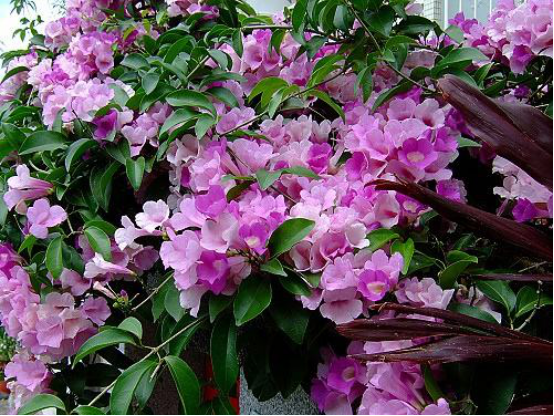
Garlic vine is a perennial evergreen climbing flower of the genus Mansoa in the family Bignoniaceae. After its flowers and leaves are rubbed, they give off a strong garlic fragrance, hence the name. It has tendrils and swollen nodes, opposite leaves, oval-shaped, entire margins, dark green leaf surfaces and green undersides. The flowers are numerous and dense, in cymes that are axillary or terminal, with funnel-shaped corollas that split into five lobes at the tip, pink or pinkish-purple, forming lush clusters when in full bloom. The flowering period lasts all year, and it can bloom multiple times a year, generally blooming most profusely from September to October in late summer and early autumn. The capsule is flat and long-linear.
Garlic vine cultivation requires sufficient light and a warm climate. It is not cold-tolerant, and long-term cold winds will affect its growth. It is generally planted in a sunny, sheltered spot with loose, fertile, slightly acidic sandy loam. For outdoor cultivation, you only need to water during dry summer periods; for container cultivation, water once a day in summer and once every 3-4 days in winter. Garlic vine prefers natural organic fertilizer; you can apply decomposed fertilizer into the planting hole at planting time, and after it matures, apply a nitrogen, phosphorus and potassium compound fertilizer once a month. For outdoor cultivation, choose a location with good drainage. For potting soil, you can choose garden soil, wood chips and peat soil, one part each, to mix the growing medium. Because the flowers and leaves have a strong garlic fragrance, insects refuse to eat them, and no obvious pests or diseases have been found in cultivation.
II. Garlic vine benefits and effects
1. Ornamental value: Garlic vine has branches and leaves that are well-spaced and graceful, with many brightly colored flowers, and no obvious pests or diseases have been found in cultivation. It can be grown in the ground or in containers, and can also be used for beautifying fences and walls or decorating gazebos and trellises. It can also serve as a climbing flower or hanging flower for balconies.
2. Medicinal effects: The roots, stems and leaves of garlic vine can all be used as medicine, and can treat respiratory diseases such as colds, fever and sore throat.
3. Culinary uses: Because garlic vine has a rich garlic fragrance, it can be used as a substitute for garlic in cooking.