Detailed Guide to Planting Methods and Care Essentials for Star Jasmine
1. Potting soil selection
For the choice of potting soil, star jasmine can be grown in a variety of media, and it also has strong adaptability to soil. Therefore, there are no fixed requirements, and the choice can be made according to the grower's preference.
2. Light and temperature
As for light, star jasmine likes to grow in sunny places, but the sunlight must not be too intense; relatively soft sunlight should be chosen. As for temperature requirements, because star jasmine has poor cold tolerance, it should not be placed in places where the temperature is too low, as this will affect the growth of star jasmine.
3. Water and fertilizer management
Star jasmine likes moisture, so it needs to be watered frequently in daily care, but attention should be paid to the amount of water; it must not be excessive, to prevent waterlogging. As for fertilizer, star jasmine likes soil with relatively strong fertility, so more phosphorus fertilizer and potassium fertilizer can be applied. Usually, a compound fertilizer can be applied once in spring and once in autumn, and no fertilizer is needed in winter and summer.
After reading the above introduction, don't you really want to plant a pot of star jasmine? Star jasmine is a treasure all over, and it also has the effect of purifying the air!
How should variegated star jasmine be cultivated? Planting methods for variegated star jasmine
When the name variegated star jasmine is mentioned, many people may not know much about it, but variegated star jasmine can be seen everywhere in daily life. Variegated star jasmine is an excellent landscaping variety with a beautiful appearance, strong vitality, and easy planting and management. Today, the editor will talk with everyone about how variegated star jasmine should be cultivated.
Variegated star jasmine is a light-loving and strongly shade-tolerant plant that likes environments with relatively high air humidity. It can be used as a year-round “flowering” plant for various flower border arrangements, and it is also an excellent material for potted plants. Variegated star jasmine is one of the excellent landscaping groundcover tree species newly developed and strongly promoted in Japan. With advantages such as brilliant color, strong growth, excellent resistance, and extensive cultivation and management, this variety stands out among existing landscaping groundcover plants.
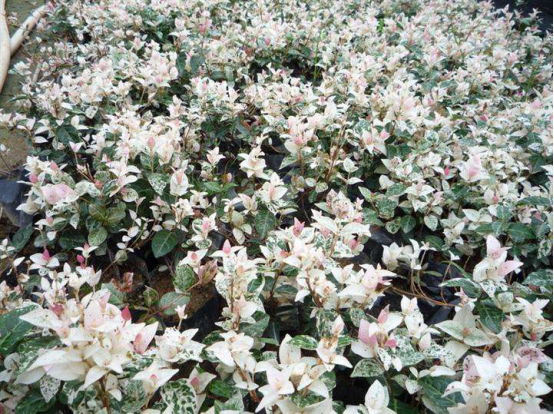
Variegated star jasmine has a brilliant appearance. Its vines are about 20 to 40 cm long, grow prostrately, and root at every node. Below the peculiar young leaves are white leaves, and further down there is an alternation of white and green, just like a poetic and picturesque ink wash painting. Its first round of new leaves is romantic pink, and the leaf color of the whole plant is rich and colorful. During growth, these tender red flower-like leaves will gradually become white with a hint of pink, and finally evolve into white “flowers.” After that, many colored markings or spots gradually develop on these pink-white leaves, ultimately forming beautiful variegation. A single plant has all three colors: red, white, and green, just like Sichuan opera face-changing, very magical and very beautiful.
Variegated star jasmine likes sunlight and environments with high air humidity. It grows in neutral and acidic, well-drained soil. It has strong disease resistance, strong growth, vigorous vitality, and relatively strong tolerance to drought, cold, and short-term flooding.
How should variegated star jasmine be cultivated?
Generally speaking, it can be propagated by cuttings in all four seasons, and the rooting rate in spring and autumn is as high as over 98%. If it is summer, some tender growing branches are relatively easy to rot, but branches that have reached semi-lignification can still take root and survive. It can also be propagated by layering. Old branch layering is generally carried out in early spring, while young branch layering is done in summer.
In addition, considering both its growth and ornamental value, seedling production, plant cultivation, and finished seedling cultivation can be separated. That is, under suitable environments such as semi-sprouting and fertile, loose cultivation substrate, it can be mass-propagated and the early-stage plants cultivated. When the plant has many branches and is about 20 cm long, it can be moved into a strong-light environment for cultivation, making its leaf color brighter and more brilliant.
Variegated star jasmine can be cultivated outdoors south of the Yangtze River basin. Of course, to ensure it can safely pass through winter, corresponding protective measures can be taken, such as enhancing light. From March to August, suitable fertilizer can be applied to promote rapid plant growth. If it is placed indoors as an ornamental potted plant, it can be used in any region, and it is best to place it in a place with good light conditions.
Do you know the most peculiar ornamental feature of variegated star jasmine? That is, its leaves can automatically change color. Doesn't it feel like a chameleon? It is not a flower, but it is even better than a flower. Surely some friends have once mistaken it for a flower. Clustered together, brilliant like rosy clouds on the horizon, the leaves constantly regenerate, and the colors constantly change, foretelling its strong vitality. These colorful scenes composed of pink-red leaves, white leaves, variegated leaves, and green leaves are enough to make people linger and be intoxicated.
Variegated star jasmine blooms year-round. It can not only beautify corridors, but is also a beautiful plant for groundcover greening and green walls, and it can also be used as a hanging basket in the air, hung on a balcony at home, full of charm.
Plant cultivation: cultivation methods for star jasmine
Star jasmine is native to the vast areas south of China's Yellow River basin. It is an evergreen climbing vine plant of the genus Trachelospermum in the Apocynaceae family. Old branches are reddish brown, ancient and twisting, sparse and fresh, naturally hanging or climbing upward, with many branches, and young branches are green. Simple leaves are opposite on new branches, elliptical or ovate, 4 cm to 5 cm long and 1.5 cm to 2 cm wide. In autumn, old leaves turn deep red, becoming even more brilliant after frost, and when new leaves grow the following spring, the old leaves fall off.The flowers of star jasmine are terminal or axillary. The pedicels are 5 cm to 8 cm long, holding up comb-like buds, covering the branches. When they bloom, the flowers are white, with five split petals arranged in a right-handed pinwheel shape, with a rich fragrance resembling jasmine, hence the alias wanzi jasmine. April to May is the full bloom period, when almost the whole plant is white. After that, flowers continue to bloom until November, lasting as long as half a year, hence the evaluation "not jasmine, but better than jasmine."
Cultivation essentials:
1. Suitable for both ground planting and pot cultivation.
It can be either ground planted or pot cultivated. For ground planting, it can be led to grow upward by attaching to walls, dead trees, or rocks, and a bamboo fence can be set up for it to climb on to make a green hedge. In the north, it can only be pot cultivated. According to personal preference, bamboo frames of various shapes can be made for it to climb on, or it can be pruned to grow in a shrub form, or a single-trunk twisted star jasmine can be planted in a tall cylindrical pot, with the twisted branches hanging down out of the pot mouth, bending and arching, to make an elegant and natural cascade-style bonsai. Star jasmine is not very particular about soil. It can adapt from slightly acidic to neutral, from sandy soil to light clay, and can also grow in weakly alkaline soil, though its growth will be somewhat poorer. For household ground planting, ordinary vegetable garden soil is generally sufficient. For pot cultivation, adding some leaf mold to vegetable garden soil will make it grow better.
2. Likes moisture, fears waterlogging, and is also drought tolerant.
Star jasmine likes moisture. During the growing season, the potting soil should be kept slightly moist. In spring and autumn, water once every two days; in summer, water once a day; in winter, water about once every half month. The potting soil only needs to be slightly moist and not dry. It must never be waterlogged at any time. Potted star jasmine placed on rooftop gardens or in courtyards should be drained of accumulated water during the rainy season. Ground-planted star jasmine should not be planted in low-lying areas, otherwise the roots are prone to rot. During the growing season, it is not too late to water again after the soil dries. In winter, ground-planted plants may not need watering.
3. Not demanding about fertilizer and tolerant of poor soil.
Star jasmine likes fertilizer, but is not demanding about it. Various fertilizers can be used. Even if it is not fertilized for a year, it can still bloom, but the number of flowers will be somewhat fewer. If potted star jasmine is to be made to bloom abundantly, more bone meal and phosphorus-potassium fertilizer can be applied, and less nitrogen fertilizer used. For ground-planted star jasmine, applying a nitrogen-phosphorus-potassium compound fertilizer once each in spring and autumn is sufficient, with no fertilizer in winter and summer.
4. Likes light and warmth, and is also cold tolerant.
Star jasmine is a temperate-zone flower that likes warmth and light. For ground planting, it should be planted in a sunny place. Growth in shady places is poor, with fewer flowers and a faint fragrance, or even no flowers. For pot cultivation, it should be placed in a place with sufficient sunlight in spring, autumn, and winter. In midsummer, if it is placed in a semi-shady place where it can see the sun in the morning or evening and avoid direct strong light at noon, it will bloom continuously; if it is too sunny at noon, flowers will be sparse, or even absent. Star jasmine is relatively cold tolerant. In the Yellow River basin and south of it, it can safely overwinter outdoors. In the north, it is still better to move it into a low-temperature room to overwinter.
5. Easy to propagate by layering and cuttings.
For the propagation of star jasmine, the preferred method is layering, especially in the plum rain season, when its tender stems very easily grow aerial roots. Taking advantage of this characteristic, its tender stems can be propagated by continuous layering, then cut apart from the middle in autumn, obtaining a large number of young seedlings. Alternatively, in the plum rain season, cut tender stems with aerial roots and insert them into plain soil, place them in partial shade; the survival rate is very high, but the survival rate of old stem cuttings is low. Potted star jasmine generally does not set seed after flowering. Ground-planted star jasmine can bear cylindrical fruit after flowering. The fruit matures in October and is collected and sown the following spring, but seedlings grown from seed only bloom after three or four years, while layered and cut seedlings can bloom the next year, so the sowing method is generally not used.
6. High ornamental and medicinal value.
Star jasmine has been a traditional Chinese medicine since ancient times. Because its flower shape is distinctive and its fragrance is rich, it was later cultivated as an ornamental flower. Its dried stems and leaves are called Trachelospermi Caulis et Folium, whose main effects are to dispel wind and dredge collaterals, and to cool blood and reduce swelling and abscesses.