How to grow a star jasmine (Trachelospermum jasminoides) bonsai? Detailed introduction to care methods
With flowers like white snow and variegated branches and leaves, the beautiful star jasmine bonsai requires not only better pruning methods but also attention to its care methods. Proper care is a necessary condition for better growth and the foundation for pruning the most beautiful star jasmine bonsai.
1. Suitable temperature and light
As a temperate flower, the star jasmine bonsai likes warmth and light, but must avoid direct strong light. We can place it in a sunny spot, preferably somewhere it can get sunlight while also avoiding direct strong light.
2. Moist soil is also very important
We can water to keep the soil moist, and often spray water on the support or the bonsai to increase humidity. However, remember never to let it become waterlogged, otherwise it will affect the normal growth of the star jasmine.
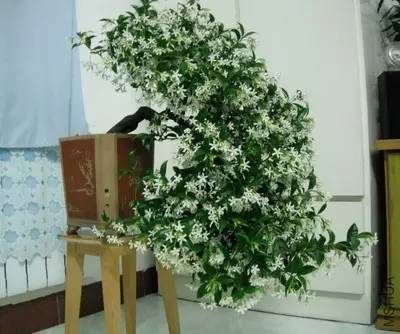
The lush star jasmine bonsai brings us more than just ordinary visual enjoyment. To make it more wild-looking and grow freely and vigorously, choosing the most appropriate pruning method is very important. The above are the main methods for pruning a star jasmine bonsai. Have you learned them?
How to make a hydroponic star jasmine bonsai? Hydroponic star jasmine bonsai care guide
Star jasmine, also known as Nai Dong, Shi Long Teng, Wan Zi Hua, and Wan Zi Jasmine, is an evergreen woody climbing plant native to Shandong, Shanxi, Jiangxi, Hebei, Henan, Jiangsu and other places in China. In gardens it is mostly used as ground cover or grown as a potted ornamental. Of course, besides being ornamental, star jasmine also has medicinal value; its roots, stems, leaves and fruits are used medicinally, with effects of dispelling wind and activating collaterals, benefiting the joints, stopping bleeding, relieving pain and reducing swelling, and clearing heat and detoxifying. It should be noted that star jasmine is a toxic plant, and its toxicity is that the whole plant is toxic. Of course, today's focus is on the production methods and care guide for hydroponic star jasmine bonsai, as follows.
I. Hydroponic methods
(1) Method one: Cut a robust star jasmine branch with aerial roots, insert the branch directly into a transparent container, then add clear water covering one third of the roots; after about 10 days, hydroponic roots can grow.
(2) Method two: Select a robust, well-formed soil-grown star jasmine, dig out the entire star jasmine plant, rinse it clean, then plant it in a transparent container, and afterwards add clear water covering two thirds of the roots.
(3) Method two: Dig out rooted runners from around the root collar of a soil-grown star jasmine, wash the runners clean, then plant them in a transparent container, and afterwards add clear water covering two thirds of the roots.
Which method to choose specifically depends on your own actual situation, but no matter which method is used, the water must be changed once every 2-5 days.
II. Care guide
After the star jasmine grows hydroponic roots, it should be cultivated with a comprehensive nutrient solution, replacing the nutrient solution about once every 30-60 days, and during this period the potted star jasmine should be placed in a place with bright scattered light. In summer, avoid direct sunlight and take shade measures. When the weather is dry, spray the star jasmine leaves to supplement moisture, and in the cold winter season move it indoors to a sunny spot for cultivation. Because it is relatively cold-tolerant, it can overwinter safely indoors. At the same time, old branches and overly long branches should be properly pruned, which helps promote new branches and increase the number of flowers.
Making a star jasmine bonsai
Growing plants requires skill, and making bonsai requires even more skill. After all, making bonsai is a technical job. If you have not mastered the skills for making bonsai, then it will be very difficult to make a good-looking bonsai. Different plants have different production methods for their bonsai, and a slight mistake may "ruin" the bonsai, let alone whether it looks good or not. Just as treating an illness requires the right medicine, making different kinds of bonsai also requires unique skills. Here, the editor will show everyone how to make a star jasmine bonsai.
Material collection and propagation measures
[Artificial propagation]: Seeds, layering, cuttings and other methods can be used. For sowing, collect seeds in early December, dry them in the sun so the follicles split open, take out the seeds, and store them in a sealed way. Sow in February to March of the following spring. Drill sowing row spacing is 15-20 cm, with a covering soil thickness of about 1 cm; by mid to late May, they can germinate and emerge. When the seedlings have 2 true leaves, thin them once, and strengthen management by building a shade frame; the seedling survival rate can reach about 70%.
Cuttings are carried out during the plum rain season, using semi-mature young branches as cuttings, cut into 8-12 cm lengths with 3-4 nodes, retaining 2-3 pairs of leaves at the upper part, inserted to a depth of about 1B2, firm the soil, water thoroughly, build a shade frame, and keep the bed soil moist; after about 20 days they can root, with a relatively high survival rate. Layering propagation can use dormant branches in February to March of spring, or semi-mature branches during the plum rain season, with soil covering to a depth of 3 cm; by August to September they can be cut away from the mother plant and transplanted.
[Collection in the wild]: Star jasmine grows abundantly wild in mountain areas. Old root stumps can be selected; after digging them out, cut off the stems and vines, pot them for cultivation, and after new branches and stems sprout, they can be processed into shapes, attached to rocks and twined around, or have soft branches hanging down, forming beautiful bonsai.
Potting process
Pot selection: Star jasmine is suitable for relatively deep glazed ceramic pots or purple clay pots, commonly including tall cylindrical pots and medium-deep square or round pots.
Soil: Star jasmine likes loose, well-drained sandy loam. For pot cultivation, it is suitable to use humus soil or aged garden soil mixed with sandy soil, with vermiculite placed at the bottom of the pot to facilitate drainage.
Planting: It is suitable to pot in spring, and also in autumn. It is best to transplant with a soil ball.
Shape-training techniques
Processing: For the processing and shaping of star jasmine, the main branches can first be properly bent and tied, then combined with pruning to cut off overly dense or overly long branches and maintain a certain skeleton posture. Bending and tying are suitable in summer, when the branches are tender and more malleable. Pruning is suitable during the dormant period to avoid milky sap flowing from wounds and affecting growth.
Tree shape: Star jasmine is trailing, with drooping branches, so it is suitable to make a hanging style, and can also be made into a rock-attached bonsai. There are two ways to handle the rock-attached style: one is to plant the star jasmine in a cave on the upper part of a rock, letting it hang down and wind around; the other is to plant it in the pot soil, arrange stone shoots, and let it twine upward. Both are relatively simple and easy to carry out.
Care and management
Placement location: The star jasmine bonsai is suitable for placement in a slightly shaded place with relatively humid air. In winter it is somewhat cold-tolerant and can be moved to an ordinary indoor place.
Watering: Star jasmine likes shade and moisture, but dislikes waterlogging. Usually keep the pot soil moist, not overly dry, and also be careful not to let water accumulate in the pot.
Fertilizing: During the spring and summer growth period, organic liquid fertilizer can often be applied, such as decomposed cake fertilizer water.
Pruning: At any time, cut off residual branches, dead leaves, and overly long or overly dense vines to maintain a certain shape.
Repotting: Repot once every 2-3 years, preferably before sprouting in spring. Retain 1B2 of the old soil, replace with fertile, loose humus soil, and place a layer of coarse sand or vermiculite at the bottom of the pot to facilitate drainage.
Pest and disease control: The main damage is from leaf ?, which can be killed by spraying with trichlorfon or phoxim at 800 times dilution.
In summary, to make a star jasmine bonsai, you should first know how to collect materials and propagate star jasmine, then pay attention to how to carry out the potting process, and finally understand how to train the posture of the star jasmine bonsai, that is, its shaping. During this period, special attention must be paid to care and management, so that the star jasmine bonsai grows in an environment free of pests and diseases. I believe that if everyone follows the above methods to make bonsai, they will certainly be able to create a beautiful and elegant star jasmine bonsai!