How to grow Pyrostegia venusta (flame vine)? Teaching you the correct care methods
Fertilizing
During the peak blooming season of Pyrostegia venusta, pay attention to adding fertilizer and water for the flowers. Generally, during the growth period, Pyrostegia venusta needs 1 topdressing per month.
Watering
When Pyrostegia venusta is blooming, the soil should be kept moist. When the soil becomes dry, water it promptly. In addition, after each watering, some clean water should also be sprayed around the leaves and on the ground.
Light
Pyrostegia venusta likes light. During cultivation, it is best to place it in a sunny, ventilated and cool place. This way, the flowers produced will have more brilliant colors, and the flowering period will also be more abundant.
Soil
The best soil for growing Pyrostegia venusta is loose soil rich in organic matter with good drainage.
In addition, Pyrostegia venusta is an evergreen climbing vine, so when growing it everyone should also pay attention to caring for it well. To increase the ornamental effect of the flowers, you can set up some trellises around the flower pot to make it easier for it to produce beautiful flowers!
How to grow Pyrostegia venusta
Soil
Because Pyrostegia venusta does not have high requirements for soil, when growing it we need to plant it in soil rich in organic matter with good drainage, and the soil layer should be deep. Generally, a mixture of leaf mold, garden soil and sand can be used, with some decomposed fertilizer or soybean cake added as base fertilizer.
Light
Pyrostegia venusta likes a growing environment with sufficient light and a warm climate. Maintaining sufficient light every day helps it bloom more vigorously.
Temperature
The suitable temperature for the growth of Pyrostegia venusta is 18 to 25 degrees. It is not cold-tolerant and needs to maintain a relatively high temperature in winter. When overwintering, it generally needs to be above 10°C. In northern regions, it can be placed indoors in a sunny place.
Watering
Watering Pyrostegia venusta should follow one principle: water when dry, not when wet, and there should be no water accumulation in the pot soil. Generally, in summer when the temperature is high, more watering is needed. Sometimes it is necessary to sprinkle water on the flower pot and the ground to increase air humidity and lower the temperature. In autumn, watering should be appropriately reduced.
Fertilizing
For fertilizing Pyrostegia venusta during the growing season, generally a thin liquid fertilizer is applied once every two weeks. During the flower bud stage, phosphorus fertilizer should be applied once or twice. After the flowers fade, nitrogen fertilizer should also be applied once. During overwintering, watering should be controlled and fertilizing stopped.
So, do you know what matters need attention during the cultivation of Pyrostegia venusta?
How to grow Pyrostegia venusta
How to grow Pyrostegia venusta. Pyrostegia venusta is propagated by layering or cuttings. Layering propagation can be carried out in spring or summer. Roots begin to form in about 1 month, and in about 3 months it can be separated from the mother plant and transplanted. Cuttings are generally taken after flowering in spring; if there is a greenhouse, they can be taken throughout the year. In early summer, young branches are used for cuttings, cut into sections more than 10 cm long with node buds, and roots form in more than 20 days. Old stems can also be used for cuttings, that is, selecting robust old stems sprouting from the base, which can reach more than 2 m in length, and inserting them into fertile sandy loam, keeping them semi-shaded. Roots begin to form in about 50〜60 days. In that year, let them grow branches and leaves freely. In winter, transplant them with soil to the foot of a wall or an open area in front of a door, support them with bamboo, and they can bloom the following year.
Pyrostegia venusta likes light and is not strict about soil, but when cultivated in fertile soil rich in organic matter, with good drainage and a deep soil layer, it grows more vigorously. After planting, the first watering should be thorough, and shading is needed. When the seedlings grow to about 70 cm tall, a trellis should be set up, and their branches should be guided onto the trellis. Pinching is also needed to encourage side branches to sprout, which helps produce more flowers. Pyrostegia venusta grows fast, blooms a lot, and has a long flowering period, so fertilizer and water must be sufficient. During the growth period, 1 topdressing is needed each month. For topdressing, it is best to use decomposed diluted soybean cake water or compound chemical fertilizer to promote lush branches and leaves and flowers all over the branches. For potted Pyrostegia venusta, it is best to choose a deep cylindrical tile pot or a large flower pot. The growing medium should mainly use leaf mold, garden soil, mountain soil, etc., and an appropriate amount of decomposed compost, soybean cake, bone meal and other organic fertilizers should be applied as base fertilizer. After planting, management is the same as for field planting. It grows better when planted in loose, fertile, slightly acidic soil with good drainage. For pot cultivation in the Jiangnan region, it needs to be brought indoors to overwinter. It is best to place it on a sunny balcony in a closed room with glass windows for care.
>Ornamental and application
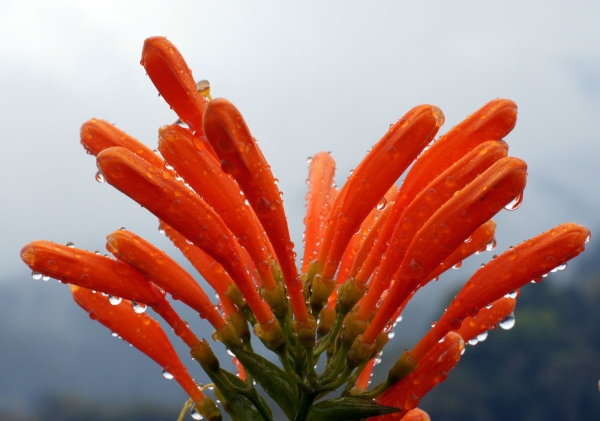
Pyrostegia venusta is a large tropical vine with extremely many branches, reaching several meters to dozens of meters in length and growing by climbing. If it climbs on a wall or trellis, it looks lush and droops like a curtain. When the flowering season arrives in winter and spring, long flower branches can sprout from each leaf axil, and the panicles gather the flowers. Strings of flowers hang like firecrackers welcoming spring. Because there are many branches, there are also many strings of flowers, interwoven with each other into a large expanse, very lively and also very spectacular.
In South China, Taiwan, China, Hainan Island and Xishuangbanna in Yunnan, Pyrostegia venusta can all be planted in the open. It is suitable for planting in courtyards and parks as flower walls and flower sheds, covering earth slopes and rockeries, or used for vertical or ground-covering greening on multi-story balconies. When the flowering season arrives, it is like bursting firecrackers and fireworks, and since it coincides with the Spring Festival, it adds even more red light and festive auspiciousness. Truly, “Slender and clustering, climbing in many layers, lush and green like a green curtain. Twinkling and sparkling, strung and dotted, skillfully hanging up red firecrackers. In the warm sun, so vivid they seem about to burst; the flowers bloom right in the festival.” These lines vividly express the flowering characteristics of Pyrostegia venusta. Now, in the Nanshan Scenic Area of Sanya, Hainan, from January to February, Pyrostegia venusta blooms in patches competing to open, and has become a beautiful tourism landscape.
As early as the 1960s, the Xishuangbanna Tropical Botanical Garden of the Chinese Academy of Sciences had planted Pyrostegia venusta. The author, moved by it, once wrote the poem “On Pyrostegia venusta”: “Here there is no winter and no plum, the cold wind does not reach the green courtyard; ask who can know the meaning of spring, firecrackers welcome spring in red strings.” We believe that in the Yangtze River basin, planting Pyrostegia venusta by combining greenhouses and open air can be attempted. Pyrostegia venusta is a flower of celebration. Can it be moved north to subtropical regions for planting? According to surveys, Fuzhou, Xiamen, Quanzhou, Sanming and other places in Fujian all have open-air planting, and they grow and bloom well.
Annual flowersRefers to herbaceous plants that complete one life cycle within one year, including sowing in spring and summer, flowering and bearing fruit in summer and autumn, and the individual dying in the same year after the seeds mature. Such as Impatiens balsamina (garden balsam), Salvia splendens (scarlet sage), Celosia argentea (cockscomb), etc. Biennial flowers refer to herbaceous plants whose growth cycle spans two years, that is, sowing in autumn of the first year, seedlings overwintering, flowering and bearing fruit in spring or summer of the second year, and then dying. Such as Viola tricolor (pansy), Pericallis hybrida (cineraria), Dianthus chinensis (China pink), Antirrhinum majus (snapdragon), Calendula officinalis (pot marigold), etc. In fact, seeds of Salvia splendens and Calendula officinalis can be sown both in spring and autumn. If sown in spring, they are annual flowers, while if sown in autumn, they are biennial flowers. Therefore, it is more appropriate to use annual and biennial flowers together.