Paulownia Cultivation Methods and Growing Techniques Explained in Detail
1. Light and temperature
Since Paulownia is a relatively easy species to grow, it can be planted anywhere with sunlight. It likes places with abundant sunshine and has strong drought tolerance, so there is no need to worry even if it goes without watering for a long time. As for temperature, Paulownia likes warm places, so temperatures can range from as low as minus 25°C to as high as 38°C. If it is too low, it is also not good for the growth of Paulownia.
2. Soil
As for soil, Paulownia has relatively strict requirements. It likes to grow in loose, fertile soil. The soil must not be too clayey or hold too much water, which would cause the roots of Paulownia to rot and hinder growth. In addition, soil that is too dry will also prevent Paulownia from developing.
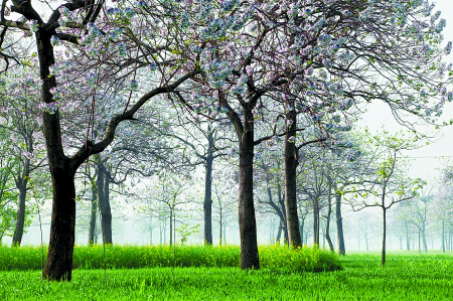
The above are the differences between Paulownia and Chinese parasol tree (Firmiana simplex). In fact, these two species are very easy to tell apart; with a little careful observation, you can distinguish them!
Paulownia cultivation methods and points to note
Paulownia cultivation methods
Light and temperature
Paulownia likes a sunny environment and is fairly shade-tolerant. Paulownia has strong drought tolerance; when growing Paulownia, simply keep the temperature between -25°C and 38°C. If the temperature drops below minus 25°C, it will suffer freeze damage.
Soil
Paulownia has relatively high soil requirements. This is mainly shown in soil fertility, soil layer thickness and looseness. If the soil is rather clayey or excessively waterlogged, Paulownia will grow poorly. Soil that is too dry will also cause Paulownia to grow weakly.
Points to note when cultivating Paulownia
Pests and diseases
The main insect pests of Paulownia are the bagworm (large bagworm moth), and scarab beetles (chafer beetles), while the diseases include anthracnose and black spot disease. The damage of scarab beetles to Paulownia is mainly that their larvae gnaw on seedlings in early spring. Control methods are mainly manual capture or releasing poultry to eat them. Paulownia is most susceptible to damage by the large bagworm moth, which can be controlled with a 3000-3200 times diluted solution of decamethrin. To control anthracnose and black spot disease, copper sulfate and ammonium bicarbonate can be mixed at a ratio of 1:10; after sealing for 24 hours, prepare a 200-times dilution and spray the seedlings, with good results.
Propagation methods
The main propagation methods for Paulownia are root cuttings, sowing, and leaving roots in place.
Flowering period and fruiting period
Paulownia flowers from March to April and fruits from September to October.
Cultivation methods and points to note for Paulownia tomentosa
Chinese scientific name: Maopaotong (Paulownia tomentosa)Latin scientific name: Paulownia tomentosaOther names: Zihuatong, Gangtong, Japanese PaulowniaBinomial name: Paulownia tomentosa (Thunb.) Steud.Kingdom: PlantaePhylum: AngiospermsClass: DicotyledoneaeSubclass: SympetalaeOrder: LamialesFamily: ScrophulariaceaeGenus: PaulowniaSpecies: Paulownia tomentosa var. tsinlingensisDistribution area: grows in areas from 500 m to 1,800 m above sea levelVariety: Guangpaotong (Paulownia tomentosa var. lanata)Paulownia tomentosa (scientific name: Paulownia tomentosa) is a plant in the genus Paulownia of the family Scrophulariaceae. Because its flowers are purple, it is also called purple-flowered Paulownia. It is a deciduous tree up to 20 m tall, with brownish-gray bark and white spots. The petioles often have sticky glandular hairs, and the leaves are entire; the lateral branches of the cymose panicle are not well developed, and the small umbel-like inflorescences have 3-5 flowers, the calyx is shallowly bell-shaped, densely covered with stellate tomentum, 5-lobed to the middle, the corolla is funnel-shaped bell-shaped, pale purple outside, hairy, white inside with purple stripes; the capsule is ovate, sharply pointed at the tip, with a leathery exocarp; the flowering period is April-May; the fruiting period is August-September. It is distributed in North America, Japan, Korea, Europe, and in China in places such as Hebei, Shandong, Hubei, Jiangxi, Liaoning, Henan, Jiangsu, and Anhui, growing in areas from 500 m to 1,800 m above sea level.1. Morphological characteristics
The tree is up to 20 m tall, with a broad, umbrella-shaped crown and brownish-gray bark; the branchlets have obvious lenticels and often bear sticky short glandular hairs when young. The leaves are heart-shaped, up to 40 cm long, with a sharply pointed tip, entire or with wavy shallow lobes, sparsely hairy above and densely or relatively sparsely hairy below; the grayish-brown dendritic hairs on the underside of old leaves often have stalks and 3-12 slender filamentous branches, while leaves on new branches are larger and their hairs are often unbranched, sometimes with sticky glandular hairs; the petioles often have sticky short glandular hairs. The lateral branches of the inflorescence branches are not well developed, about half the length of the central main branch or slightly shorter, so the inflorescence is pyramidal or narrowly conical, generally less than 50 cm long, rarely longer; the common peduncle of the small cymes is 1-2 cm long, almost equal to the pedicel, with 3-5 flowers; the calyx is shallowly bell-shaped, about 1.5 cm long, with tomentum on the outside that does not fall off, split to the middle or beyond the middle, and the calyx teeth are ovate-oblong, sharply pointed or slightly blunt in flowers and blunt in fruit; the corolla is purple, funnel-shaped bell-shaped, 5-7.5 cm long, curved at about 5 mm from the base of the tube, suddenly enlarged upward, with glandular hairs outside, almost hairless inside, and the limb is 2-lipped, about less than 5 cm in diameter; the stamens are up to 2.5 cm long; the ovary is ovate, with glandular hairs, and the style is shorter than the stamens. The capsule is ovate, densely covered with sticky glandular hairs when young, 3-4.5 cm long, the persistent calyx does not curl back, and the pericarp is about 1 mm thick; the seed including the wing is about 2.5-4 mm long. The flowering period is April-May, and the fruiting period is August-September.This species often varies with habitat and altitude in the density of indumentum, the size of flowering branches and corolla, and the sharpness or bluntness of calyx teeth; when growing at higher altitudes, there is a tendency for flowering branches to become smaller, calyx teeth to be blunter during the flowering period, and the corolla to be slightly shorter.
2. Growing environment
It is cold-tolerant, drought-tolerant, salt-alkali-tolerant, and wind-sand-tolerant by nature, with very strong resistance, and has a very wide range of climatic adaptation; growth is affected at high temperatures above 38°C, and it suffers freeze damage at an absolute minimum temperature of -25°C. This species is relatively tolerant of drought and poor soil, and is especially suitable for the colder and drier regions of the north, but its trunk is low and its growth rate is relatively slow.3. Geographical distribution
It is distributed in southern Liaoning, Hebei, Henan, Shandong, Jiangsu, Anhui, Hubei, Jiangxi and other places in China, usually cultivated, with wild populations in the western regions. It can reach an altitude of up to 1800 m. It has also been introduced and cultivated in Japan, Korea, Europe and North America.