What are the precautions for growing pear trees
Pear trees love light very much. Sufficient light helps them carry out photosynthesis and form organic matter, which plays a huge role in the growth of all the organs of the pear tree. If there is insufficient light, it will cause the pear tree to grow slowly, make the whole pear tree develop poorly, and also affect the pear tree's immunity. If there is insufficient light during the fruiting period of the pear tree, it will also affect the quality of the fruit.
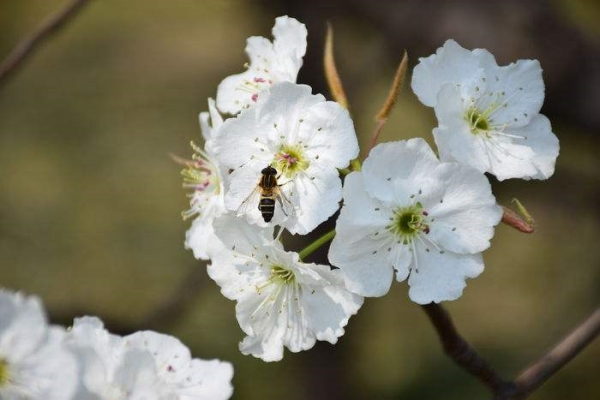
The above is an introduction to the seedling-raising methods for pear trees! Before raising seedlings, the choice of terrain is especially important. Be sure to choose a place with fertile soil and sufficient light for care!
Growing methods and precautions for Callery Pear
Chinese scientific name: Callery PearLatin scientific name: Pyrus calleryana Decne.Other names: Wild Pear, Taiwan Wild Pear, Mountain Pear, Deer Pear, Thorn Seed, Bird Pear, Yangsui, Red Pear, Jiang PearKingdom: PlantaePhylum: AngiospermsClass: MagnoliopsidaSubclass: RosidaeOrder: RosalesFamily: Rosaceae, genus PyrusSubfamily: MaloideaeGenus: PyrusEnglish names: Callery Pear, Bean PearCallery Pear is a perennial deciduous fruit tree, a tree. It is a deciduous tree of the genus Pyrus in the Rosaceae family, with other names such as Deer Pear, Tang Pear, Wild Pear, and Bird Pear. It is native to various places in East China and South China in China as far as Vietnam, and has several varieties. It often grows wild on warm and humid hillsides, swamps, and mixed woods, and can be used as rootstock for grafting European pears and others. The roots and leaves have medicinal value and can moisten the lungs and relieve cough, clear heat and detoxify, and treat acute conjunctivitis; the fruit can strengthen the stomach and stop dysentery. In Lanxi, Zhejiang, it is called: Jiang Pear.1. Basic characteristics
Structure
Stem: height can reach more than 12 m, stem bark grayish brown, with irregular deep cracks, branches hairless, winter buds finely hairy.Leaves: 3~4 leaves clustered at the tips of branchlets, leathery, ovate or elliptic, with fine rounded teeth or finely rounded serrate margins, 4~8 cm long, apex acuminate, rarely shortly mucronate, base broadly cuneate, petiole 2~6 cm long, pubescent.
Flowers: corymb with 6~12 small flowers, pedicels 1.5~3 cm long, 5 petals, white, ovate, base with a short stalk, styles 2~3; inflorescence and calyx tube hairless, stamens about 20.
Fruit: pome globose, about 1 cm in diameter, brown, with pale lenticels, apex without persistent sepals.
Characteristics
Deciduous tree, height can reach more than 12 m, stem bark grayish brown, with irregular deep cracks, branches hairless, winter buds finely hairy. Leaves broadly ovate to ovate, 4~8 cm long, apex acuminate, rarely shortly mucronate, base broadly cuneate, margin obtusely serrate, petiole 2~6 cm long, hairless.Inflorescence and calyx tube hairless, flowers white, stamens about 20. Fruit round, about 1 cm in diameter, brown, with pale lenticels, apex without persistent sepals. The fruit of the Callery Pear is extremely small, and when mature the fruit diameter is only about 1 cm, shaped like a small bean, hence the name "Bean Pear".
2. Origin and distribution
Wild in open country, at the foot of mountains, or along roadsides. Distributed in Jiangsu, Zhejiang, Hubei, Jiangxi, Henan, Hebei, Shandong, Shanxi, Gansu, Shaanxi, Liaoning, and other places. Often used as rootstock for grafting pear trees.In forests of Central China, South China, and northern Taiwan, China, distributed from Indochina to Japan.
In forests at an altitude of 500~1,000 m in northern and central Taiwan, China, produced in the low-altitude mountainous areas of Taipei County and Nantou County.
3. Basic characteristics
Morphological characteristics
Deciduous tree of the genus Pyrus in the Rosaceae family, with other names such as Deer Pear, Tang Pear, Wild Pear, and Bird Pear. It is native to various places in East China and South China in China as far as Vietnam, and has several varieties. It often grows wild on warm and humid hillsides, swamps, and mixed woods, and can be used as rootstock for grafting European pears and others. The plant height can reach 3-5 m, the tree shape is obovate, the crown is relatively large, and the crown width is 4-9 m. Young branchlets are tomentose, then shed. Leaves broadly ovate or ovate, a few oblong-ovate, 4-8 cm long, 3-6 cm wide, apex acuminate, base broadly cuneate to nearly rounded, margin with fine obtuse serrations, both sides hairless.In late April to early May, the flowers open before the leaves. The flowers form umbel-like racemes, with 5 white petals, ovate, base with a short claw, 20 stamens, slightly shorter than the petals. Flowers 6-12; inflorescence stalk and pedicels hairless; pedicels 1.5-3 cm long; flowers white, 2-2.5 cm in diameter; calyx tube hairless, sepals hairless outside, tomentose inside; styles 2, rarely 3, hairless. If cultivated for landscaping, it can create the artistic conception of "as if a night of spring breeze came, and thousands of pear trees bloom."
The pome is relatively small, nearly spherical, 1-1.5 cm in diameter, brown, with spots, sepals shed. Flowering period April, fruiting period August-September.
Ecological characteristics
Light-loving, slightly shade-tolerant, not cold-tolerant, drought-tolerant and barren-tolerant. It has low requirements for soil and can also grow in alkaline soil. Deep-rooted. Has resistance to pests and diseases. Grows relatively slowly.Growing methods and precautions for White Pear
Chinese scientific name: White PearLatin scientific name: Pyrus bretschneideri RehdOther name: White PearKingdom: PlantaePhylum: AngiospermsClass: DicotyledonsOrder: RosalesFamily: RosaceaeSubfamily: MaloideaeGenus: PyrusSpecies: White PearDistribution area: distributed in Hebei, Shanxi, Shaanxi, Gansu, Qinghai, Shandong, Henan, and other places.White Pear (Latin scientific name: Pyrus bretschneideri Rehd.) is a tree of the genus Pyrus in the subfamily Maloideae of the Rosaceae family, 5-8 m tall, with a spreading crown; biennial branches purplish brown, leaves ovate or elliptic-ovate, petiole densely tomentose when young, linear to linear-lanceolate, umbel-like racemes, fruit yellow, ovate or nearly spherical with fine dense spots, seeds brown obovate. Flowering period April, fruiting period August-September. The fruit of the White Pear has a waxy luster, thin peel, thick flesh, small core, delicate texture, crisp and juicy, sweet and refreshing, contains a variety of nutrients, and has medical effects such as promoting salivation, quenching thirst, moistening the lungs, relaxing the intestines, strengthening the heart, and promoting urination.1. Plant history
The White Pear is the most widely cultivated and highest-quality system in China. In the modern sense, the White Pear mainly refers to the crisp-fleshed, large-fruited cultivars distributed in the Huang-Huai River basin of China. Among them, Yali Pear and Laiyang Cili Pear are the most famous. They have been introduced to many countries around the world and are often widely used as experimental materials as representatives of Chinese pears. In China, White Pear cultivars are generally placed under the scientific name P. bretschneideri. P. bretschneideri was named by Rehder in 1915. The basis for the naming was a seedling tree grown from seeds that Dr. Bretschneider sent from Beijing to the Arnold Arboretum in 1882, and it was believed that P. bretschneideri might be the White Pear (pai-li: white pear) that Dr. Bretschneider had mentioned. According to Rehder's description, the fruit of this species is nearly spherical, the sepals are shed, and the leaf margins are sharply serrate with bristles. As early as 1933, Mr. Hu Changchi of the Department of Horticulture at Ginling University in Nanjing pointed out in an article introducing Laiyang Cili Pear in the journal of the Japanese Horticultural Society that cultivated pears in China evolved from 4 species. These 4 species are Ussuri Pear (P. ussuriensis), White Pear (P. bretschneideri), Sand Pear (P. serotina), and Chuan Pear (P. pashia). As for the classification of Laiyang Cili Pear, he did not give a clear answer. He only speculated that Laiyang Cili Pear might have evolved from P. ussuriensis or P. bretschneideri. But by 1937, he clearly placed 43 pear cultivars mainly distributed in North China, including Yali Pear and Laiyang Cili Pear, under the name P. bretschneideri.Thereafter, in works on pear classification written by Chinese authors, this scientific name was mostly used to represent White Pear cultivars. The works adopting the scientific name P. bretschneideri mainly include: the first comprehensive work introducing Chinese pears, "Chinese Fruit Tree Chronicles Volume 3: Pear", written by Pu Fushen and Wang Yulin and published in 1963; Yu Dejun's work "Taxonomy of Chinese Fruit Trees"; Wang Yulin's English work (Chinese Pears), and others. When Chinese horticulturists Lee (Li Shuxuan) and Shen (Shen Jun) wrote articles introducing Chinese pears in the American Proceedings of American Society for Horticultural Science and Hort Science respectively, they also used the scientific name P. bretschneideri to summarize White Pear cultivars. When Chinese researchers introduced Chinese pears in Japanese journals, they also used P. bretschneideri to represent White Pear cultivars. The only exception is "Taxonomy of Temperate Fruit Trees in China" by Mr. Wu Gengmin. In this book, Mr. Wu adopted the scientific name suggested by Japanese horticulturist Kikuchi Akio and placed White Pear cultivars under the name P. ussuriensis var. sinensis (Lindley) Kikuchi. Regarding the relationship between P. bretschneideri and the so-called White Pear cultivars, that is, the origin of the White Pear, there is great controversy in academic circles. Kikuchi Akio believed that P. bretschneideri (White Pear or Can Pear) is not a native species, but a hybrid of local main cultivars such as Red Pear, Autumn White Pear, and Honey Pear with Birchleaf Pear. It is mainly distributed in Changli County, Hebei Province. The fruit is oblong, with shed sepals, fruit diameter 2.5~3 cm, locules 3~4, fruit stalk 4.0~4.5 cm, leaves ovate or long ovate, needle-like serrate, bristles incompletely developed. He crossed Birchleaf Pear with large-fruited cultivars of Japanese Pear or Chinese Pear, and the progeny obtained had traits similar to P. bretschneideri (White Pear or Can Pear). At the same time, he believed that large-fruited cultivars distributed in North China, such as Yali Pear, evolved with Ussuri Pear as the basic species or one of the basic species. He called these pears Chinese Pears or North China Pears and named them P. ussuriensis var. sinensis (Lindley) Kikuchi. These views of his had a great influence not only on Japanese horticulturists but also on European and American horticulturists. Authoritative reference books published in Japan, such as the "Encyclopedia of Fruit Tree Horticulture" issued by Yokendo in 1972 and the "World Encyclopedia" published by Heibonsha in 1988, mostly adopted the scientific name suggested by Kikuchi Akio to represent Chinese White Pear cultivars.2. Morphological characteristics
Tree, up to 5-8 m tall, crown spreading; branchlets stout, cylindrical, slightly curved, densely pubescent when young, soon shed, biennial branches purplish brown, with sparse lenticels; winter buds ovate, apex rounded obtuse or acute, scale margins and apex pubescent, dark purple. Leaves ovate or elliptic-ovate, 5-11 cm long, 3.5-6 cm wide, apex acuminate or rarely acute, base broadly cuneate, rarely nearly rounded, margin with sharp serrations, tooth tips with bristle-like awns, slightly connivent inward, purplish red-green when young, tomentose on both sides, soon shed, old leaves hairless; petiole 2.5-7 cm long, densely tomentose when young, soon shed; stipules membranous, linear to linear-lanceolate, apex acuminate, margin glandular-serrate, 1-1.3 cm long, sparsely pubescent outside, denser inside, early deciduous. Umbel-like racemes, with 7-10 flowers, 4-7 cm in diameter, peduncle and pedicels tomentose when young, soon shed, pedicels 1.5-3 cm long; bracts membranous, linear, 1-1.5 cm long, apex acuminate, entire, densely brown long-tomentose inside; flowers 2-3.5 cm in diameter; sepals triangular, apex acuminate, margin glandular-serrate, hairless outside, densely brown tomentose inside; petals ovate, 1.2-1.4 cm long, 1-1.2 cm wide, apex often erose, base with a short claw; stamens 20, about half as long as the petals; styles 5 or 4, nearly as long as the stamens, hairless. Fruit ovate or nearly spherical, 2.5-3 cm long, 2-2.5 cm in diameter, apex sepals shed, base with a thick fruit stalk, yellow, with fine dense spots, 4-5 locules; seeds obovate, slightly flattened, 6-7 mm long, brown. Flowering period April, fruiting period August-September.