How Does Cycas Reproduce? Introduction to Common Cycad Propagation Methods
There are roughly 2 propagation routes: sexual reproduction, i.e. seed propagation, and asexual reproduction, i.e. separating the suckers at the base of the plant for propagation.
As for the specific propagation methods, please refer to the introduction on cycad propagation methods on this site.
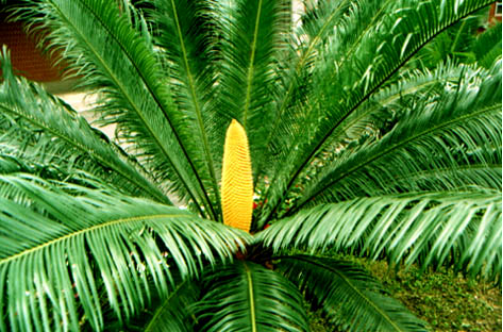
If you want your cycad to grow well, just follow the 5 care essentials above and you will be fine!
Cycad Propagation Methods
Seed Propagation of Cycads
After collecting cycad seeds in late autumn, you can sow them immediately or store them in sand and sow them in the following spring. Cycad seeds are best sown in pots by the dibbling method, with a covering depth of about 2 cm. After sowing, place them in an environment of 30-33°C, and they will generally germinate in about two weeks. Cycad seedlings need to be grown for 2-4 years before they can be transplanted.
Sucker Propagation of Cycads
This is best done between January and February in early spring.
Taking the Suckers
Cycad suckers sprout mainly at the base of the stem and on the trunk. It is best to choose plump, well-developed suckers that are more than 3 years old, or those with 4 or 5 leaves, as propagation material. Never choose suckers that are too tender, as they are not easy to keep alive. Use a sharp knife to cut the sucker off at its base. Concentrate when cutting and proceed carefully to minimise damage to the stem skin. Suckers that have already rooted can be planted directly in a culture soil rich in humus, with good drainage and aeration, for management. If the sucker has not rooted, it should be placed in a cool, ventilated spot to dry for about 2 or 3 days, and once the cut has dried slightly, root induction can be carried out.
Root Induction
Before planting, it is best to treat the wound first to prevent rot; generally you can apply plant ash, sulfur powder, etc. Then plant it in plain sand, with the substrate depth at about half the height of the sucker. Water it once, and afterwards keep it indoors in a spot with light for care. Generally, new roots will sprout in about 2 months, and in about 3 or 4 months it will put out 1-2 new leaves.
Transplanting
Once the new leaves have fully unfurled, it can be moved into culture soil for management. The culture soil is generally best prepared by mixing leaf mould, mycorrhizal soil, river sand and calcium-magnesium phosphate fertiliser in a ratio of 9:4:6:1.
Trunk Section Propagation of Cycads
Cut the cycad trunk into sections of about 10 cm and bury them in sandy soil, with a covering depth of about 4-6 cm, keeping the soil moist. Once the trunk sections send out new shoots, they can be planted separately.
A Brief Introduction to the Cultivation Methods of Encephalartos woodii
A Brief Introduction to the Cultivation Methods of Encephalartos woodii
[Common Question] How do you grow Encephalartos woodii?
[Expert Answer]
Ecological Habits of Encephalartos woodii
It likes light and tolerates slight semi-shade. It likes warmth and is not very cold-tolerant; when planted in the open ground in the Shanghai area, measures such as wrapping with straw are needed in winter for warmth. It likes fertile, moist and slightly acidic soil, but it can also tolerate drought. It grows slowly, and plants more than 10 years old can flower. The cycad has a beautiful plant shape and supple leaves, and is relatively
shade-tolerant. It can be placed outdoors as well as enjoyed indoors. Because its growth rate is very slow, its selling price is relatively high. Cycads like a slightly moist soil environment. Because they grow very slowly, you must be careful that the amount of watering is not too much, otherwise it is not conducive to the normal physiological activity of their root system. From March to September each year, apply a diluted liquid fertiliser to the plant once a week, which can effectively promote leaf growth. Cycads like an environment with sufficient light. Try to keep the environment ventilated, otherwise the plant is prone to scale insects. Cycads like warmth and are afraid of severe cold. Their optimum growth temperature is 20-30°C, and the overwintering temperature should not be lower than 5°C.
A Brief Introduction to the Cultivation Methods of Encephalartos woodii
Cultivating Encephalartos woodii
Vegetative Reproduction
Encephalartos woodii reproduces vegetatively by means of rapidly growing basal suckers.
Sexual Reproduction
Unless a female Encephalartos woodii plant is found, Encephalartos woodii cannot reproduce sexually. However, Encephalartos woodii can be hybridised with E. natalensis. By continually crossing the hybrid back with Encephalartos woodii, after several generations the female plants will be very close to the original species. Gene analysis of chloroplast DNA shows that all chloroplasts are inherited from the female E. natalensis, so the hybrid cannot produce a pure female Encephalartos woodii.
Editor's Summary:Encephalartos woodii is one of the endangered species and one of the rarest plants in the world. Today the editor has mainly introduced the ecological habits and cultivation methods of Encephalartos woodii, hoping it will be helpful to everyone.